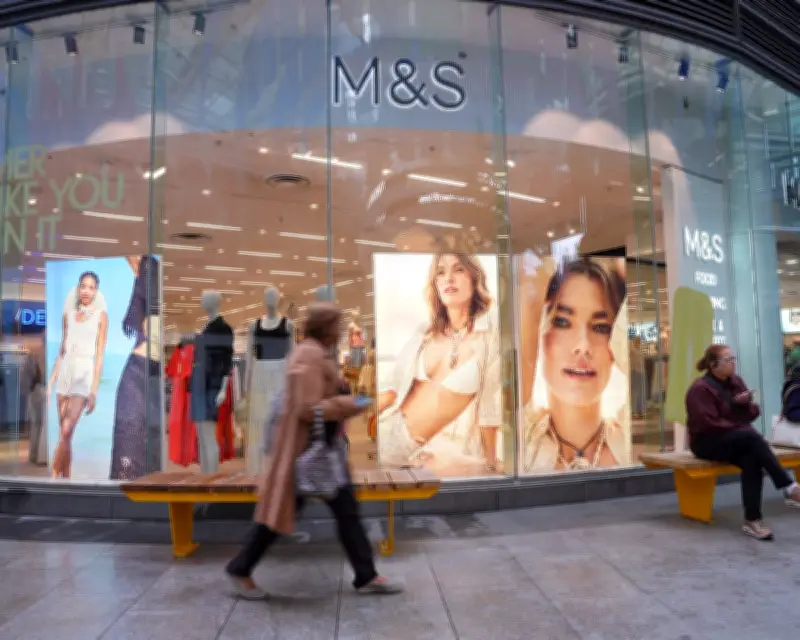
Marks & Spencer has begun selling Ann Summers crotchless knickers on its website, a move that has sparked online outrage with critics calling the items “tawdry” and “S&M”. However, retail experts suggest this is less a scandal and more a calculated step in the retailer’s century-long evolution of underwear trends, aimed at engaging younger demographics.
A strategic partnership or a publicity stunt?
Catherine Shuttleworth, chief executive of retail consultancy Savvy, views the collaboration as part of a broader strategy. “They’ve started introducing brands to bring them into sectors that probably isn’t their core,” she says. “And this is another one. It’s just a little bit more eye-catching.” The Ann Summers range, which includes bras and chemises alongside the knickers, sits alongside other third-party brands on M&S’s website, such as Pour Moi and Calvin Klein.
The retailer itself frames the move as customer choice. In a statement, an M&S spokesperson said: “Our ‘brands at M&S’ strategy is all about giving customers greater choice through carefully selected third-party brands that complement our existing M&S offer. Ann Summers is one of the latest brands to join [M&S online], helping broaden our underwear and nightwear offer.”
Younger shoppers driving sales
M&S underwear has long been a “national obsession”, according to Shuttleworth, but its image has shifted recently. In 2024, the store reported that people under 30 accounted for a third of underwear sales – double the figure from 2023. Shuttleworth suggests the Ann Summers partnership could be a way to keep this demographic engaged. “They are always innovating for every stage of your life,” she says. “And I think this is a gap in their category. Ann Summers is a byword for sex, isn’t it?”
The publicity factor is undeniable. “It doesn’t really matter whether they sell any crotchless pants or not, we’re all going to be talking about it,” says Shuttleworth. “You might also go online to look. You might not buy those, but you’ll think: ‘I could do with replacing my pants.’”
A history of evolving underwear trends
M&S has sold underwear since the 1920s and fitted bras since 1947. It was the first retailer to sell pre-shrunk cotton underwear in 1965, and by 1976 knickers were its biggest export, with nearly 4 million pairs sold internationally each year. Fashion has dictated various styles, from the “hip-hugger” looks of the 1960s to thongs, which peaked in popularity in the mid-2000s.
In 2016, the store sold 60 million pairs of knickers annually, with Brazilian knickers – a style that reveals part of the wearer’s bum – making up 10% of those sales. By 2021, thongs had made a comeback, driven by the popularity of low-rise jeans. Currently, the No. 1 bestseller is a five-pack of white full briefs.
Experts downplay the outrage
Lorraine Topper, a researcher at The Underpinnings Museum, argues the reaction is disproportionate. “M&S have always followed fashion with regard to their lingerie designs,” she says. “For some reason, it’s the multipack of full briefs that sticks in people’s heads when you talk about their underwear, rather than, for example, the beautiful lace designs from the Rosie Exclusively range.”
Topper describes the outrage as “a fuss over nothing … Open-crotch underwear for women was the norm before the 1920s so this type of garment isn’t quite as scandalous as we might first think.”