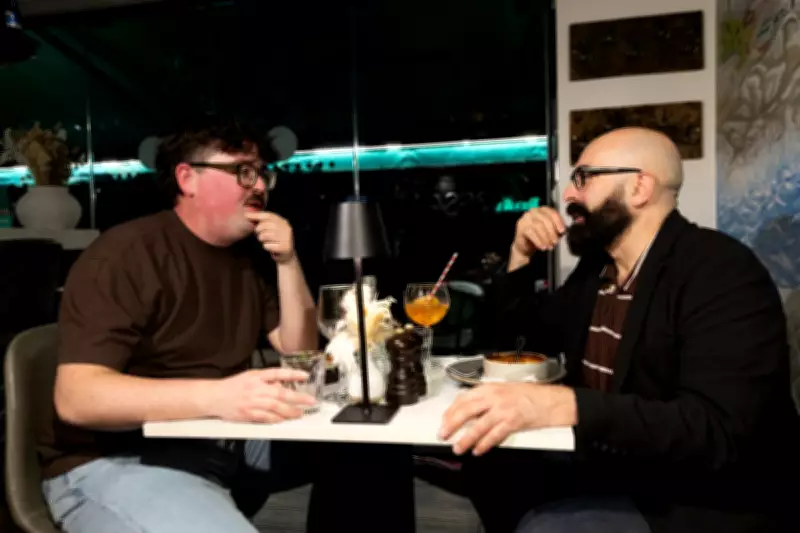
A London Dinner Debate: Property Rights and Irish Unity
In a London restaurant, two men from starkly different backgrounds sat down for a meal that would reveal deep divides over one of the city's most pressing issues: the private rented sector. Diarmuid, a 25-year-old accountant with Green Party ideals, and Richard, a 42-year-old TV presenter and landlord, found themselves discussing whether property is a fundamental right or a legitimate business venture.
The Diners: Two Worlds Collide
Diarmuid, originally from rural Ireland, works as an accountant in London. He typically votes Green or Liberal Democrat tactically and holds strong republican views regarding Irish unity. Interestingly, he lacks a driving licence but possesses a commercial boat licence from his earlier work with boats.
Richard, a London-based TV and radio presenter, also runs a property business. Politically homeless but theoretically aligned with Labour, he has previously supported the Women's Equality Party. His background includes training in contemporary dance and running a dance organisation, with past performance art exploring his Spanish heritage through flamenco.

The Starter: First Impressions and Fried Mozzarella
The conversation began pleasantly enough. "We got on really well, started chatting straight away," Diarmuid recalled, though he noted Richard's apparent higher tax bracket. Richard found Diarmuid "mild and mellow, chilled," though surprised by his accounting profession.
Their culinary choices reflected their different approaches: Diarmuid opted for fried mozzarella sticks and truffle tortellini, while Richard enjoyed a parmigiana starter followed by pasta carbonara, accompanied by an Aperol spritz and pinot grigio, finishing with affogato with hazelnut liqueur.
The Main Course: Property as Right Versus Business
Here the fundamental disagreement emerged. Diarmuid stated firmly: "I think property is a right, not a business, which is obviously very different to what Richard thinks, because he's a landlord." While acknowledging Richard might be among the "great" landlords, Diarmuid maintained: "I still don't think it should be a career path."
Drawing from his Irish upbringing during the 2008 crash, Diarmuid described "massive ghost housing estates" built for tax breaks that remain empty while people struggle to find homes. "There's a human on either side of the equation and one is making money off the other," he argued.
Richard defended his position passionately: "I feel landlords are running a business, providing a service, and we're hugely maligned, particularly in the press." He emphasized his long-term relationships with tenants, including babies born in his properties, and criticized recent regulations and taxation as "over the top" and "scandalous."
The landlord pointed to England's 4.7 million private rented households, questioning Green Party motions about abolishing private landlords: "What would happen to those renters?"
Shared Plate: Unexpected Agreement on Housing History
Surprisingly, the two found common ground discussing right-to-buy policies. Both agreed that selling council houses was initially positive, but the failure to reinvest proceeds created today's housing shortage. "The stock went down and has never recovered," Diarmuid noted.
Richard, despite never supporting Thatcher, acknowledged the principle behind the policy that saw 1.9 million homes sold since 1980, admitting the Blair government continued many Thatcherite approaches he supported.
Dessert: Finding Unity on Irish Unity
The conversation took an unexpected turn toward Irish politics. Diarmuid, a "strong republican," described what he called "the occupied six counties" and advocated for a united Ireland.
Richard demonstrated remarkable empathy, acknowledging the historical context could be viewed through colonization. "I said it could be great if it could become one Ireland," he recalled, suggesting democratic measures might make this possible sooner than expected.

Diarmuid appreciated this dialogue more than discussions with fellow Irish people closer to the conflict: "We had a really good conversation, a lot better than you'd have with another Irish person."
The Bill: Reasonable Conclusions
Despite their fundamental disagreement on property, both men departed with mutual respect. Diarmuid simply stated: "I thought he was lovely." Richard appreciated that his dining companion was "not spiky or aggressive – he was a reasonable chap."
Their dinner at Rossella in London NW5 proved that even those with opposing views on contentious issues like London's housing crisis can engage in substantive dialogue and discover unexpected areas of agreement, particularly when the conversation expands beyond immediate disagreements to broader historical and political contexts.