
Thailand's Strategic Pivot to High-Value Exhibition Economy
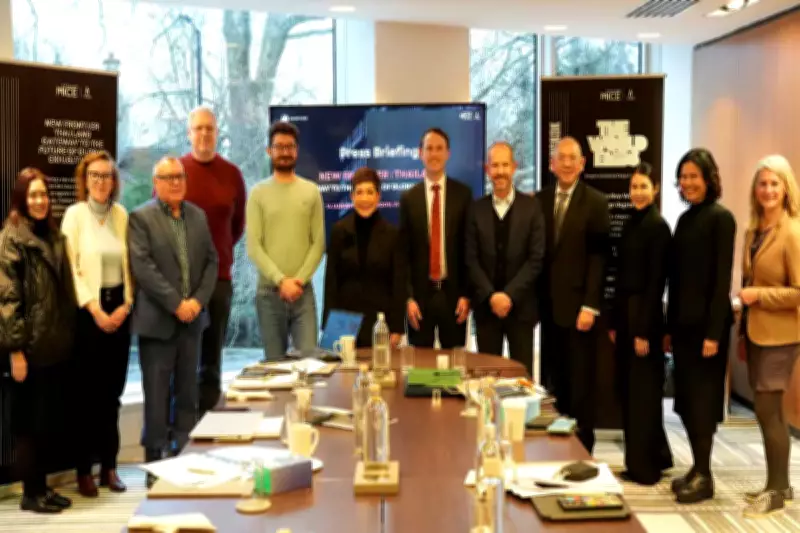
Thailand has launched an ambitious economic repositioning strategy that aims to transform the country from a regional exhibition host into a global hub for high-value, design-led business events. The comprehensive plan, unveiled by the Thailand Convention and Exhibition Bureau (TCEB) during a London briefing on 14 January, represents a fundamental shift in how the nation approaches its exhibition sector.
From Scale to Value Creation
While Thailand already ranks among Asia's leading exhibition destinations, hosting 509 domestic and international exhibitions in 2025 that attracted 23.6 million participants and generated approximately $2.9bn (£2.3bn) in revenue, the new strategy focuses on quality over quantity. With the largest exhibition venue capacity in ASEAN and the fourth largest in Asia, the country is now prioritizing value creation over mere scale.
"We are evolving from transactions to value creation," emphasized Dr Supawan Teerarat, President of TCEB. "Creativity allows industries to move up the value chain."
Redefining Business Travel Economics
Central to Thailand's new approach is a strategic pivot from mass tourism toward high-value business travel. The bureau has introduced the concept of "Return on Experience" (ROE) to replace traditional return on investment (ROI) metrics. Business visitors already significantly outspend leisure tourists, with conference visitors spending up to fourteen times more when long-term commercial relationships are considered.
Exhibitions are no longer viewed simply as drivers of hotel occupancy but as catalysts for supply-chain partnerships, foreign direct investment, and manufacturing expansion. Thailand is also targeting growth in "bleisure" travel – the extension of business trips into longer stays – which increases per-visitor spending across hospitality, retail, and wellness sectors.
Design as Industrial Strategy
The centerpiece of Thailand's creative economy push is The World Ends, a Bangkok International Design Expo scheduled for November 2026. This innovative event represents a departure from conventional trade fairs, serving instead as a cross-sector platform linking design with manufacturing, energy, mobility, and medical innovation.
Thailand's creative economy is already valued at $44.5bn, contributing more than eight percent of national GDP. The strategic integration of design into established industrial sectors – from electric vehicles to medical technologies – aims to "premiumise" exports and enhance global competitiveness. This approach mirrors successful strategies implemented in Northern Italy and parts of South Korea, where design capability has been systematically integrated into advanced manufacturing.
Geopolitical Positioning and Sustainability Integration
Thailand is leveraging its geopolitical position as a neutral gateway in an increasingly fragmented global landscape. The country maintains visa-free entry for 93 countries and visa-on-arrival access for more than 30 others, providing a significant competitive advantage for global organizers navigating restrictive visa regimes elsewhere.
The country's hosting of Gastech 2026 – described as the "Davos of the energy sector" – will position Thailand as a strategic platform for global energy dialogue. The event is expected to attract 50,000 attendees and 30 government energy ministers, occupying 75,000 square meters at the Bangkok International Trade & Exhibition Centre (BITEC).
Sustainability has become integral to Thailand's exhibition strategy, with TCEB setting a target to reduce carbon emissions from the events industry by 20,000 tonnes of CO₂ equivalent by 2030. Financial and logistical support will increasingly be linked to carbon measurement and reduction requirements, with organizers encouraged to track emissions through dedicated "Zero Carbon" applications.
Cultural Capital and Industrial Credibility
Bangkok's inclusion in UNESCO's Creative Cities Network as a City of Design provides significant cultural capital, while large-scale energy summits demonstrate industrial credibility. The new design expo aims to bridge these two strengths, creating a comprehensive platform for high-value economic engagement.
For international investors, organizers, and corporations assessing Asian market exposure, Thailand is positioning itself not merely as a destination but as a sophisticated platform designed to capture higher-value trade in a fragmented global economy. As 2026 approaches, Thailand is betting that the future of exhibitions lies not in footfall alone but in influence, capital flow, and intellectual property development.




