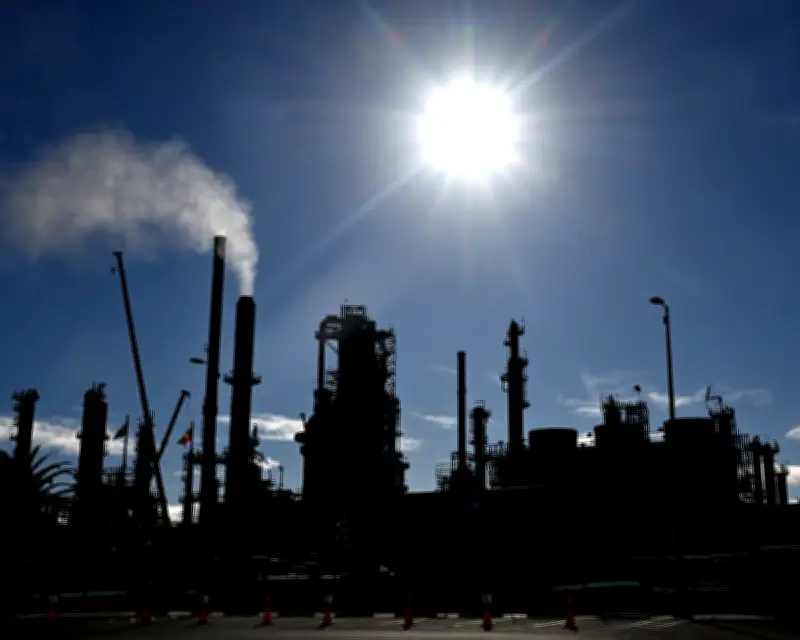
Leading Australian climate policy experts have labeled a proposed new oil refinery in Western Australia as an investment in 'dinosaur technology' that would require public subsidies and do little to enhance the country's fuel security. The Albanese government on Tuesday announced a $4 million early-stage feasibility study with the WA government for a refinery in the Pilbara region, but experts argue the funds would be better spent on green technology to reduce reliance on fossil fuels.
Feasibility study expected to show project uneconomic
Experts told Guardian Australia that while conducting the feasibility study is not a bad idea, it will ultimately demonstrate that the project is uneconomic and would require government subsidies. Greg Bourne, a councillor at the Climate Council and former regional president of BP in Australia, said any potential refinery is unlikely to be commercially viable. 'From a commercial point of view, you've got to be able to make sure you're going to get a profitable return over the next 20, 30 years,' Bourne said. 'Australia is beginning to get more into renewables and if you look forward 10 years, you start saying less oil and gas are going to be needed, and if you look forward 20 years, you say it's just not worth [it].'
Expert warns of signal against clean energy transition
Professor Frank Jotzo, director of the Centre for Climate and Energy Policy at the Australian National University, aired his criticisms at this week's Clean Energy Summit in Sydney. He said investing in an oil refinery would send 'a big signal against the clean energy transition.' Jotzo, who recently led a government review on carbon leakage, told Guardian Australia a new refinery would likely need government subsidies to compete with more efficient mega refineries in Singapore and south Asia. He argued that the future for liquid fuels in Australia should be in renewable electricity, not local crude oil, which is in short supply. 'If you want to subsidise anything, then subsidise the next generation of technologies that is there to produce zero emissions liquid fuels,' Jotzo said. 'If there are state and federal subsidies, that should be on new technology rather than some dinosaur tech that could still be there in 50 years' time.'

Domestic crude oil production declining rapidly
According to Geoscience Australia's 2025 commodity resource report, Australia's domestic crude oil production 'continues to decline rapidly, and without new commercial discoveries, production is projected to cease within the next 7 years.' Baethan Mullen, chief executive of the thinktank the Superpower Institute, said this means a new refinery would probably exclusively refine imported crude oil, doing little to improve Australia's sovereign capability. The Superpower Institute's analysis shows Australia is now 95% reliant on foreign imports of fuel, with only 4% refined locally from Australian crude oil. Mullen noted that some petrol in Australia is refined from condensate, a byproduct of gas extraction, but condensate is generally not used to make diesel products. 'Diesel products are the main product we need, particularly in WA in the mining sector and in agriculture,' Mullen said. 'So a refinery built on the west coast, close to the North West Shelf [where condensate is extracted] is still likely to need to import crude oil to make diesel, and that doesn't make us any more fuel secure than we are now.'
Industry trends show declining refining capacity
Since 2003, six of Australia's eight oil refineries have closed, leaving only two operational, including the Ampol Lytton refinery in Queensland. Like Jotzo, Mullen said this is because the economics no longer stack up given Australia's smaller-scale production competing with refineries in Asia. 'Our analysis would suggest it's not going to be a viable prospect … it's fairly well understood by people who analyse these markets that the answer is not in rebuilding refining capacity here,' Mullen said.