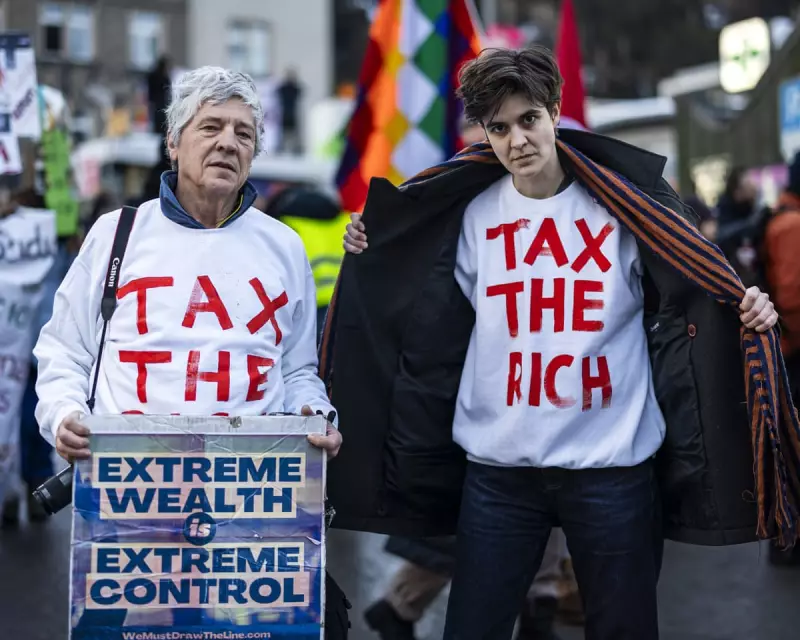
While the world's political and business elite convene at the 2025 World Economic Forum in Davos to discuss global risks, a glaring omission threatens to render their talks futile. According to leading economist and philosopher Ingrid Robeyns, the most significant danger facing humanity – the neoliberal capitalist system itself – remains conspicuously absent from the agenda.
The Glaring Omission in the Global Risks Report
The WEF's own 2026 Global Risks Report, published ahead of the meeting, identifies geo-economic confrontation, misinformation, and social polarisation as the top short-term threats. Looking a decade ahead, environmental catastrophes lead the list. While economic inequality is noted as a central connecting factor, ranking seventh, Robeyns criticises the report for reducing the issue to mere perceptions of exclusion, rather than confronting its systemic roots.
The analysis fails to acknowledge that neoliberal capitalism, which rose to dominance from the late 1970s, is the primary driver. This system, characterised by privatisation, a power shift from labour to capital, and reduced taxes for the wealthy, has led to unprecedented wealth concentration. This concentration is now actively eroding democratic foundations worldwide.
Wealth, Power, and the "Wealth Defence Industry"
Robeyns, author of Limitarianism: The Case Against Extreme Wealth, argues that extreme inequality is fundamentally about the distribution of what society produces collectively. The neoliberal myth of wealth stemming solely from individual effort ignores the essential, often publicly-funded, ecosystem that enables profit, from childcare and education to healthcare.
In recent decades, the divide has accelerated. Capital owners have grown richer while workers have become poorer, a trend exacerbated by tax structures that favour wealth over labour. The wealthiest now often pay minimal tax. This system is protected by what scholars term the "wealth defence industry" – professionals within the top 10% who work to safeguard the assets of the ultra-rich.
A Historical Path to Collapse
The refusal to debate alternatives carries profound historical warning. Economic historian Guido Alfani, in As Gods Among Men, notes that extreme wealth was historically tolerated because the rich aided society in crises – a role now largely abandoned. Analyst Luke Kemp, studying 5,000 years of civilisational rise and fall in Goliath's Curse, identifies the same dangerous trends in global capitalism, with inequality as a key predictor of societal collapse.
Kemp presents two future paths: global societal collapse or radical systemic change. The current trajectory, supported by elites who benefit from the status quo, points towards the former. The WEF report contains zero references to capitalism or socialism, ignoring vast academic scholarship on the flaws of the current model and potential alternatives.
The ultimate purpose of an economy, Robeyns concludes, is to enable a good life for all within ecological limits. Neoliberal capitalism demonstrably fails this test. Until the elites in Davos and beyond are willing to ask the uncomfortable question – "am I part of the problem?" – and honestly debate the system that enriches them, the world's most pressing crises cannot and will not be solved.