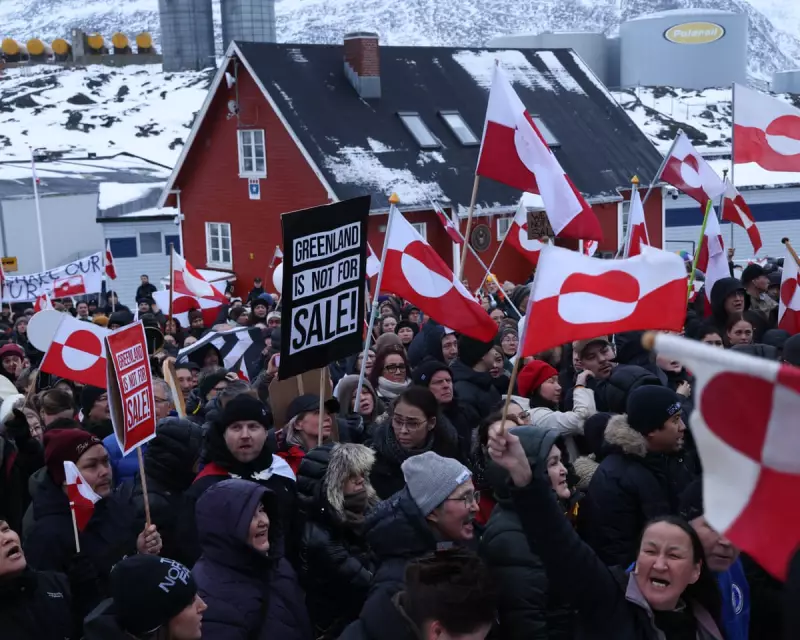
Residents of Greenland's capital, Nuuk, are monitoring flight-tracking apps and having difficult conversations with their children about a future under American control. This palpable anxiety stems directly from renewed threats by former US President Donald Trump to acquire the vast, ice-covered island, dragging the largely autonomous Danish territory into the centre of a global power struggle.
A Strategic Prize Emerges from the Melting Ice
The core of Trump's interest is not a historical whim. Climate change is rapidly transforming the Arctic, shrinking the ice cap and unlocking once-frozen assets. New shipping routes are becoming viable, promising to redraw global trade maps, while the retreating ice sheet exposes vast deposits of rare earth minerals critical for modern technology, from smartphones to guided missiles.
This transformation has turned Greenland from a remote, frozen outpost into a strategic gateway between North America, Europe, and Russia. In any potential conflict between nuclear powers, missiles would traverse the polar region. The US already maintains an early-warning system at Pituffik in north-west Greenland, while Russia has rebuilt Cold War-era bases and China declares itself a "near-Arctic state." For Trump, mere access is insufficient; the stated goal is control.
Political Fault Lines and a Superpower's Pressure
The threat has sent shockwaves through Greenland's delicate political landscape. While all major parties support eventual independence from Denmark, Trump's rhetoric has forced a brutal reprioritisation: security now, sovereignty later. Premier Jens-Frederik Nielsen has firmly stated, "Greenland does not want to be part of the US," aligning with the Kingdom of Denmark.
However, cracks are visible. The Naleraq party, the second-largest in Greenland's parliament, advocates for negotiating directly with Washington, bypassing Copenhagen—a division a superpower could exploit. The pressure was evident when Greenland's foreign minister, Vivian Motzfeldt, gave an emotional interview describing the intensity of recent diplomatic encounters, a sign this is far from normal statecraft.
Trump has linked the issue to trade, threatening a tariff war with Europe over Greenland, a move criticised by UK Prime Minister Keir Starmer as "wrong." This pattern mirrors actions in Ukraine, where Trump's administration secured a share of future mineral profits, suggesting a consistent strategy of tying resources to security demands.
Living Under the Shadow of a Threat
For the 56,000 inhabitants of Greenland, this is not an abstract geopolitical game. The Guardian's Nordic correspondent, Miranda Bryant, reporting from Nuuk, found a marked shift in mood since Trump's return to power. "People told me that Venezuela made a huge difference to how serious the threat feels," she said. "When he first started saying he wanted the US to acquire Greenland, it was strange, and almost laughable. Now it feels real."
Families are grappling with unimaginable questions: Should they flee pre-emptively? If soldiers arrive, do they submit or protest? With little official guidance, citizens feel exposed. One woman panicked upon seeing a US Hercules aircraft leave Pituffik on a flight-tracking app, convinced it was heading to Nuuk to invade. "That's the level of anxiety now," Bryant notes, "people watching the skies and the seas themselves because they don't know what else to do."
Europe's Dilemma and a Fragile Principle
Denmark and its European allies face an impossible dilemma. While Copenhagen can—and is—increasing its military presence and cooperation in Greenland, it cannot easily confront a nuclear-armed ally openly discussing conquest. Analysts describe Trump's approach as a "crude return to cold war style military concerns."
The collective effort in Brussels, Copenhagen, and Nuuk is now to defend a fundamental principle that suddenly appears fragile: that borders cannot be changed by force, even as the physical borders of ice melt away. This offers cold comfort to Greenlanders watching the horizon, wondering if their peaceful society is about to become the next pawn in a great power game where the rules are being rewritten.