
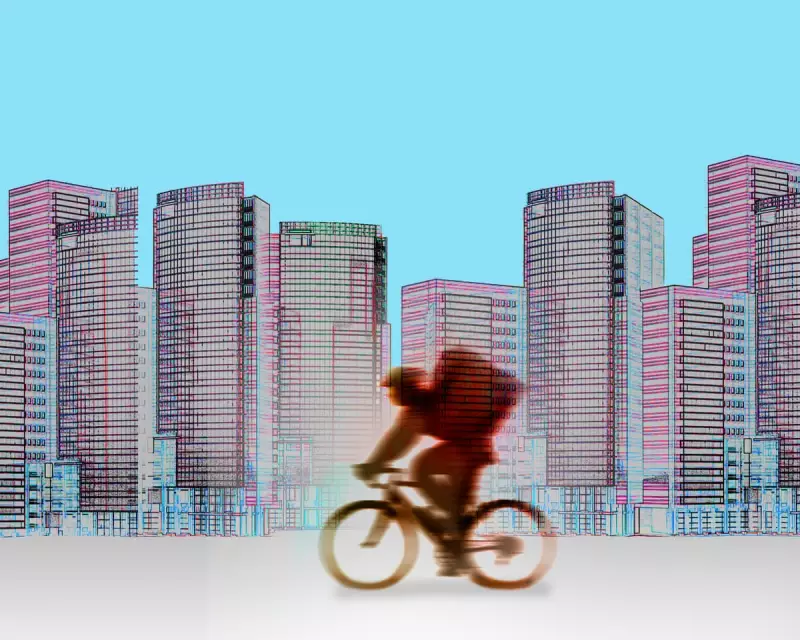
David Rayfield’s career trajectory took a sharp turn from the predictable grey of corporate offices to the unpredictable streets as a food delivery rider. His story, moving from a salaried position to the gig economy on a bicycle, highlights a profound culture shock, the tangible dangers of the job, and a complex trade-off between autonomy and security.
The Sudden Shift: From Redundancy to the Road
After being made redundant four times in just six years, Rayfield faced months of fruitless job applications. With bills mounting, he needed an immediate solution. He sold his unused Xbox at a Cash Converters store and used the proceeds to buy a half-decent mountain bike, embarking on a new chapter delivering for platforms like Uber Eats.
The initial sensation was one of liberation. The rigid structure of office life—monitored hours, same walls, same colleagues—was replaced by a stark independence. “I don’t have to worry about anybody making me redundant because there is no anybody – there’s just me,” he notes. The ability to choose his own hours, to pause in a park for lunch, offered a freedom absent from his previous roles.
A Daily Gamble: Danger and Discrimination on the Streets
This newfound liberty comes with significant physical risk. Rayfield’s account is punctuated by violent and frightening incidents that underline the vulnerability of delivery riders. He was punched in the ribs by a skinhead while waiting in a sidestreet, an attack so sudden he initially mistook it for a bird strike.
The perils are often vehicular. He suffered a nasty collision when a driver opened a car door into the bike lane without looking, sending him crashing onto the bitumen. On another occasion, his front wheel caught in a tram track—a uniquely Melbourne hazard—tearing up his knee. He has been forced into gutters by aggressive drivers, and watches constantly for hazards in bike lanes he describes as less than a metre wide, squeezed between moving and parked traffic.
Rayfield observes a stark societal bias: “If there’s a form of life that’s lower than cyclists in the eyes of cars, it’s Uber Eats bikes.” This contrasts sharply with the generally friendly interactions with customers receiving their orders, some of whom are apologetic for the convenience.
The Gig Economy Mechanics: Gamified Rewards and Unreliable Pay
The financial model of the work is inherently unstable. While 80% of his deliveries are fast food and coffee, his income is supplemented by unreliable, gamified bonus schemes run by the delivery apps. These might offer an extra $72 for completing 30 orders before a Thursday, but they are random events based on demand and location. The base wages, he admits, are much lower than his previous office earnings.
The trade-off, for him, is qualitative. He weighs “listening to Wu-Tang Clan with wind in my hair versus dreading another company restructure.” The job offers an intimate, kinetic knowledge of the city and a level of personal control, but the constant vigilance required is exhausting. After a shift, his mind and body often crash from the sustained tension of navigating urban dangers.
A Band-Aid, Not a Cure: Weighing the Ultimate Cost
Rayfield is clear-eyed about the limitations. He describes the work as “a Band-Aid on a broken leg”—a temporary fix, not a long-term career. The jury is still out on whether it trumps an office job. It’s a series of brutal comparisons: air-conditioning versus scorching heat, freedom versus monitored hours, pointless meetings versus a fitness-improving outdoor activity that carries a real risk of serious injury or death.
His experience has fundamentally altered his perception of urban infrastructure, feeling in his bones how cities are designed primarily for cars, with cyclists often an afterthought. Despite the camaraderie with some customers and the personal autonomy, the physical toll and financial insecurity present a sobering picture of the modern gig economy for delivery riders in the UK and beyond.




