
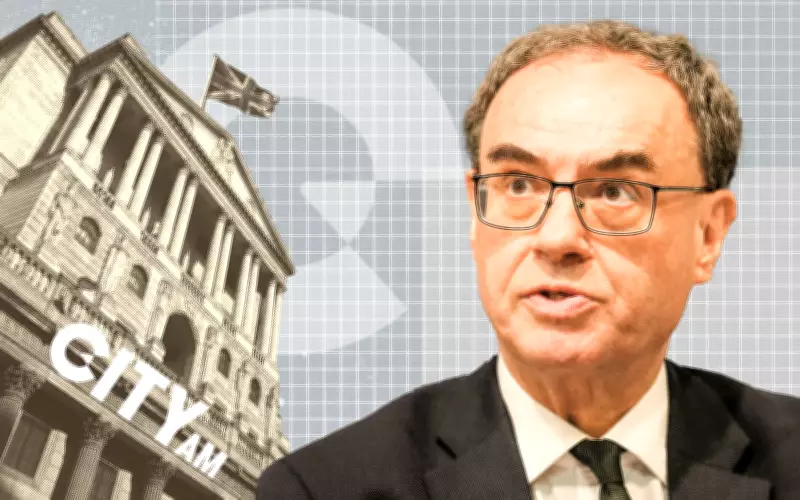
Bank of England Urged to Pause Rate Cuts Amid Iran War Uncertainty
Economists on City AM's Shadow Monetary Policy Committee have strongly advised the Bank of England to adopt a "wait and see" approach before implementing further interest rate reductions. The escalating conflict in Iran has created significant economic turbulence, prompting experts to recommend maintaining the current Bank Rate at 3.75 percent.
Middle East Crisis Impacts Economic Outlook
The ongoing war in Iran has dramatically increased energy prices, with Brent Crude Oil surpassing $100 per barrel and natural gas prices more than doubling from pre-conflict levels. This development has raised serious concerns about potential stagflation—a dangerous combination of high inflation and low economic growth—with some analysts warning that a recession cannot be completely ruled out.
Recent data from the Office for National Statistics reveals troubling economic indicators, including rising unemployment, near-stagnant economic growth, and declining inflation rates. However, forecasters anticipate more challenging economic data in the second half of the year, particularly when the energy price cap resets in July.
Shadow MPC Vote Reflects Cautious Stance
The Shadow Monetary Policy Committee voted 7-2 in favor of keeping interest rates unchanged, with members responding independently from their respective organizations. Many economists indicated they would have supported rate cuts had the Middle East conflict not erupted, highlighting how geopolitical events have dramatically altered monetary policy considerations.
Julian Jessop, an independent economist who voted to hold rates, emphasized the need for careful assessment: "It is still right to look past the temporary impact of commodity price shocks, especially if these will also dampen economic activity. Nonetheless, it will take time to gauge all the second round effects, including on inflation expectations."
Diverging Perspectives Among Economists
While the majority favored maintaining current rates, some economists advocated for immediate reductions. Ben Ramanauskas, Senior Research Fellow in Economics at Policy Exchange, voted to cut rates by 25 basis points, arguing that "monetary policy remains restrictive" and that the Bank should aim for a neutral rate of around three percent by year's end.
Katharine Neiss, Chief European Economist at PGIM Fixed Income, revealed she would have supported a rate cut before the conflict but now favors caution: "Waiting is not a free lunch and there are risks associated with being behind the curve given the marked weakening in the UK labour market data."
Government Response and Fiscal Implications
Sir Keir Starmer's government has refrained from announcing a comprehensive multi-billion pound energy support package despite sustained high oil prices. Instead, authorities have focused on targeted assistance for households using heating oil. Chancellor Rachel Reeves has suggested there is "scope" for more substantial government intervention.
A delay in interest rate reductions could place public finances in a precarious position, though the Chancellor gained nearly £2 billion in additional headroom during the Spring Statement, partly due to optimistic borrowing cost forecasts from the Office for Budget Responsibility.
Strategic Considerations for Monetary Policy
Anna Leach, Chief Economist at the Institute of Directors, emphasized the heightened uncertainty: "The inflationary outlook has become highly uncertain. The outbreak of conflict in Iran has stoked oil and gas price volatility. In light of this new shock, it makes sense for the Bank to take a moment to see how the conflict evolves."
Kallum Pickering, Chief Economist at Peel Hunt, highlighted the severity of the situation: "The escalating conflict in the Middle East poses the most serious downside risk to the UK economy since the Russian invasion of Ukraine in 2022. Financial markets are priced for a short conflict, but risks are skewed towards a protracted one."
Potential Scenarios and Future Directions
Ruth Gregory, Deputy Chief UK Economist at Capital Economics, outlined varying scenarios: "If oil and gas prices peak around current levels and soon fall back, inflation probably wouldn't breach the three to four percent range. In this scenario, interest rate cuts would probably be delayed rather than cancelled."
Vicky Pryce, Chief Economic Adviser at the Centre for Economics and Business Research, suggested complementary measures: "Holding rates should be accompanied by a stop, at least temporarily, of Quantitative Tightening by the Bank of England to ease pressure on bond yields and on mortgage rates."
The consensus among most Shadow MPC members indicates that while maintaining restrictive monetary policy may be difficult given rising unemployment and predictions of easing price growth, the extraordinary circumstances created by the Iran conflict warrant extraordinary caution from policymakers.




