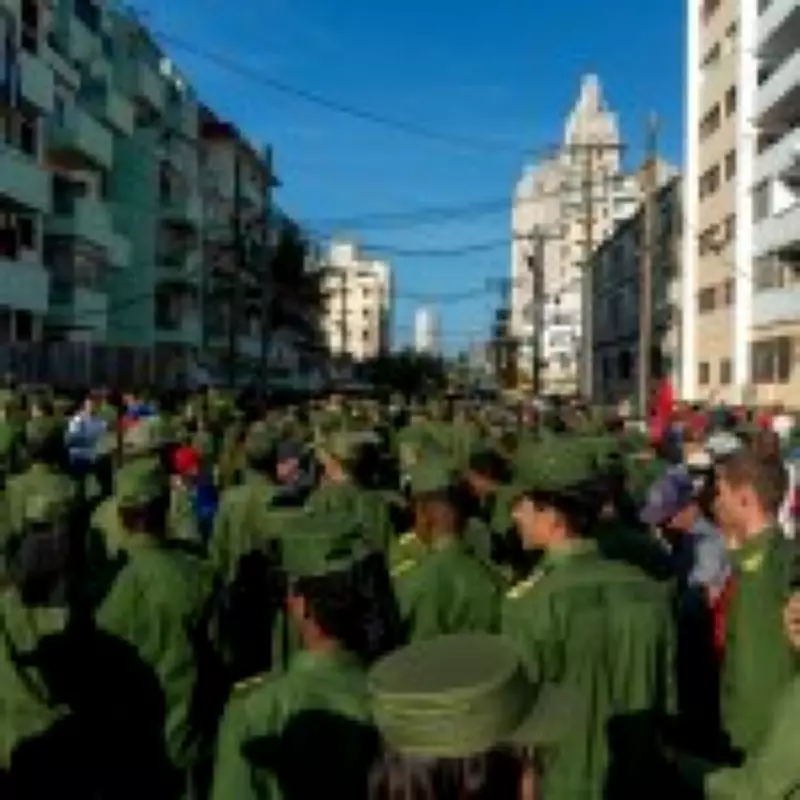
The United States is fully prepared to attack Cuba, with a significant buildup of troops and weapons in the Caribbean signaling a potential escalation. A months-long energy blockade imposed by the Trump administration has already plunged the island into darkness, with food and medical supplies running critically low.
US Plans for Regime Change
By the end of 2026, the US government aims to 'change the leadership' of Cuba, seeking government insiders to 'cut a deal' to facilitate this transition. According to Politico, all that remains is a final 'go-ahead' from President Trump before launching a military attack. The US Navy currently has its largest troop concentration in the Caribbean, second only to the Middle East.
Secretary of State Marco Rubio warned, 'Cuba is in a lot of trouble. Having a failed state 90 miles from our shores is a threat to the national security of the United States.' The recent indictment of Raúl Castro for allegedly shooting down planes in the 1990s, along with US claims that Cuba possesses drones capable of attacking Florida, could provide a pretext for military action.

Expert Warnings
Dr. Stephen Wilkinson of the International Institute for the Study of Cuba at the University of Buckingham cautioned that a military coup in Cuba would be 'the biggest tragedy in American foreign policy in years.' He told Metro, 'Taking over Cuba is just another fantasy, just like the idea that the US can defeat Iran is a fantasy. They've underestimated the Iranians, and they're underestimating the Cubans. The Cubans are made of very tough stuff. They're not going to give up.'
Historical Context of US-Cuba Relations
The US desire to annex Cuba dates back to 1803, when it was a Spanish colony. Cuba's strategic location at the mouth of the Gulf of Mexico made it vital for protecting sea lanes to the Mississippi Delta and the Panama Canal. American investments in Cuban sugar further deepened economic ties.
'The relationship has very little to do with 20th-century ideological struggles. It has mainly to do with 19th-century anti-colonial struggles,' Dr. Wilkinson explained. 'The Cubans have wanted their sovereignty and independence and have fought for it for a long time.'
In 1902, after Cuba won independence from Spain, the US intervened, imposing a constitution and settlement that sparked backlash. Throughout the 20th century, Cubans continued their fight for true independence, achieved in 1959 when Fidel Castro took power. The US then attempted to assassinate Castro and launched the failed Bay of Pigs invasion.
In 2015, Presidents Barack Obama and Raúl Castro normalized relations, a diplomatic milestone. However, during Trump's first term, these gains were reversed, and Cuba was redesignated as a state sponsor of terrorism.
Why Attack Cuba Now?
The US has long sought government change in Cuba, viewing its socialist government and independence as a threat. The Cuban Missile Crisis of 1962, when the Soviet Union placed nuclear missiles on the island, left a lasting legacy of tension. Cuba's alliances with China, Venezuela, and Iran further alarm US officials.
Dr. Wilkinson noted, 'The Cubans have wanted their sovereignty and independence and have fought for it for a long time.' The current military buildup and political pressure suggest that the US may be on the brink of another intervention.