The UK government has requested that domestic refineries maximize jet fuel production as part of contingency planning to prevent airlines from being grounded due to supply disruptions caused by the Iran war.
Energy minister Michael Shanks stated that the government is closely monitoring UK jet fuel stocks and collaborating with airlines, airports, fuel suppliers, and other governments as carriers face soaring fuel costs due to the conflict. Normal flows of fossil fuels from the Gulf have effectively halted since the war began, following the de facto closure of the Strait of Hormuz, through which one-fifth of the world's oil and gas passes.
Shanks noted that UK airlines typically purchase fuel months in advance and that aviation fuel suppliers hold bunkered stocks. The UK also imports jet fuel from countries not reliant on the Strait, including the United States. Airlines UK has confirmed that airlines continue to operate normally without jet fuel supply issues, but the government remains vigilant.

There are now only four operational refineries in the UK, following closures at Grangemouth and Lindsey in 2025: Fawley (Hampshire, ExxonMobil), Humber (Lincolnshire, Phillips 66), Pembroke (Wales, Valero), and Stanlow (Essex, Essar). These sites produce petrol, diesel, jet fuel, and fuel oil for domestic use and export. The number of UK refineries has dropped from a peak of 18 in the 1970s.
Global jet fuel shipments fell to a record low last week, with just under 2.3 million tonnes transported by ship in the seven days to April 26, less than half the pre-war weekly average, according to data firm Kpler. Airlines report no immediate supply problems within their typical four-to-six-week horizon, but some have announced flight cancellations and are lobbying for government assistance amid rising fuel prices and potential supply crisis.
Airlines that cancel flights due to fuel shortages will not lose valuable takeoff and landing slots at busy airports, thanks to exemptions granted by Airport Coordination Ltd. Budget carrier Jet2 has hedged 87% of its fuel needs for the summer at an average price of $707 per metric tonne, providing cost certainty, but notes that geopolitical uncertainty makes booking predictions difficult.
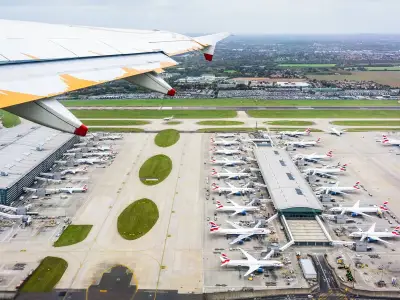
Heathrow Airport reported an uncertain outlook due to the conflict, despite a short-term boost in passenger numbers from airspace closures in the Middle East. Almost 19 million passengers traveled through Heathrow in the first quarter, up 3.7% year-on-year, but the airport does not expect this trend to continue given regional instability.