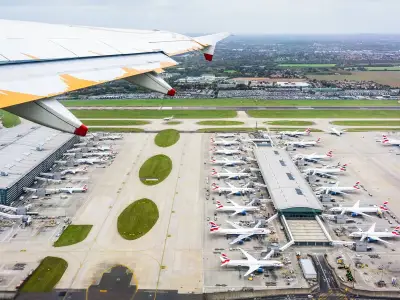
As I flew back from my delightful Mykonos escape on Wednesday afternoon, I had my head buried in a book. The flight had been pretty bumpy, the seatbelt sign periodically flashed on and off, and we’d finally begun our descent into London Heathrow. Then a loud bang. A bright yellow flash from the left side of the plane. Being on the back row, I had no window, but I could see the panic on people’s faces as they strained to look towards the engine.
My first thought? A bird had gone through the engine. People held hands, and we came into land. Still, no announcement about what had happened from the cabin crew or the cockpit. They were all smiles and calm. Once we’d touched down on the ground, the pilot’s voice crackled over the PA system: ‘That was actually a lightning strike that hit the plane.’
What happens when a plane is struck by lightning?
Andrew McKechnie, former pilot and expert in flight operations and airline management, tells Metro that if there’s an airplane in the path of the lightning, it could indeed get struck. ‘From a passenger’s point of view, what happens is that there’s a loud bang and a flash outside the windows,’ he explains. ‘If you’re sitting close to where the lightning strikes, it can be quite startling!’

But the aviation expert explains that planes are actually designed to withstand a strike like this. ‘The fuselage of an aeroplane conducts electricity, so it forms a “Faraday cage”,’ Andrew says. This is an enclosure made of conductive material like metal which blocks the electricity from getting inside.
‘When lightning strikes, the electrical discharge is conducted through the fuselage, and the occupants aren’t affected (apart from hearing the bang),’ he adds. ‘Some modern aeroplanes, like the Boeing 787 Dreamliner, have composite structures. These have copper wires embedded in the composite to provide the same protection as a metal fuselage.’
Can a lightning strike cause damage?
While the plane may be able to keep flying, it won’t usually get off scot-free. ‘The aeroplane will be damaged,’ Andrew says. ‘But usually, the damage is minor. Where the lightning strikes the metal of an aeroplane, the heat of the lightning will punch a small hole. ‘If the lightning strikes a non-metal part, it might cause cracks or charring.’
This type of incident also has the potential to affect navigation systems, according to the expert. He admits the magnetic compasses may point in the wrong direction after a lightning strike. ‘It’s less of a problem now than it was in the past, because modern aircraft navigation systems are not based on magnetic compasses,’ Andrew explains. ‘Aircraft electronic systems are well protected from lightning.’
While the lightning strike on my flight didn’t lead to an emergency landing, there’s a very slim chance that this type of weather could cause a problem. ‘The weather that caused the lightning strike might prevent a flight from landing at its planned destination,’ he adds.
Andrew experienced this himself some years ago when flying from Genoa, Italy. The aircraft was struck by lightning but it was the heavy rain and winds which prevented the flight from touching down. They diverted to Nice, France, instead. ‘We were all pleased to be back on the ground, but it was a long bus journey back to Genoa,’ he jests.
What is the protocol when your plane is struck?
You might be wondering what is going on in the cockpit when lightning hits your plane. Is there a checklist? A mayday call? It’s actually much less dramatic than you’d think. ‘Pilots put a lot of effort into avoiding lightning strikes,’ Andrew says. ‘We use radar and lightning detectors to stay away from thunderstorms. ‘But if an aircraft is struck by lightning, the pilots will check for any obvious damage and that all the navigation and communication systems are working. ‘Most importantly, they’ll report the lightning strike to their engineers so that the aircraft can be checked after landing.’
What can’t happen, is the plane immediately taking off again with new passengers to a new destination. ‘Engineers need to identify any damage before it flies again,’ Andrew adds. ‘This can take a long time. Imagine looking for a mark the size of a 5p coin on something the size of an airliner.

‘Because lightning travels through the aircraft, there will always be two marks (one in, one out) and the airplane isn’t going anywhere until they’ve both been found.’ This could obviously delay the new flight, especially if the damage needs to be repaired immediately. ‘About 99% of the time they’ll make a temporary repair and arrange for a permanent repair during the next scheduled maintenance,’ the expert adds.
Ultimately, you have nothing to worry about when you’re going through a storm. ‘You’re probably already getting quite a bumpy ride, and you might see flashes and even hear rain on the fuselage,’ Andrew admits. ‘When lightning strikes, it’s going to make you jump, but the aeroplane will continue flying just fine.’