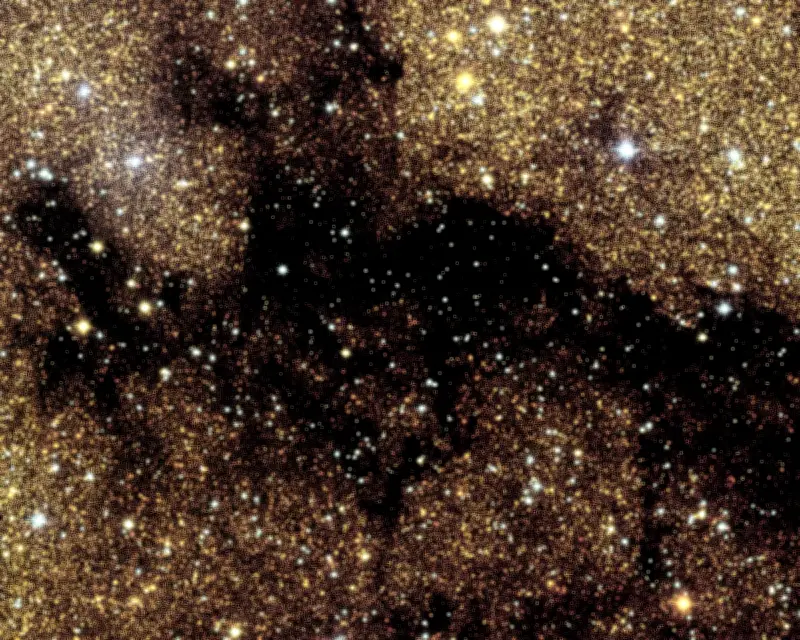
The European Space Agency's Euclid telescope has captured the largest and most detailed image ever taken of visible light emanating from the centre of the Milky Way, revealing more than 60 million stars in the galactic bulge. This dazzling snapshot marks a significant milestone in astronomy, promising to accelerate the discovery of planets beyond our solar system.
Record-breaking image of the galactic bulge
The image, composed of nine pointings from Euclid's visible light camera, covers an area of the sky larger than the full moon. Astronomers pointed the telescope at the Milky Way's centre for 26 hours in March last year to obtain the data. The camera's sensitivity is rare, allowing it to distinguish individual stars in the crowded galactic bulge, a vast, tightly packed structure filled mainly with old, cooler stars.
Dr Eamonn Kerins, an astrophysicist at the University of Manchester's Jodrell Bank Centre for Astrophysics, said: 'It was never built with this science in mind, but it has proved to be a superb facility for the work. This data fires the starting pistol in a new age of exoplanet discovery, where we go from knowing about 6,000 exoplanets to finding more than 100,000 across the galaxy.'

A new era of exoplanet discovery
The €1 billion (£862 million) telescope launched in 2023 to construct the most accurate 3D map of the cosmos and shed light on dark energy and dark matter, which together constitute about 95% of the universe. However, its capabilities extend beyond cosmology. The image will boost the hunt for exoplanets through microlensing, where a star's gravity bends light from a more distant star, making it appear brighter. When a planet orbits the nearer star, its gravity creates a spike in brightening.
In August, NASA plans to launch the Nancy Grace Roman space telescope, expected to find about 1,500 microlensing exoplanets. The Euclid image will enhance these measurements by showing the same stars before they overlap, allowing astronomers to measure their motion and confirm planet masses. 'The Euclid snapshot will improve those measurements possibly by up to a factor of three, which for a single image is quite something,' Kerins added.
Complementary observations
The Roman telescope aims to detect a further 100,000 exoplanets by observing transits, where a planet crosses its parent star, causing a slight dimming. Euclid data will help confirm these are transiting planets rather than binary star systems, which can produce similar signals. The combination of Euclid and Roman observations is expected to revolutionise exoplanet science, dramatically increasing the known number of worlds beyond our solar system.