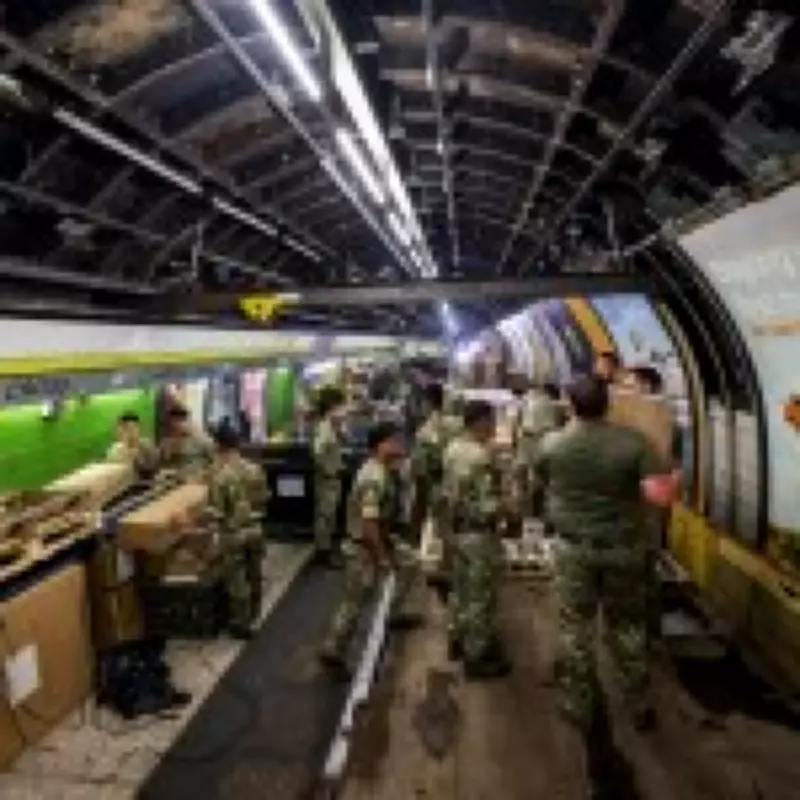
A disused platform at one of London's busiest Underground stations was transformed into a command centre for a Nato war simulation, marking the first time in over 85 years that the Tube has been used for military purposes since Londoners took shelter during the Blitz.
Last week, the hidden tunnels beneath Charing Cross station became the nerve centre for Operation 'Arrcade Strike,' a British Army command post exercise led by the Allied Rapid Reaction Corps (ARRC) as part of a Nato deployable corps headquarters drill. The exercise tested the capability to plan and command a massive military operation involving up to 100,000 personnel from the UK and Nato countries.
Blending in with Commuters
Major Jess Wood, chief of the Joint Air Ground Integration Centre, described the surreal mix of everyday commuter life with the military exercise. 'It's a very impressive set up behind a pretty nondescript grey door in the tube corridor. Someone stopped me on my way into work and asked how to get to Heathrow yesterday!' she said. After long shifts underground, she admitted missing daylight and 'more fresh air.'

Corporal Ismaila Ceesay, 28, an information management specialist from Stratford, east London, said all personnel had to arrive in civilian clothes to avoid alerting the public. 'I've reached into my London roots and adopted a London look to blend in like a local, so no one can suspect I'm anything but a commuter going to work. I've got my hoody on, changed my gait and I try to blend in. Winston Churchill was hidden underground in London in the Second World War, so it's nothing new. It worked for him,' he added.
Fictional Scenario, Real Threats
While the exercise scenario is fictional, the systems and command structures are operational. The scenario was set in 2030, the year UK military planners believe the threat from Russia could be at its strongest. A Tube station buried deep underground, with platforms at Charing Cross reaching up to 98 feet, would be an ideal command hub in a real conflict. A command post is the nerve centre of operations and a prime target for enemies, vulnerable to Russian long-range missiles, drones, and electronic interference, the British Army said.
One senior commander participating in the exercise stated: 'Arrcade Strike is not a conceptual exercise. It is a rehearsal of the plans we already have and a demonstration of our ability to fight and therefore to deter.'
New Technology and Formations
The exercise focused on a new digital system called Project Asgard, an AI-powered tool that draws data from satellites, sensors, and the imaginary battlefield to assist commanders in decision-making. It also unveiled a new formation, 9 Deep Recce Strike Brigade (9 DRS), designed to target enemies from long distances using a rocket system with a 93-mile radius and attack drones capable of reaching up to 372 miles.
The exercise comes amid heightened tensions, as last week Russia and Belarus launched massive nuclear weapons drills near Nato members' borders, involving 64,000 troops and nearly 8,000 pieces of equipment.