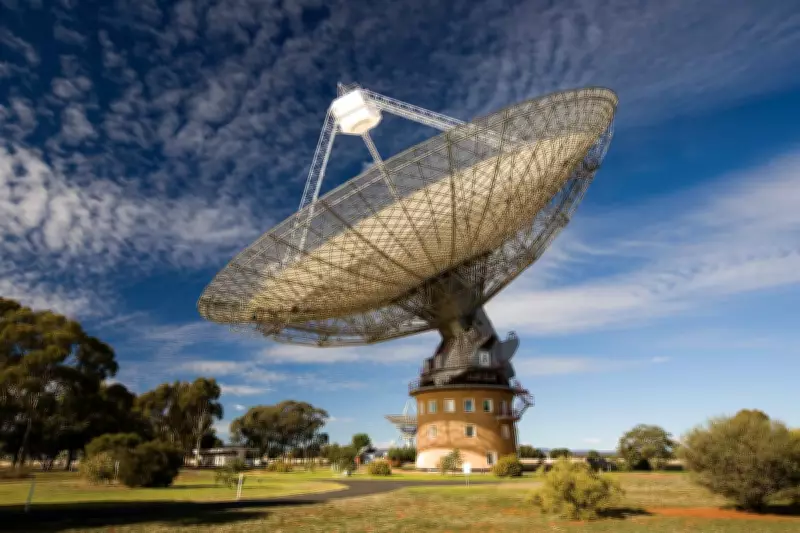
Australia's Dish Telescope Plays Key Role in Artemis II Lunar Mission
The Murriyang radio telescope in Parkes, New South Wales, immortalised in the beloved Australian film The Dish, is once again at the forefront of space exploration. This historic instrument, which broadcast Neil Armstrong's moonwalk in 1969, is now tracking NASA's Artemis II mission, launched from Florida, and sending critical data to support the crewed lunar journey.
From Apollo to Artemis: A Legacy of Lunar Tracking
On July 21, 1969, the Parkes telescope faced extreme wind gusts of up to 110 km/h, far exceeding its safety shutdown threshold of 35 km/h. Operators risked the equipment to ensure the world could witness Armstrong's historic steps. Today, the 64-meter dish, given its Wiradjuri name Murriyang in 2020, has volunteered to monitor the Orion spacecraft as it orbits Earth before heading to the moon and returning to splash down in the Pacific.
This mission marks the first crewed lunar expedition since Apollo 17 over five decades ago, when Captain Eugene A. Cernan spent 73 hours on the lunar surface. NASA's Kevin Coggins highlights that the telescope's involvement demonstrates capabilities for building a resilient, public-private ecosystem to support innovation and exploration.

Australian Infrastructure Supports Deep Space Communication
While the Parkes telescope captures attention, the Canberra Deep Space Communication Complex (CDSCC), part of NASA's Deep Space Network and operated by CSIRO, handles the heavy lifting for Artemis II in Australia. CDSCC education officer Rhianna Lyons explains that the complex will track the mission whenever visible in the sky, using radio antennae to maintain primary communications with astronauts.
The CDSCC collaborates with other network stations in Madrid and California, ensuring continuous coverage. Despite being sidelined in The Dish film, the CDSCC now plays a central role, with operators preparing for years to manage communications from a mission control setup designed for teamwork.
Innovations in Space Communication and Collaboration
Beyond traditional radio waves, the Australian National University is testing laser communications at its Quantum Optical Ground Station in Mount Stromlo Observatory. In partnership with NASA via the Australian Space Agency, this technology can transmit data up to 100 times faster, potentially revolutionizing future lunar missions. Dr. Kate Ferguson from the ANU Institute for Space emphasizes that building this capability in the southern hemisphere is crucial for reliable deep space communication.
Additional support comes from Southern Launch in South Australia, using a Raven Defense dish for tracking, and includes Australian-built components on the Orion capsule. The mission aims to test life support systems, navigation, and radiation protection, paving the way for a planned 2028 moon landing and eventual Mars expeditions.
Strategic Shifts in Space Exploration
Artemis II represents a historic shift from the Cold War-era space race to modern goals of colonization and resource exploration. Professor Andrew Dempster of UNSW's Australian Centre for Space Engineering Research notes that while Mars remains a target, NASA's recent focus on a lunar base over an orbiting station refocuses strategic aims. Astrophysicist Richard de Grijs from Macquarie University views the mission as a signal of humanity's organization beyond Earth, with China and private companies like SpaceX also advancing lunar ambitions.
Astronomer Alan Duff from Swinburne University of Technology calls Artemis II a record-breaking endeavor, sending humans beyond low Earth orbit further than ever before. As the Orion spacecraft ventures around the moon's dark side, revealing unseen regions, this mission underscores a collaborative effort in the new era of space exploration.