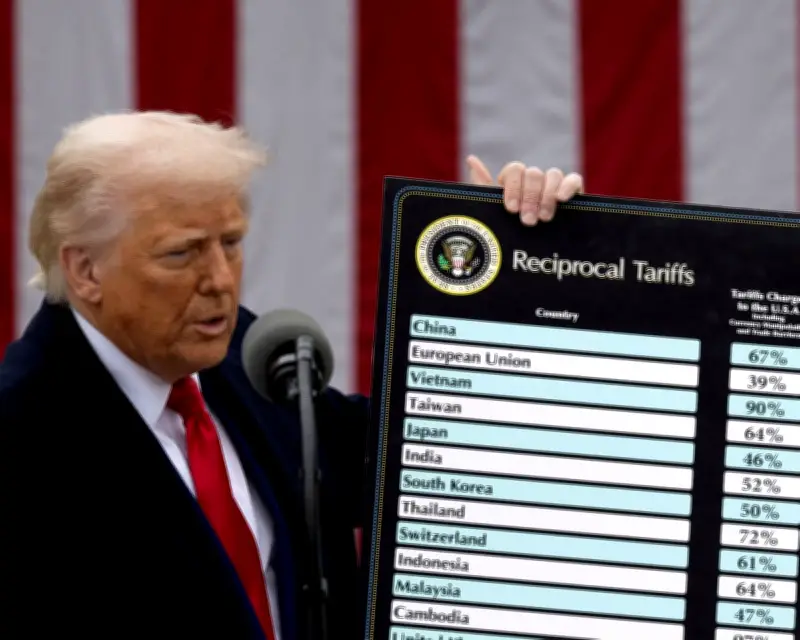
President Donald Trump has once again turned to tariffs as his preferred economic weapon, imposing a 50% tariff on Canadian goods and across-the-board tariffs of 10% or 12.5% on goods from more than 80 countries. These moves come amid falling approval ratings, rising inflation, and international backlash against his unilateral policies.
Economic Impact on American Households
The Yale Budget Lab estimates that Trump's tariffs will increase costs for the average US household by $1,100 each year. As tariffs are taxes on imports, US consumers bear the burden, worsening affordability concerns. Since Trump returned to office, the US has lost 75,000 factory jobs, with executives citing uncertainty caused by his erratic trade policies. Moody's Ratings chief credit officer Atsi Sheth told the New York Times: "Volatility and unpredictability is the new normal."
Justifications Under Scrutiny
Trump invoked a never-used provision of the Smoot-Hawley Tariff Act, a 1930 law that worsened the Great Depression, to justify the 50% tariff on Canada. He claimed Canada discriminated against the US by halting liquor imports from 11 provinces after Trump imposed punitive tariffs and suggested making Canada the 51st state. Trump also cited a 25% Canadian tariff on US-made cars as retaliation for his own 25% tariff on Canadian cars. One analyst summarized: "Trump is essentially telling Canada: I have a right to punch you in the nose whenever I want. But if you punch me back, that's illegal discrimination against the US."

Forced Labor Pretext
For the broader tariffs, Trump turned to forced labor as a pretext, despite showing little prior concern for worker exploitation. His US trade representative issued a report finding dozens of countries—including Canada, the UK, Australia, Norway, Japan, China, and the EU—insufficiently enforcing forced labor bans. The report cited forced labor in rice from Myanmar, tobacco from Malawi, and cotton from China. However, Trump's administration cut over $500 million from labor department efforts to combat forced labor, child labor, and human trafficking. Thea Lee, former deputy undersecretary for international labor affairs, said: "This was a completely indiscriminate meat ax that was taken to these projects, and workers will suffer." Kelly Fay Rodriguez, former special representative for international labor affairs, told Equal Times: "Unfortunately, it is extremely likely that child labor and forced labor practices will increase."
Hypocrisy and Consequences
Critics note Trump's hypocrisy: while punishing allies for forced labor, he seeks closer ties with China, which the Biden administration found had serious forced labor issues in Xinjiang. Trump has also never raised the federal minimum wage of $7.25 an hour and has repeatedly weakened labor unions. Ontario Premier Doug Ford responded to the 50% tariff: "We won't back down. The fastest and only way to get US alcohol back on Ontario shelves is for the U.S. to drop its illegal tariffs on Canada."
Global and Political Ramifications
The tariffs are likely to further depress Trump's approval ratings and anger trading partners. With midterm elections approaching, Republicans face a precarious situation as the tariffs exacerbate economic woes. The International Labor Organization reports over 27 million people in forced labor worldwide, but Trump's actions suggest he is using the issue as a pretext rather than a genuine concern. As one observer noted, Trump cares far more about what's good for billionaires than for workers.