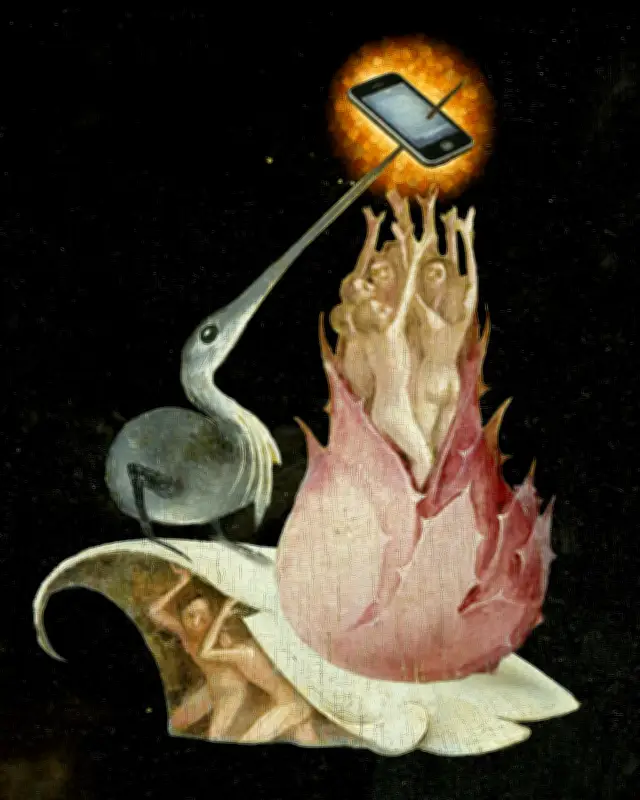
The Paradox of Modern Pleasure
For anyone with an Internet connection and a little discretionary income, the contemporary moment offers a superabundance of seductive distractions. Yet a pervasive mood of emptiness persists. Why are so many at once overstimulated and bored? Welcome to the era of decadence without pleasure.
The concept of decadence as a marker of cultural decline coinciding with high wealth has existed since ancient Greece and Rome. After Roman emperor Elagabalus took the throne at 14, he served flamingo brains, seasoned food with pearls, and, according to one account, smothered guests with rose petals. Nero had enemies sewn into animal skins and devoured by dogs. Decadence carries a pejorative ring, suggesting decay and excess.
Critics of decadence often hail from the political right, such as conservative columnist Ross Douthat in his 2020 book The Decadent Society or billionaire investor Peter Thiel’s complaints about faltering innovation. JD Vance warns of Rome’s fall in his memoir Communion. But leftist thinkers like Franco “Bifo” Berardi also worry about a “slow cancellation of the future”.

Decadence as Cultural Potential
Yet a passionate minority has found hope in decadence. Cultures later judged decadent produced extraordinary art, like Rococo painting before the French Revolution or Weimar Berlin’s experimental cinema. In the late 19th century, artists such as Oscar Wilde, Aubrey Beardsley, and Joris-Karl Huysmans developed styles championing extravagance and artifice. Their taboo-busting grotesquery protested against modern civilization’s inertia.
The decadents were not just provocateurs. They insisted pleasure was “useless”, enjoyed for its own sake. Essayist Walter Pater, a guiding light of English decadence, wrote in The Renaissance: “Not the fruit of experience, but experience itself, is the end.” Pater once stopped traffic to stroke a cat—for the sensation of fur beneath his fingers.
Today’s Shriveled Decadence
Today’s fixations mirror fin-de-siècle decadence but in technologically mediated forms. GLP-1s turn eating into a problem to be managed. Anti-ageing remedies and “looksmaxxing” turn self-styling into painful self-optimisation. AI restages artifice by outsourcing thinking to a machine butler. The problem is not that we are too decadent; we have inherited the surfaces—luxury, excess, artifice—but surrendered the commitment to pleasure.
The result is a culture where pleasure is subordinated to optimisation and replaced by numbing algorithmic stimulation. Quantity and speed cannot make up for the paradox: today’s decadence is often “meh” and oddly joyless. This spring, Amazon’s Chinese rival launched in the UK under the name Joybuy, promising emotional fulfilment.
The Looksmaxxing Era
Bryan Johnson, the tech tycoon behind the “Don’t Die” movement, has turned his quest for immortality into ascetic self-management. He avoids alcohol and sun, never goes out in the evening, subsists on lentils and broccoli, and swallows up to 111 pills daily. His fight against death costs $2m a year. Johnson resembles Duke Jean des Esseintes, the hero of Huysmans’s 1884 novel Against the Grain. Both are medically fragile and obsessed with sensation, but des Esseintes immerses in subtleties of sensation, while Johnson treats delight as suspect.
Johnson is not an anomaly. At Dr Sally Greenwald’s exclusive OB-GYN practice, nicknamed the “Billionaire’s Vagina Club”, middle-aged women improve their “sexspan” through bespoke advice and tracking devices. Greenwald says: “Sex equals sleep, stress reduction, cardiovascular engagement, relational fulfilment, and pelvic-floor health.”
These attitudes reflect a narrow elite obsessed with human enhancement. The class politics of pleasureless decadence: biohacking for the rich, algorithmic stimulation for the rest. In extreme inequality, rich people set terms for pleasure. The ruling class distrusts pleasure; what passes for fun among the top 0.001% amounts to 80-hour workweeks, $40,000 Equinox memberships, or courtside seats at Madison Square Garden.

GLP-1s and the Inhibition of Appetite
One in eight American adults report taking GLP-1 injectables for weight loss, according to a 2025 Gallup poll. The global market is expected to reach $190bn by 2035. While these medications confer real benefits, some users report diminished pleasure across areas of life: lethargy, decreased libido, emotional flatness. Fin-de-siècle decadence celebrated abundance, as in Aubrey Beardsley’s 1896 drawing The Fruit Bearers. Today’s anhedonic decadence celebrates inhibition of appetite.
Looksmaxxing, a subculture aimed at young men, treats the body as a site of correction. It rejects subjective taste for mathematical norms, measuring facial proportions. As Max Beerbohm wrote in 1894: “To make oneself beautiful is a universal instinct.” While fin-de-siècle decadents treated the face as a mask to play with, looksmaxxers recast it as a set of metrics requiring correction.
AI as the Pleasureless Decadence Machine
AI marks a triumph of artifice beyond old decadents’ imagination. Yet its productions—LinkedIn posts about entrepreneurship, cartoon soap operas—are hollow, with no felt experience behind them. AI is the pleasureless decadence machine. Algorithmic culture saturates with slop promising numbing stimulation. AI researchers warn of “human enfeeblement” as tech companies draw users into dependency.
Fin-de-siècle decadence was primarily literary, with language that affected readers viscerally. In contrast, LLMs leach language of pleasure by blandifying it, steering toward the predictable. Pleasure is central to how embodied beings perceive value. Philosopher Carissa Véliz writes in Prophecy: “There is no pleasure or pain for an AI, no skin in the game.” Without felt relation to pleasure, judgments of value become abstract.
Reclaiming Everyday Pleasures
Fin-de-siècle decadence offers lessons for today’s disembodied, tech-optimised world. The decadents were moody and morbid, but they were all too human. Wilde’s The Picture of Dorian Gray reflected society’s concealed desires. Decadence also appreciated female desire; the lesbian poets Michael Field turned an explicit female gaze on art history. In a poem on Leonardo’s Leda, they grant Leda power: “She draws the fondled creature to her will.” Their Saint Sebastian is a passive icon of masculine beauty.
Black and postcolonial artists have drawn from decadence. Bruce Nugent’s homoerotic story Smoke, Lilies and Jade opens with the Black hero Alex pondering Wilde’s remark that “a cigarette is the most perfect pleasure because it leaves one unsatisfied”. Alex meets a white man he calls Beauty, and they embrace. Enjoying forbidden pleasure is the ultimate decadent act.
A renewed, democratic decadence could revolt against optimisation. Every day acts of aesthetic perception—like Pater stopping traffic to stroke a cat—matter. So far, neodecadent energies appear in satirical entertainments like Saltburn or The White Lotus, which equate pleasure with status. But signs of something more original emerge: the sensuous cinema of Peter Strickland, Anish Kapoor’s blood-coloured sculptures, Shola von Reinhold’s Lote, John Corigliano’s opera The Lord of Cries. These offer materials for a New Decadence that could give pleasure back to people.
Walter Pater’s epicurean pleasure script asks: What effect does this produce on me? Does it give me pleasure? What sort or degree? Giving attention to what you feel is where real pleasure lies, so long as it harms no one else. “A counted number of pulses only is given to us of a variegated, dramatic life,” Pater writes. “Our one chance lies in expanding that interval, in getting as many pulsations as possible into the given time.” Against the pressure to optimise life, decadence commands: feel it.