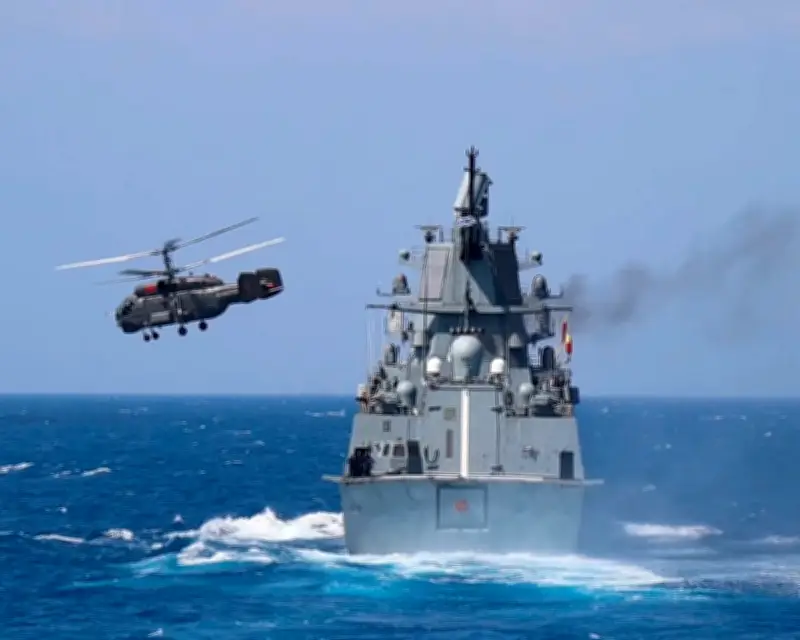
From the Strait of Hormuz to the North Sea, a global maritime war is raging, imperiling the centuries-old cooperation that underpins international law and free trade, according to foreign affairs commentator Simon Tisdall.
US campaign in Hormuz echoes 19th-century piracy patrols
The US military campaign to protect merchant shipping from Iranian attacks in the Strait of Hormuz mirrors a similar mission nearly 200 years ago. In 1825-27, a US naval squadron led by Commodore John Rodgers was sent to the Mediterranean to defend American ships from Greek corsairs. Then as now, the sole purpose was to protect US trade and business interests, not to support regime change.
Trump's equivocal stance on tolls undermines free sea doctrine
Although the US has not ratified the 1982 UN Convention on the Law of the Sea, it has historically upheld the principle of freedom of navigation, or mare liberum, developed by 17th-century Dutch jurist Hugo Grotius. US Secretary of State Marco Rubio declared in June that no country may charge tolls on international waterways. Yet President Donald Trump has suggested the US might impose tolls, and a recent memorandum of understanding with Iran accepts Iran's right to monetize transit through the Strait of Hormuz alongside Oman. This equivocal stance reflects a broader breakdown in the free sea consensus.

Copycat blockades and toll threats spread globally
The Hormuz standoff has inspired copycat actions. In Yemen, Iran-aligned Houthi militias have blockaded the Bab al-Mandab strait, striking two oil tankers this week and spooking energy markets. Indonesia is debating imposing tolls in the Strait of Malacca, through which 22% of global maritime shipping passes. Turkey might charge for passage through the Bosphorus, and Spain in the Strait of Gibraltar. About 80% of global traded goods by volume go by sea, threatening supply chains.
Clashes escalate in South China Sea and around Taiwan
Overt maritime clashes between regional rivals are increasing, particularly in the South China Sea and waters around Taiwan. China's creation of artificial islands on reefs and confrontations with neighbors like the Philippines are root causes. Beijing rejects the 2016 Permanent Court of Arbitration ruling that its sovereignty claim over most of the South China Sea lacks legal basis. Last week, a Chinese missile destroyer held a live-fire drill inside Japan's exclusive economic zone, 180 km from Okinotori island. Tensions rose after Japanese Prime Minister Sanae Takaichi suggested a Chinese bid to seize Taiwan could trigger a Japanese military response.
Russia expands hybrid maritime operations
A Russian frigate accompanied the Chinese warship off Japan, highlighting Russia's role. Russia's Black Sea fleet has suffered severe losses since 2022 due to Ukrainian missiles and drones. To compensate, Russia has expanded hybrid 'grey zone' operations against Ukraine's European allies, targeting Baltic undersea pipelines and cables. It has also stepped up activities in the North Atlantic, North Sea, and Channel, suspected of mapping underwater infrastructure for sabotage. On July 8, a Russian warship held a live-fire drill 70 nautical miles south of Plymouth, home of the Royal Navy. Last month, a Russian frigate fired warning shots near a private yacht off the Isle of Wight.
Global arms race accelerates as maritime lawlessness grows
Other incidents include the US sinking of an Iranian warship off Sri Lanka in March, a clash between Chinese and Philippine ships last week, Trump's threats to annex Greenland, and US bombing of civilian boats off Venezuela. A Chinese nuclear submarine test-fired a long-range ballistic missile in the South Pacific this month. This instability fuels an accelerating global arms race, pressuring the UK to increase defence spending, including upgrades to the Trident nuclear deterrent.
This many-fronted war of the sea tells a bigger story: the breakdown of maritime cooperation, international legal norms, and rules governing free trade, offshore defence, sovereignty, borders, fisheries, deep-sea mining, and environmental pollution. It reflects a world where powerful countries impose their will on weaker ones, abandoning the concept of global commons and shared space.