Spain's Railway System Faces Mounting Pressure Following Consecutive Tragic Accidents
The Spanish rail network finds itself at the centre of a national safety debate following a second serious incident within days, raising urgent questions about transport infrastructure across the country. This latest accident occurred near Barcelona, compounding the tragedy of a previous high-speed train collision that resulted in multiple fatalities.
Second Derailment in Catalonia Claims Young Driver's Life
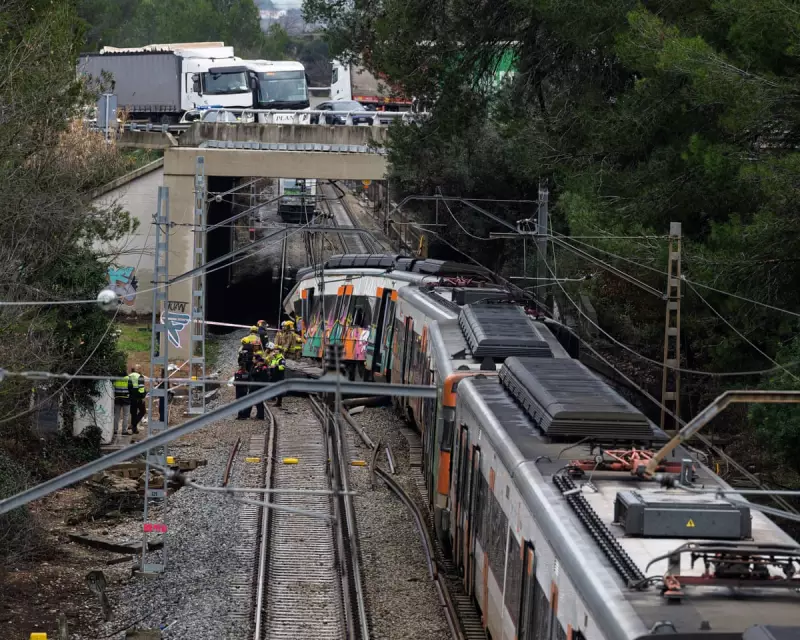
On Tuesday evening, approximately at 9pm, a retaining wall collapsed onto railway tracks near Gelida in Catalonia, north-eastern Spain. This structural failure caused a local commuter train to derail, resulting in one fatality and numerous injuries. The victim has been identified as Fernando Huerta, a 27-year-old trainee driver from Seville.
Emergency services reported that 41 people sustained injuries in the incident, with five individuals remaining in critical condition following the derailment. Preliminary investigations suggest that unusually heavy rainfall in the Catalonia region may have contributed to the wall's collapse, though official inquiries continue.
Network Shutdown Causes Widespread Disruption
As a precautionary measure following the Gelida accident, regional authorities took the significant step of shutting down Catalonia's entire rail network pending comprehensive safety inspections. This decision stranded hundreds of thousands of commuters and created substantial chaos on alternative transport routes, particularly affecting road networks during peak travel periods.
Earlier on the same Tuesday, another incident occurred when a train travelling along the Maresme coast north of Barcelona struck a rock on the tracks. While this caused minor injuries and temporary delays, the train was eventually able to continue its journey after assessment.
Union Calls for Immediate Safety Measures
In response to these consecutive incidents, Spain's largest train drivers' union, Semaf, has announced plans for an indefinite strike. The union demands urgent assurances regarding professional safety standards and infrastructure maintenance across the national rail system.
"We are going to demand criminal liability from those responsible for ensuring safety in the railway infrastructure," Semaf stated in an official communication. The union expressed its refusal to accept "the constant deterioration of the rail network" and called for "urgent new measures" to address safety concerns.
Previous High-Speed Tragedy Still Under Investigation
This latest accident follows Monday night's devastating collision between two trains near Adamuz, close to Córdoba in southern Spain. That incident resulted in at least 43 fatalities and 152 injuries, marking one of Spain's worst railway disasters in recent years.
Investigators examining the high-speed crash have revealed concerning details from the train's black box recorder. The driver of the Málaga to Madrid service alerted the control centre about technical difficulties moments before the collision, specifically mentioning an "enganchón" (a snag) near Adamuz.
According to train operator Adif, this issue related to the connection between the train's operating system and the overhead power source. Despite the driver following instructions to disconnect from the power source and requesting that oncoming trains be stopped, the collision occurred with a regional train travelling in the opposite direction.
Political Reactions and Safety Statistics
Spain's Transport Minister, Óscar Puente, has emphasised that the two accidents are "completely unrelated" despite their temporal proximity. However, opposition parties have seized upon the incidents to criticise the government's handling of transport infrastructure.
Alberto Núñez Feijóo, leader of the right-wing Popular Party, described the situation as "too much" and demanded immediate clarification regarding the state of Spain's railways. Meanwhile, Pepa Millán, spokesperson for the far-right Vox party, claimed that many Spaniards now feel "afraid to get on a train."
Despite these recent tragedies, European Union statistics indicate that Spain maintains one of Europe's safest rail networks. According to 2024 data, Spain recorded just one passenger fatality in rail accidents, compared to 20,000 deaths on European roads during the same period.
Broader Implications for Spanish Transport Infrastructure
These consecutive incidents have brought unprecedented attention to Spain's dual-track railway system. The country operates both the extensive, high-efficiency AVE high-speed network—spanning nearly 4,000 kilometres and largely developed with European Union funding—and various regional services that have historically faced challenges with reliability and funding.
The accidents have highlighted potential vulnerabilities in both systems, prompting calls for comprehensive safety reviews and infrastructure investment. As investigations continue into both the Gelida derailment and the Adamuz collision, Spain's transport authorities face mounting pressure to restore public confidence in the nation's rail network while addressing legitimate safety concerns raised by transport workers and political representatives.