Ukraine's Railway Network Under Sustained Attack
Russia has dramatically intensified its assaults on Ukraine's railway system, with attacks increasing threefold in recent months as Moscow attempts to cripple one of Kyiv's most vital logistical networks. According to senior Ukrainian officials, the escalation represents a strategic shift in targeting patterns, with trains and their drivers becoming primary objectives.
Systematic Destruction of Critical Infrastructure
Oleksii Kuleba, Ukraine's deputy prime minister for infrastructure, revealed alarming statistics about the scale of destruction. Since the beginning of 2025, there have been 800 separate attacks on railway infrastructure, damaging more than 3,000 railway objects and causing approximately $1 billion in losses. The most concerning development is the precise targeting of individual locomotives and their operators.
"If you compare just the last three months, attacks have increased three times over," Kuleba stated. "What we have seen in these escalating attacks is that they are going after trains, especially trying to kill the drivers."
The significance of Ukraine's rail network cannot be overstated. According to state statistics, the system carries more than 63% of the country's freight, including crucial grain exports, and handles 37% of passenger traffic. With civilian airports non-operational since Russia's full-scale invasion, the railways have become the primary means of transportation for both civilians and visiting foreign dignitaries.
Precision Strikes and Local Impact
Oleksandr Pertsovskyi, head of Ukrainian state railway Ukrzaliznytsia, highlighted the changing nature of the threat. "It's not just about the quantity of attacks, it's also the approach of the enemy forces," he explained. "Now, as they have very precise Shahed drones, they are targeting individual locomotives."
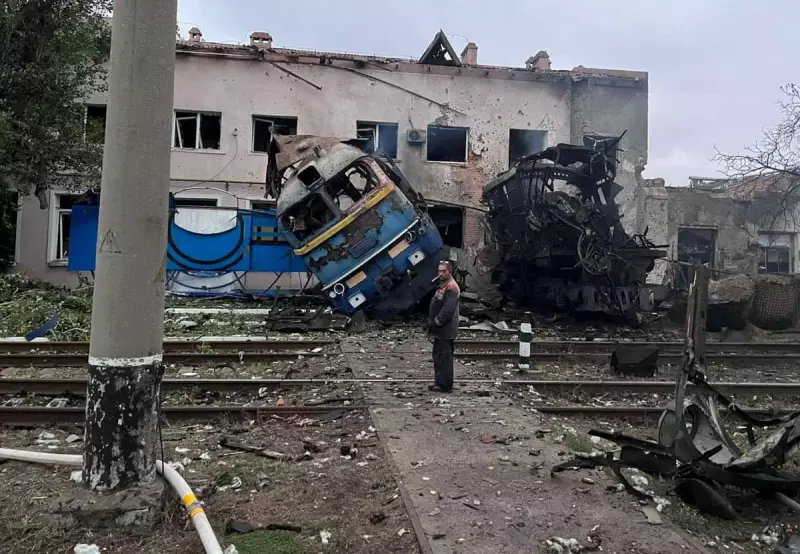
The human cost of these attacks was vividly illustrated by Tetyana Tkachenko, station head at Lozova in the Kharkiv region, where the main station building was severely damaged in a drone strike. "It was night and everyone was sleeping," she recalled. "I woke up from the huge explosion because I live very close to the station. It happened at 2.44am. There were five trains on the station."
Tkachenko explained why Lozova station represented such a strategic target: "Lozova is on a major junction. You can go in four directions, to Dnipro, to Sloviansk, Poltava and Kharkiv." These lines serve multiple critical functions, transporting passengers, freight, and military support, including evacuating wounded soldiers from eastern frontlines.
Defence Measures and Ongoing Vulnerabilities
Ukrainian authorities have implemented enhanced protective measures, including equipping trains with electronic counter-drone systems and training railway staff to operate dedicated air defence teams. Oleksandr Podvarchansky, responsible for tracks in the Lozova area, described the emergency protocols: "Every single air alarm, we have to stop and use a bomb shelter. If there is a train on the tracks we move it to the nearest station so people can evacuate."
Despite these efforts, vulnerabilities remain. Military expert Serhii Beskrestnov noted that trains present ideal targets for drones due to their predictable routes and relatively slow speeds. As Russian drone technology advances, with increased range and sophistication, more of Ukraine's railway network falls within striking distance.
Kuleba identified three primary Russian objectives: destroying southern logistics to prevent goods reaching seaports, disrupting rail traffic near frontlines in Chernihiv and Sumy regions, and comprehensive destruction in the industrial Donbas heartland.
The situation presents a grim paradox: while damaged tracks can often be repaired within a day, the systematic destruction of rolling stock poses a more fundamental threat. As Beskrestnov warned: "If the Russians keep hitting diesel and electric locomotives, the time will come very soon when the track will still be intact but we'll have nothing left to run on it."