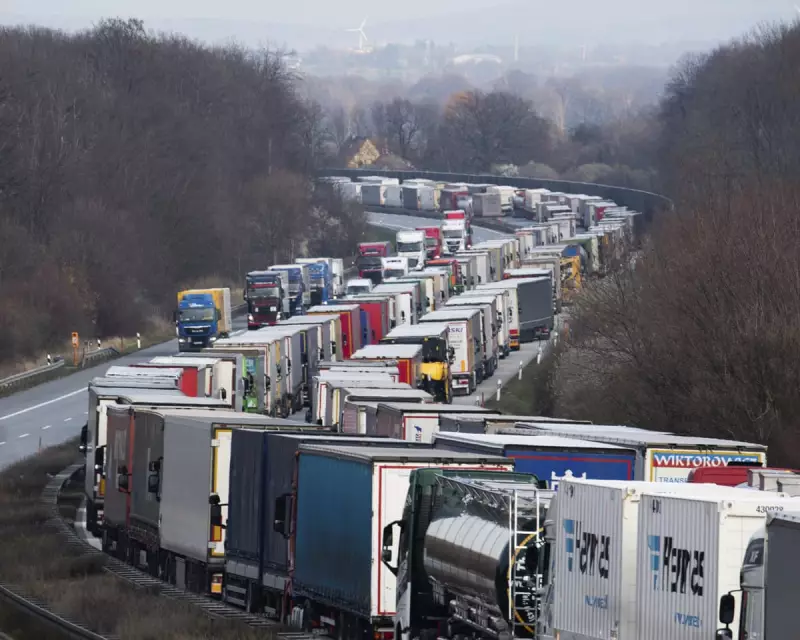
The European Union's ambitious plan to decarbonise its freight transport sector is in a "dire" situation, according to a stark warning from the continent's leading automotive industry body. The European Automobile Manufacturers' Association (ACEA) has revealed that a mere fraction of the trucks delivering goods across the bloc are zero-emission vehicles, putting legally binding climate targets at severe risk.
A Stark Reality Check for Green Freight
Christian Levin, chair of ACEA's commercial vehicles board, issued the sobering assessment as the European Commission considers softening targets for electric cars. He called for an immediate and urgent review of the trucking sector's specific challenges. The core of the problem is a glaring mismatch between regulatory ambition and on-the-ground reality.
Out of approximately 6 million trucks operating within the EU, only around 10,000 are electric, and these are predominantly confined to short, predictable routes. The commercial vehicle sector is now demanding a comprehensive market audit, mirroring the Commission's review of the car industry, to address fundamental barriers.
The Crippling Cost and Infrastructure Gap
Levin highlighted the prohibitive financial burden facing fleet managers. An electric 40-tonne truck carries a price tag of roughly €300,000, which is double the cost of its diesel equivalent. For businesses operating on razor-thin margins of 2-3%, this makes the transition economically unviable without significant support.
"The main reason customers are holding back is they just see it's more expensive to operate a battery electric vehicle," Levin explained. He cited concerns over flexibility, residual value risks, and the danger of being unable to fulfil a transport assignment if charging infrastructure is absent on a new route.
Karin Rådström, chair of the board of management at Daimler Truck, underscored the catastrophic lack of public charging points for Heavy Goods Vehicles (HGVs). Europe currently has only about 1,500 public HGV charging points, but Rådström stated that 35,000 are needed to enable the transition—a rate of about 500 installations per month.
"I've been chief executive of Daimler Truck now for 14 months, and I think in total, during these 14 months, there were less than 500 built," she said, illustrating the monumental scale of the acceleration required. The UK's situation was highlighted as particularly acute, with reports last year indicating just one public HGV charging point in the entire country.
Billions in Fines Loom Without Intervention
The current EU CO2 targets for manufacturers are stringent: 43% of new heavy trucks must be zero-emission by 2030, rising to 65% by 2035 and 90% by 2040. Failure to meet these fleet-wide averages results in heavy fines. With electrically chargeable trucks accounting for fewer than 2% of new HGV registrations, the industry is on a collision course with these regulations.
Levin projected that if the current low uptake trajectory continues, the truck manufacturing industry could face annual fines totalling around €2 billion. Sigrid de Vries, director general of ACEA, urged the Commission to initiate an early review of the targets. The goal is to align the sector's obligations with the "enabling conditions"—like charging infrastructure and financial incentives—that are currently not in place.
The collective message from industry leaders is clear: without a rapid and coordinated push to address sky-high costs, a crippling lack of infrastructure, and the absence of meaningful tax breaks, the EU's green freight revolution will stall before it ever gets moving.