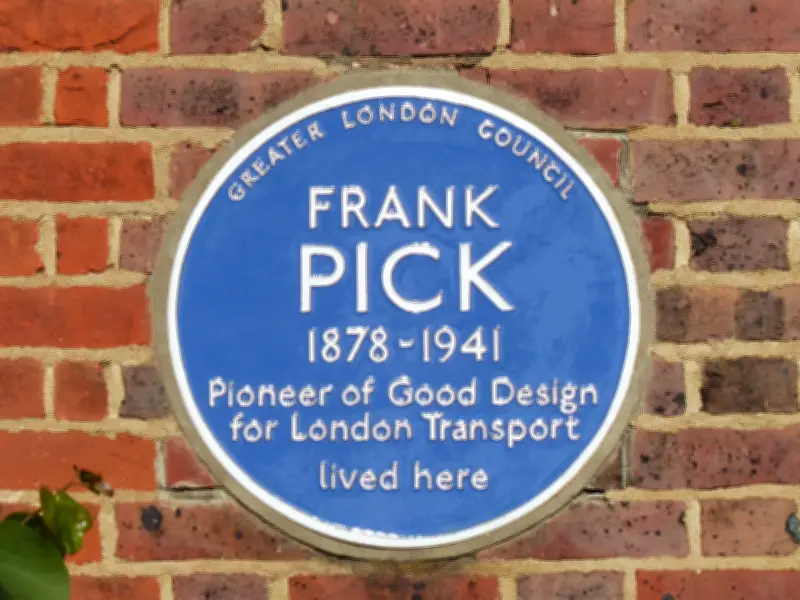
The former Hampstead home of Frank Pick, the visionary manager who shaped the identity of London's Tube network, now bears a blue plaque. Attached to a house in Wildwood Road, Hampstead Garden Suburb, it reads: "Frank Pick Pioneer of Good Design for London Transport lived here."
Commuters using the Tube today may take for granted the familiar roundel marking each station, the Johnston font used in signs across the network, or the patterned upholstery on trains, buses and trams. But everywhere you travel — not least passing through 1920s and 30s stations such as the circular ticket hall at Piccadilly Circus — you can see the influence of Frank Pick.
Early Career and Rise at the Underground
Born in Lincolnshire in 1878, Pick joined the North Eastern Railway in 1902 as a trainee manager, later becoming personal assistant to its general manager, Sir George Gibb. When Gibb became managing director of the Underground Electric Railways Company of London in 1906, he invited Pick to join him. The company — known as the Underground Group — had taken over the debt-ridden District Railway and was opening three deep-level Tube lines which by 1907 were in serious financial trouble.
The future of the London Underground was very much in the balance when Albert Stanley, later Lord Ashfield, took over in a last-ditch bid to save the business. He gave his staff six months to turn the company around — and crucially gave Pick freedom to develop his ideas about publicity. Despite no previous experience, Pick quickly introduced eye-catching posters to encourage people to travel, then turned his attention to stations, signs and branding.
Shaping the Network and Brand
One of his first initiatives in 1908 was to help create a coordinated network to increase ticket sales, allowing passengers to buy tickets across the different operating companies and introducing colour-coded maps to show the whole network. He started a Traffic Development and Advertising Department for the Underground Group and became its commercial manager in 1912. Pick changed transport poster design by moving away from words to images which promoted the many London attractions that could be reached by Underground. Designed by leading artists, they showed theatres, zoos and parks were within reach of London travellers.
He was also involved in shaping the transport network. When the Underground Group took over the London General Omnibus Company in 1912, he helped plan and promote bus and Underground services, walking miles to study existing routes and consider where people might travel. His work led to new bus routes, services and links between buses and Underground stations which were advertised on posters and became popular with commuters.
Standardising the Roundel and Johnston Typeface
Pick was also keen to give the Underground a recognisable identity and began testing a new typeface to be used across the network, replacing the different styles used by separate companies. In 1913 calligrapher Edward Johnston was asked to create an official typeface which became known as Underground Railway Block, and later simply as Johnston. An updated version, Johnston100, is still used exclusively by Transport for London. He also worked to standardise — writing an exact specification of standard proportions, colours and lettering that remains in use today.
During the 1920s and 1930s, the Underground expanded and it was Pick who selected architect Charles Holden to design practical, easy-to-use stations including a new entrance for Westminster station in 1922, stations on the Morden extension of the Northern line in 1926, and stations for the Piccadilly line extensions between 1931 and 1933. Pick also commissioned established and new textile designers to create branded moquette, the patterned upholstery still used on seating today.
Later Career and Lasting Legacy
By 1928 he had risen to become managing director of the Underground Electric Railways Company of London. As the Second World War approached, he helped organise London Transport's role in the mass evacuation of civilians, but he quit London Transport in 1940 after a disagreement with Lord Ashfield over government involvement in its finances. For a brief but unhappy spell he became director general of the Ministry of Information — but clashed with prime minister Winston Churchill after refusing to distribute false propaganda in Germany.
Pick died suddenly at his Hampstead home shortly after retiring in 1941. But his legacy lives on in the look and feel of London's iconic transport system, with the blue plaque now marking the house where he lived and died in 1941, ensuring his contributions are remembered by future generations.