The Desperate Search for Mexico's Disappeared
In the western Mexican state of Jalisco, a traffic junction plastered with photographs of missing people has become known locally as the 'roundabout of the disappeared'. This poignant renaming reflects a national tragedy: more than 100,000 people are officially recorded as missing across Mexico, with the true number likely even higher due to widespread fear of reporting cases to authorities.
Most of these disappearances connect directly to Mexico's brutal drug crisis, with organised crime groups and drug cartels believed responsible for the majority of abductions. For families like Guadalupe Ayala's, whose 25-year-old son Alfredo Ezequiel Campos was taken from his Tlajomulco home six years ago, the search for answers continues despite constant danger.
Innovative Forensic Methods Bring Hope
In a groundbreaking effort to accelerate searches and reduce risks for relatives, the Jalisco Search Commission has launched the Found project in collaboration with mother collectives and international universities including Oxford. The initiative employs unconventional methods including pig carcasses, drone technology and artificial intelligence to locate clandestine burial sites.
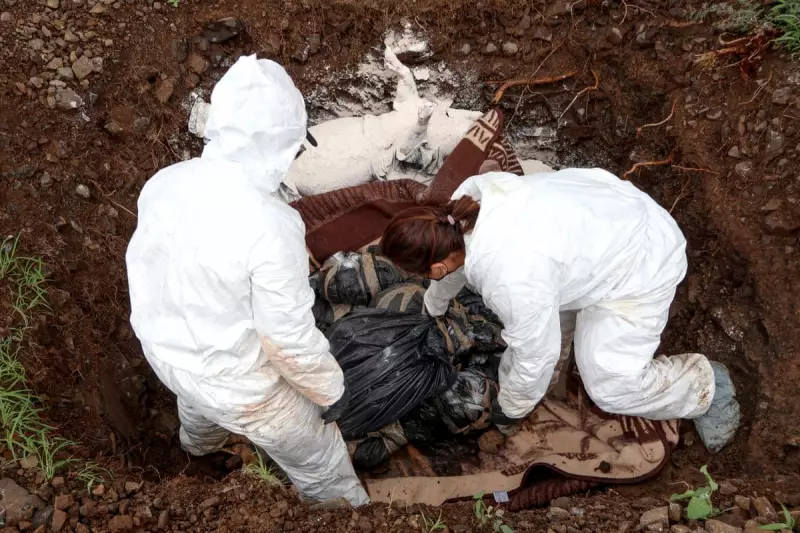
At the University of Guadalajara, forensic scientists have buried numerous pig carcasses across sixteen experimental plots, carefully replicating various conditions in which real victims might be concealed. The scenarios include bodies wrapped in blankets, dismembered remains, cremated ashes, and burials covered with stones, with two control plots left empty for comparison.
Pigs provide ideal human analogues due to their anatomical, genetic and physiological similarities to people, explains Tunuari Roberto Chávez Gonzalez of the Jalisco Search Commission. Researchers have already observed distinct vegetation patterns emerging above the burial sites, with plants appearing immediately above pigs wrapped in blankets. 'Even though the ground might be dry, the blanket retains water,' notes Gonzalez.
Technology and Traditional Knowledge Combine
The scientific approach extends beyond pig burials to include advanced geophysical technology. Researchers employ electrical resistivity tomography, which creates subsurface soil images by measuring voltage variations, and drones equipped with multispectral cameras that detect soil substances indicating decomposition, such as nitrogen and potassium.
These methods have proven remarkably effective. During a search at an abandoned Zapopan house where criminal groups operated, a mothers' collective initially discovered about four bags containing human remains. Using electrical resistance technology, the Jalisco Search Commission quickly located 29 additional bags and three complete bodies within hours.
Traditional knowledge from years of searching also contributes valuable insights. Volunteer searchers have identified that cartels frequently dig graves near specific tree types—huisaches (sweet acacia) and mesquites—which provide digging shade while their taproots grow downward rather than spreading horizontally to obstruct excavation.
Tragic Closure and Continuing Crisis
For Guadalupe Ayala, the search for her son reached a devastating conclusion when the Fundej collective discovered four arms, with forensic analysis confirming one belonged to Alfredo. Further body parts emerged over subsequent months.
'When you finally find the person and find them segmented like that, that's the worst nightmare,' Ayala recounts. 'You wonder how he was tortured, how was his death?' The coroner's report revealed her son had been exposed to extreme cold before death, a detail that caused particular distress.
While welcoming technological advances that accelerate discoveries, Víctor Hugo Ávila Barrientos, a Jalisco state commissioner, acknowledges these methods don't address the root cause. 'Even if I had a thousand searchers, it's going to keep growing if we don't prevent deaths from happening,' he states. 'But in the meantime, we hope to develop the expertise to find those who do disappear as soon as possible.'