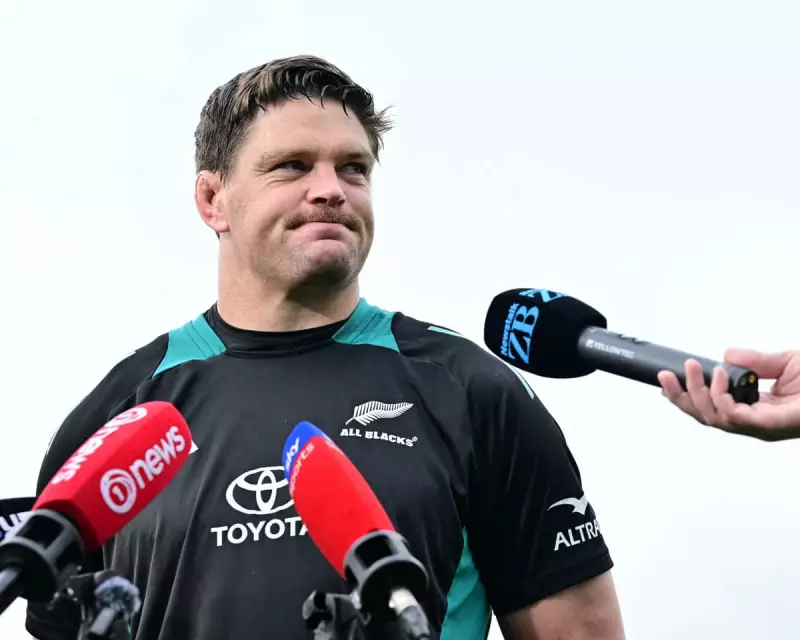
The landscape of international rugby has shifted dramatically for New Zealand's All Blacks, who find themselves in the unfamiliar position of playing second fiddle to South Africa's Springboks. Under new captain Scott Barrett, the team navigates what many are calling their 'Beta' phase after decades of Alpha dominance in world rugby.
A Changing of the Guard
During a recent training session at the Lensbury hotel on the banks of the Thames, the atmosphere appeared relaxed on a warm autumn day. Will Jordan practised catching high balls while Beauden Barrett took shots at goal, but beneath the surface calm lies a team undergoing significant transformation. Head coach Scott Robertson represents a clean break from two decades of consistent leadership, moving away from the patriarchal style of his predecessors Ian Foster, Steve Hansen, and Graham Henry.
When asked if his team aimed to make a statement performance against England, Robertson's response revealed much about the new reality: "A statement performance? We're just looking for a result." This marks a stark contrast to the era when every All Blacks appearance automatically constituted a statement, and victories were expectations rather than aspirations.

The Experience Drain to Japan
The most significant challenge facing the current squad is the exodus of experienced players to Japanese club rugby. Following their most recent World Cup final appearance, eight senior players departed. While some like Sam Whitelock, Aaron Smith, and Dane Coles reached retirement age, others including Brodie Retallick (33), Sam Cane (33), Richie Mo'unga (31), and Shannon Frizell (31) should theoretically have years of Test rugby remaining.
The statistics reveal the stark reality of this experience gap. The World Cup final squad boasted 1,387 caps collectively, while the team selected to face England carries only 984 caps. More concerning is how this experience is distributed - well over a third belongs to just three players: Barrett, Savea, and Codie Taylor. The situation has been exacerbated by injuries to key players including Jordie Barrett, Patrick Tuipulotu, Dalton Papali'i, Tupou Vaa'i, and Ofa Tu'ungafasi.
Structural Challenges and South African Contrast
New Zealand's predicament highlights a fundamental structural difference between their approach and South Africa's. Springboks coach Rassie Erasmus enjoys complete freedom to select players regardless of their club affiliations worldwide, while Robertson must contend with New Zealand Rugby's domestic-focused selection policies.
With over 100 New Zealanders now playing in Japan's top three divisions, the financial appeal is undeniable - shorter seasons and higher salaries prove irresistible to many players. While the union understandably seeks to protect domestic competitions, this comes at the expense of national team strength. The recent 43-point thrashing by South Africa in Wellington, representing the largest-ever home defeat for the All Blacks, underscores the consequences of this policy.
Despite back-to-back victories against Australia, Ireland, and Scotland providing some consolation, the All Blacks now operate in a new reality where they're no longer the automatic top dogs of world rugby. The aura of invincibility that once surrounded them has diminished, replaced by a more vulnerable, transitional team finding its way in a changed competitive landscape.