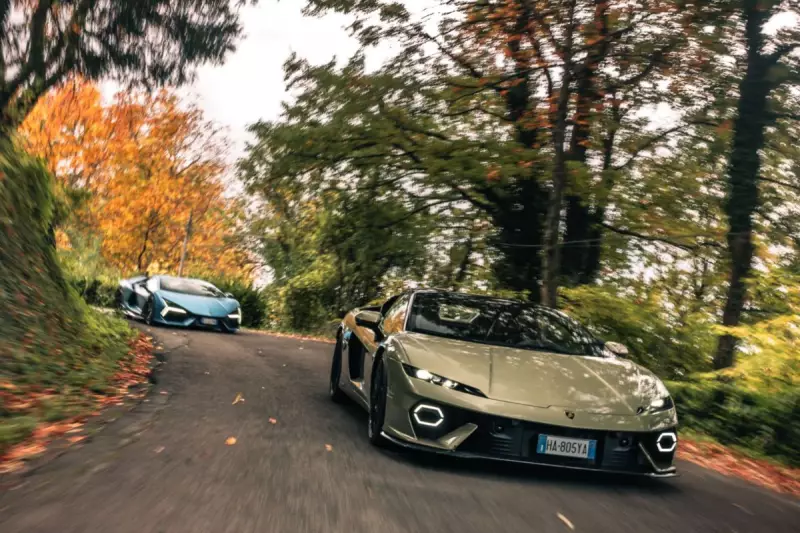
After years of anticipation, the moment of truth has arrived. On Monday 10 November 2025, I finally slipped behind the wheel of the Lamborghini Temerario - the car I've been most excited to drive all year. Following a Zoom call with the chief designer last summer and a technical preview in London twelve months ago, I thought I knew this machine inside out. Yet sitting here in Sant'Agata Bolognese, I'm filled with uncertainty about what to expect.
Filling The Huracan's Shoes
The Temerario faces an enormous challenge: replacing the best-selling Lamborghini supercar of all time. Its predecessor, the Huracan, achieved remarkable success with over 20,000 units sold during its decade-long production run. Rather than sticking to the same winning formula, Lamborghini has taken a radical new approach.
Gone is the Huracan's beloved naturally aspirated V10, replaced by a twin-turbocharged V8 supported by three electric motors. The specifications are staggering: 920 horsepower, 0-62mph in 2.7 seconds, and a top speed of 213mph. But raw numbers only tell part of the story - the true test lies in how this hybrid powertrain performs on the road.
Inside Lamborghini's Sant'Agata Headquarters
Before hitting public roads (all previous drives have been track-only), I received privileged access to Lamborghini's headquarters. For someone who grew up with Countach and Diablo posters adorning their bedroom walls, this experience felt genuinely magical.
Our tour began in the heavily guarded Centro Stile design studio, where the futuristic Manifesto concept car takes centre stage. Using Apple Vision Pro goggles, I explored the Temerario's technology through augmented reality. One command made the body panels transparent, revealing the aluminium spaceframe beneath. Another displayed the intricate workings of the V8 engine and electric front axle. Moving graphics illustrated downforce and drag using real computational fluid dynamics data from wind tunnel testing.
Next came the Ad Personam customisation studio, where more than 25% of new Lamborghinis now receive some level of personalisation. This service represents a major revenue stream, competing directly with Ferrari's Tailor Made and McLaren's MSO programmes. The most extravagant option ordered to date? Custom paint mixed with real diamond dust, costing £220,000 plus tax.
The final stop was the super sports car production facility, where both the Revuelto and Temerario are assembled on the same line at a rate of 20 vehicles per day. Despite this output, the order bank already stretches to mid-2027, meaning buyers face a significant wait for delivery.
Design That Demands Attention
When design chief Mitja Borkert first showed me Temerario sketches, I remained unconvinced. Seeing the finished car in metal completely changed my perspective. This aggressively angled wedge successfully achieves Borkert's ambition to "give adrenaline a shape".
The profile follows classic 'Gandini lines' that have defined mid-engined Lamborghinis since the Countach. Hexagonal daytime running lights pay homage to Marcello Gandini's 1967 Marzal concept. While the front aspect appears somewhat generic, the rear view proves far more distinctive with wings that cut away to reveal the 325/30 ZR21 rear tyre tread patterns. The high-mounted central hexagonal exhaust resembles a superbike's tailpipe.
Unlike its Revuelto sibling, the Temerario features conventional doors rather than upward-opening 'Lambo doors'. Handles hide within side scoops that channel air to the mid-mounted V8 - essential given this engine's incredible 10,000rpm redline.
Engineering Excellence
That screaming V8 represents a significant engineering achievement. While the Huracan's 5.2-litre V10 reached 8,500rpm, this new powerplant soars to five figures. Importantly, it shares nothing with the Urus SUV's V8, featuring an aluminium block, titanium conrods and a flat-plane crankshaft.
The internal combustion engine alone generates 800hp at 9,000rpm, with the remaining 120hp coming from a 3.8kWh battery and three axial-flux electric motors. The front axle uses two motors for active torque vectoring, while the rear wheels are driven by a transversely mounted eight-speed dual-clutch gearbox. Though electric-only range barely reaches five miles, the car defaults to EV mode on start-up, helping achieve 25.2mpg and 272g/km CO2 emissions in official tests.
Chassis components include double wishbone suspension and massive carbon-ceramic brakes with 10-piston front calipers. The Temerario weighs 1,690kg without fluids - approximately 300kg heavier than the Huracan due to its hybrid system.
Transformed Interior Experience
Whatever debates surround the new powertrain, the Temerario's cabin represents a substantial improvement. Occupants benefit from 34mm more headroom and 46mm additional legroom, while material quality takes a noticeable step forward. Luggage capacity proves surprisingly practical for a mid-engined supercar, with a deep front trunk and narrow storage behind the seats.
The driver and passenger each get their own digital display, complemented by an 8.4-inch central touchscreen. The steering wheel incorporates four rotary controllers for adjusting hybrid settings and suspension stiffness. Slim, tactile shift paddles and the traditional Lamborghini 'bomb switch' starter button complete the cockpit. An optional telemetry system with three cameras records driving performance, allowing videos to be shared via the Lamborghini Unica app - though given this car's capabilities, owners should think carefully before posting incriminating evidence.
On The Road: Taming The Beast
Initially, the Temerario feels surprisingly subdued. Unlike the Huracan's thunderous V10 announcement, the new V8 remains relatively quiet at low speeds. Navigating industrial towns around Sant'Agata, it sounds almost ordinary.
Everything changes as urban landscapes give way to autumnal Apennine mountain roads. With space to explore the upper rev range, the Temerario transforms. Acceleration builds linearly then becomes frenzied beyond 7,000rpm, accompanied by a hard-edged metallic scream. Initially, I found myself changing gear around 8,000rpm out of habit, but holding nerve until the 10,000rpm limiter delivers the unhinged experience Lamborghini enthusiasts crave.
Driving in convoy through winding mountain passes, the Temerario feels balanced and agile. Sport mode offers the most playful handling, while Corsa mode prioritises lap times. A drift dial even lets drivers adjust their angle of attack. The steering feels lighter than I'd prefer, but gearshifts occur with whipcrack speed and the brakes inspire absolute confidence.
In tight corners, torque vectoring pulls the car toward the apex before instant electric torque slingshots it onward. Turbo lag is completely absent. Though the extra weight compared to the Huracan remains noticeable, harder, faster Performante- or STO-style variants will likely follow. Interestingly, the Temerario GT3 racer foregoes hybrid technology and four-wheel drive, potentially influencing future road cars.
Verdict: Evolution Or Revolution?
The Huracan and its Audi R8 sibling featured arguably the most exciting road-legal engine of the modern era, but emissions and noise regulations doomed the V10. Given these constraints, Lamborghini's achievement in creating a 10,000rpm V8 seems remarkable. As one insider noted: "We must meet Volkswagen Group quality standards. Lamborghini performs all the same durability tests as VW does on a new Golf."
Both the Ferrari 296 GTB and McLaren Artura deliver purer driving experiences, but the Lamborghini counters with a more powerful and exciting engine. If you have £260,035 to spend on a supercar (closer to £300,000 with options), the Temerario deserves serious consideration.
Is it more thrilling than a Huracan? At the limit, perhaps, but the older car always felt like a live grenade, even at idle. The Temerario offers greater sophistication and betters its predecessor in most objective measures. For driving enthusiasts, however, its ultimate incarnation may still await.