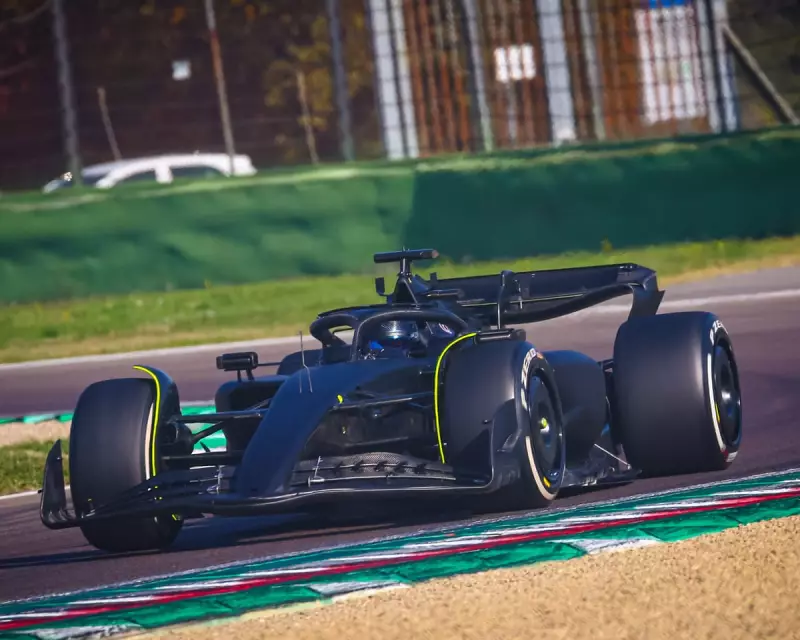
In a remarkable undertaking that echoes the ambition of NASA's Apollo moon landing, Cadillac is racing against the clock to construct a Formula One team from nothing, with their debut in Melbourne now just over 100 days away. The American automotive giant received its official F1 entry at last year's Las Vegas Grand Prix, triggering a monumental effort to be ready for the 2026 season opener.
The NASA Blueprint for F1 Success
Cadillac's team principal, Graeme Lowdon, has openly compared the frantic project to the historic Apollo mission, acknowledging the immense pressure of the super-short timeline. While they may not be putting a man on the moon, the challenge of creating a competitive F1 outfit in under three years feels equally daunting. At the heart of this endeavour is Chief Technical Officer Nick Chester, who joined in March 2023, a time when the team lacked even an approved entry.
"You can have five minutes looking back at what you’ve done and go: ‘Wow, isn’t this fantastic what we’ve done in less than three years,’" Chester reflects. "And then the next minute you think: ‘Yeah, we’ve still got quite a lot to do.’" Chester, a veteran of Fernando Alonso's title-winning years at Renault, confirms that building an F1 team from the ground up is a unique opportunity, unparalleled in his career.
A Driver Line-Up Built on Experience
In a major coup for the new team, Cadillac secured the services of two highly experienced drivers in August. Sergio Pérez, currently with Red Bull, and Valtteri Bottas, formerly of Mercedes, will lead the charge in 2026. Their knowledge of what it takes to succeed at the sport's pinnacle is considered invaluable.
Bottas struck a note of realistic optimism about the task ahead: "Of course, we’re realistic. There’s going to be a mountain of work to do, and it’s going to be probably a difficult start, because it is F1. But we’re not there to stay at the back. I believe with this structure, with this group, these people, there’s no reason why we shouldn’t be able to get relatively quickly up to the pace and enjoy some success."
The team has also signed 25-year-old Californian IndyCar winner Colton Herta as a test driver, with a view to him earning a race seat, a move that could significantly boost F1's popularity in the US.
A Radical Management Structure
To achieve this ambitious goal, Cadillac has torn up the traditional F1 team management book. Instead of a hierarchical system, they have adopted a flat management structure modelled directly on NASA's Apollo project. This approach empowers individuals and teams across different locations—including their Silverstone base, a new HQ in Indianapolis, and GM's engine facility in Charlotte—to work autonomously and solve problems quickly.
"If you have to go through a process where someone has a problem and they raise it up to their manager, that manager talks to a manager somewhere else, it goes back down the chain, it’s super slow," explains Chester. "So we empower people to really get on with it. Moving away from management approval for everything is so much cleaner and quicker."
This cultural shift is supported by rapid recruitment, with headcount now exceeding 400 people and on track to reach a target of 600. The team will initially run with Ferrari power units until their own GM-built engine is ready for the 2029 season.
While expectations are being managed, with the team acknowledging that simply making the grid is an achievement, the ambition is clear. "The first thing we want to show is that we should be there," Chester states. The success of this all-American venture will be closely watched, not just by motorsport fans, but by F1's commercial bosses, who see it as a key to unlocking exponential growth in the valuable US market.