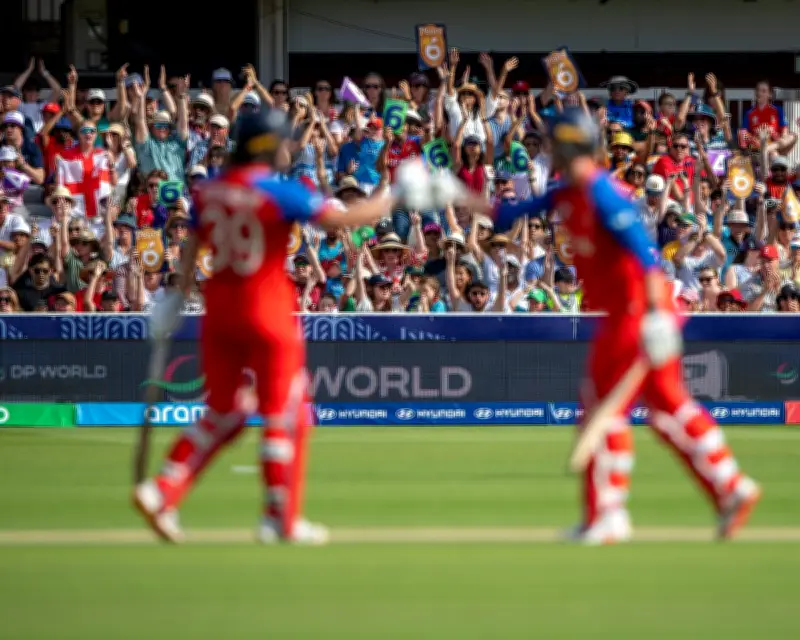
Record-breaking T20 World Cup highlights surge in women's cricket
The International Cricket Council (ICC) chief executive, Sanjog Gupta, has declared that women's cricket is growing faster than the men's game in many regions, citing record attendance and viewership figures from the recent T20 World Cup. The tournament, held in England, attracted 245,815 spectators, smashing the previous attendance record by over 100,000. The final at Lord's, a sellout with 28,887 fans paying up to £60, generated over £1 million in ticket sales, making it the highest-grossing women's cricket match in history.
UK rights holder Sky Sports reported more than 15 million viewer hours during the competition. In India, the group-stage match between India and Pakistan drew over 25 million viewers on JioHotstar, generating 1.1 billion minutes of watch time—a figure larger than the cumulative viewership for the entire T20 World Cup two years ago.
Gupta: 'Era-defining' shift in global cricket
Gupta described the growth as 'era-defining,' noting that women's World Cups now hold as much significance for the Indian market as the 1983 men's World Cup did. He highlighted cricket's appeal in non-traditional markets, such as Brazil, where women are gravitating toward the sport as a means of finding identity and belonging. 'In emerging markets, women's cricket is playing the leading role in driving participation and elevating performance standards,' Gupta said. 'The ranking of women's teams in these countries is often higher than the men's teams, creating a virtuous circle.'
The T20 World Cup expanded to 12 teams this year, with plans to grow to 16 by 2030. The first Women's Champions Trophy will take place in Sri Lanka next year, aligning the women's game with the men's four-year global tournament cycle for the first time.
Financial disparities and scheduling challenges
Despite the success, Gupta acknowledged challenges, including the financial dominance of India's Board of Control for Cricket in India (BCCI), which receives 40% of ICC revenues, compared to just 4% for the West Indies. West Indies captain Hayley Matthews criticized this inequality after her team's semi-final defeat to Australia.
Scheduling also raised integrity concerns, as a fixed draw guaranteed India a place in the first semi-final had they progressed, despite their group-stage elimination. Gupta defended such accommodations, stating they are necessary to balance global and local audiences. 'We always look to balance the global viewing audience with the audience in countries hosting the event,' he said. 'That's why one semi-final was pre-decided for a time slot available in prime time in South Asia.'
For the next tournament in Australia in 2028, similar scheduling will be implemented. Gupta noted that during the men's T20 World Cup, India accounted for 60% of global TV viewership, underscoring the importance of the Indian market.