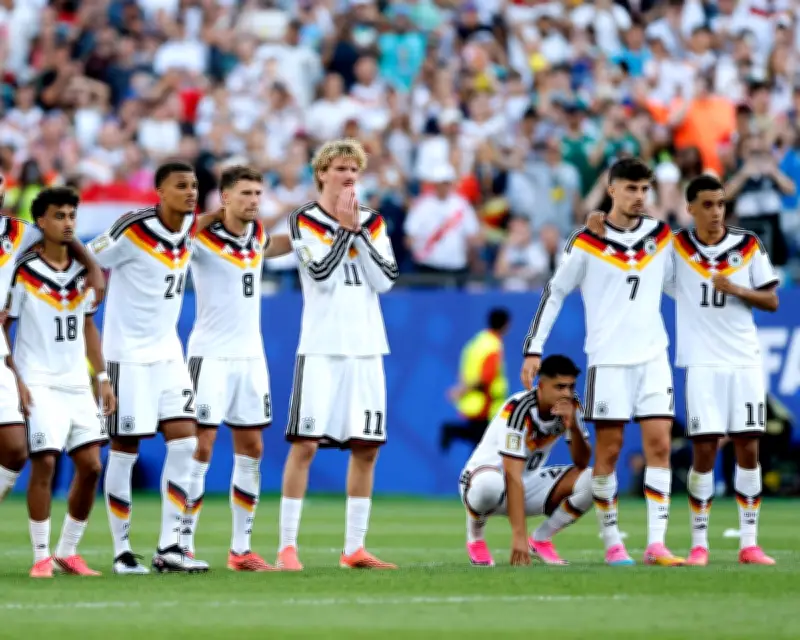
Germany have been eliminated early from a World Cup for the third time in a row, a stunning failure that former captain Philipp Lahm attributes not to a lack of talent but to a fundamental lack of identity and continuity. Since winning the tournament in 2014, Germany have not won a single World Cup knockout match.
Lack of continuity and clear playing style
Lahm, writing in a column produced with German online magazine Die Zeit, said: 'I am stunned. Germany have been eliminated early from a World Cup for the third time in a row. I need time to recover from this. The key word that needs to be discussed is continuity – something the national team have lacked for a decade.' He argued that German football has not decided how it wants to play, with constantly new ideas and new players in new positions under coach Julian Nagelsmann, who experimented too much.
'Germany have always been successful when player roles were clearly defined, the hierarchy was established and the team had a clear concept of how to attack and defend. That conviction was completely missing,' Lahm wrote. He noted that at this World Cup, the team did not look as if they had undergone the necessary process, lacking control in building play from the back and keeping possession.
Germany no longer a tournament team
Germany used to be known as a Turniermannschaft ('tournament team'), finding rhythm as the tournament progressed. 'Those days are gone,' Lahm said. 'This time, the team got worse from game to game.' He criticised Nagelsmann for abandoning promising approaches that worked, such as using Deniz Undav as an impact substitute, only to deviate from that strategy against Paraguay.
Lahm offered specific tactical critiques: Joshua Kimmich should have played in midfield for the national team as he does for Bayern Munich, and Florian Wirtz should have played centrally behind Kai Havertz consistently, rather than being moved around. 'Nagelsmann likes to change systems and formations. That is his style, he says. Yet great teams such as Spain or France always play according to the same pattern,' Lahm wrote.
Nagelsmann's changes and team response
Lahm questioned Nagelsmann's changes, including using a different formation against Ecuador in the final group match than against Paraguay in the last 32. 'Like many things, I didn't understand that move. Every change sends a message to the team – a message that needs to be understood,' he said.
Despite the failure, Lahm found hope in the team's unity. 'When faced with failure, the players didn't turn on one another; the team protected their own.' He cited Antonio Rüdiger praising Jonathan Tah and Nico Schlotterbeck, Havertz raving about Undav, and Kimmich standing up for both Leroy Sané and Nagelsmann. 'That is something to build on.'
System players and leadership
Lahm defended the players against accusations of lacking attitude, noting that in 2018 the World Cup-winning generation performed disastrously, but not in 2022 and 2026. He described today's generation as 'system players' who came through youth academies, viewing football as a profession since age 12 or 13. 'It is hard to keep pace with all that. That is where leadership is required.'
He criticised the tendency to fall back on 2014 World Cup winners, such as Manuel Neuer, which signals a lack of faith in the current generation. Lahm pointed to Argentina and France, who built teams around established stars like Lionel Messi and Kylian Mbappé, while maintaining order and security under their coaches.
Fundamental issues before naming successors
Lahm noted that three consecutive Germany coaches – Joachim Löw, Hansi Flick and Julian Nagelsmann – have failed at World Cups. He does not see a problem with the players, citing individuals playing for top European clubs: Rüdiger at Real Madrid, Wirtz at Liverpool after a huge transfer, Havertz at Arsenal, Musiala with world-class potential, and Kimmich at Bayern. 'Only France possess more talent than Germany,' he wrote.
But he stressed that before discussing Nagelsmann or potential successors, fundamental issues must be clarified. 'German football needs to decide how it wants to play. Are we Spain? Are we Argentina? Are we France? No, we are Germany. We have our own culture, our own brand of football. We should reconnect with our identity.'