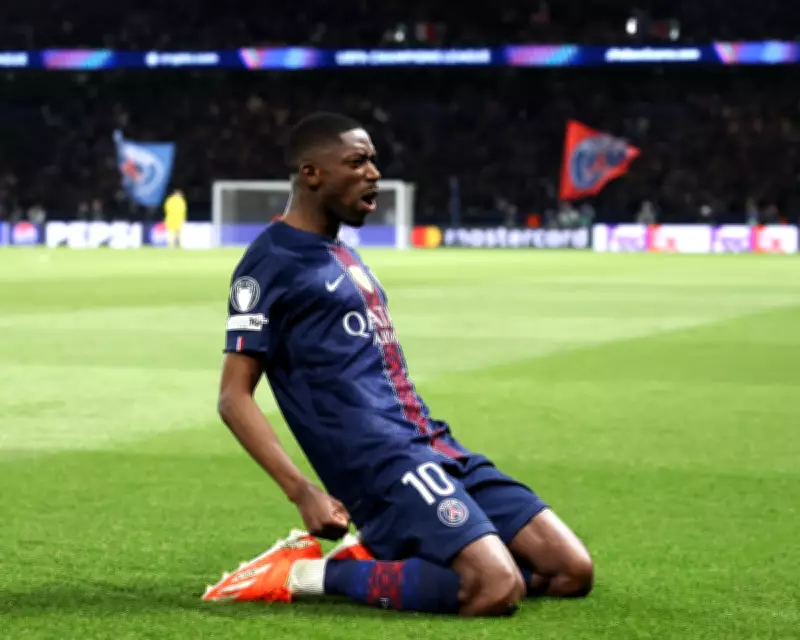
Ousmane Dembélé grins when he says that, if he does not press, he will be benched by Luis Enrique. The Ballon d'Or winner does not do his defensive work under duress. Like the rest of his teammates, he seems to derive enjoyment from a part of the game that was once seen as unnatural. Attackers would attack and defenders would defend; simple rules for a simple game. But demands have changed.
From Star Power to Collective Effort
The forward line of Kylian Mbappé, Lionel Messi and Neymar was a mouthwatering prospect but they failed to take Paris Saint-Germain close to a Champions League title and there was a lack of joy in their work. All attack and no defend made PSG a dull watch. There was a lesson in their failure: that football had changed and matches could not be won by the sheer weight of their attacking talent.
Luis Enrique tried to teach Mbappé that lesson in his final season at the club. In a documentary on the manager's first year at PSG, there was a scene in which Mbappé was sat down like a naughty schoolboy and forced to watch his own defensive shortcomings during the Champions League quarter-final against Barcelona. Luis Enrique made his demands very clear: "I read that you like Michael Jordan," he said. "Michael Jordan grabbed his teammates by the balls and defended like a son of a bitch. You think you have to score goals for us. Of course, you're a phenomenon, a world-class player, no doubt, but that doesn't matter to me that much. Being a leader is, when you can't help us with goals, you help us defensively. If you set the example by going to press, you know what we have? A fucking team."
Mbappé has since admitted that he was "half-thinking about Madrid at that point" and that he "didn't make the most of Luis Enrique". The France captain never bought into the overarching philosophy. He thought that defending would stymie his attacking potential and he did not want to give up the freedom he had been granted by his former managers for the sake of the collective.
New Generation Embraces Pressing
The players who now make up PSG's forward line – Dembélé, Khvicha Kvaratskhelia, Désiré Doué and Bradley Barcola – have no such qualms. In Europe's top five leagues, no player has made more presses per 90 minutes than Doué. Kvaratskhelia also features in the top five. The footage of Dembélé waiting to pounce on Yann Sommer's goal-kick during last season's Champions League final is one of the prevailing images of PSG's maiden triumph. Fail to comply and you're on the bench; having four world-class options for three places in the team ensures that threat is not a hollow one.
But the players themselves, notably Dembélé, also drive the standards. "Above all, we have to play for Paris Saint-Germain to win matches because, if we play alone on the pitch, that won't work. Last year, we put the club above everything else, before thinking about ourselves. We need to rediscover that. We have to play for the club first and foremost before thinking about ourselves," he said in February. Performances in the Champions League since suggest he has been heard by his teammates.
Statistical Dominance
PSG rank second in ball recoveries in this season's competition, behind Atlético Madrid. Last season, they topped this metric – and by some distance. But as they showed emphatically against Bayern Munich last week, their defensive diligence does not come at the detriment of spectacle, flair, entertainment or efficiency.
Kvaratskhelia is proof of that. The Georgian has 10 goals and five assists in the Champions League – a record for a PSG player in a single campaign – and has also become only the fourth player to score or assist in six consecutive knockout games in the tournament. Dembélé did the same last season.
Of course, PSG are not alone in adopting a super-aggressive high-press approach, and in recent days, much attention has been paid to the conditions that allow them to implement it better than others – notably clubs north of the English Channel. The quality of Ligue 1 and its reduction to 18 teams in 2023, the removal of the Coupe de la Ligue in 2020, and the financial chasm that separates PSG from their domestic competitors all are valid reasons why PSG can perform to this level at this stage of the season in the Champions League. It's no surprise that Bayern Munich are doing the same given their similar situation in the Bundesliga.
Regardless, PSG's all-action, uber-fluid, high-press has brought success and most of the other elite teams in Europe are trying to replicate it. It marks a significant divergence from tradition for French football, historically a pot-pourri of outside influences. There are other approaches – as seen in the other Champions League semi-final – but this is the direction of travel and PSG are leading the way.