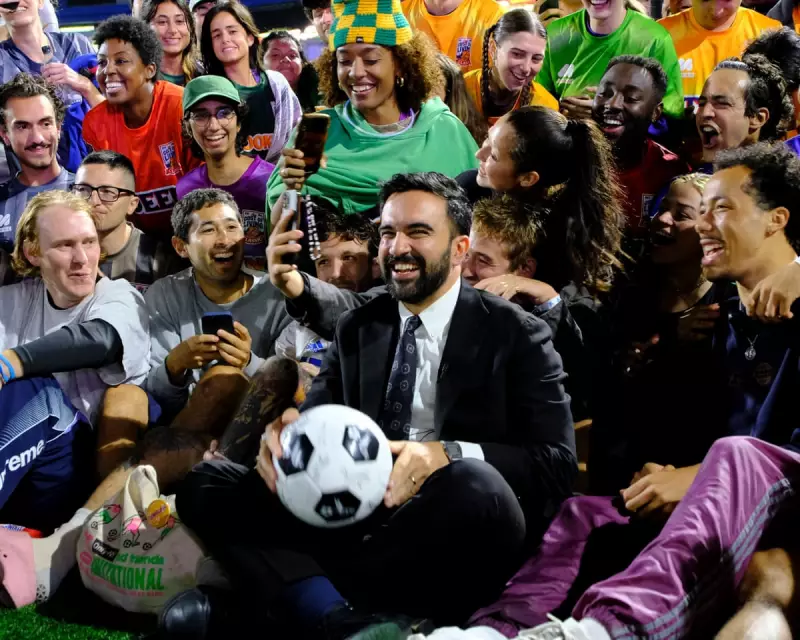
The moment New York's mayor-elect, Zohran Mamdani, received a surprise video message from Arsenal icon Ian Wright on a podcast last week was more than just a charming fan moment. It served as a revealing snapshot of how football fandom in the United States has fundamentally transformed, moving from a peripheral interest to a powerful, shared cultural force.
From Niche to Mainstream: The US Embraces the Global Game
Mamdani's genuine, star-struck reaction—"I love this man"—was not a calculated political manoeuvre. It was an authentic display of allegiance that sits at the crossroads of two significant narratives about America's relationship with football. For decades, the sport was often viewed as a niche pursuit, confined to immigrant communities or coastal elites with a taste for European culture. That era is decisively over.
Interest in the Premier League has grown steadily for over ten years, with every major club now boasting vibrant official supporters' groups across the country. Football has seeped into the national consciousness through celebrity-driven projects like Ryan Reynolds' involvement with Wrexham AFC, through global stars like Cristiano Ronaldo influencing the political sphere, and through the building excitement for the 2026 World Cup on home soil. The game is no longer an import; it is a fixture.
Two Stories of Fandom: Curated Worldliness and Diasporic Heritage
Mamdani's personal connection to Arsenal illustrates the dual pathways of American fandom. For many US progressives over the last two decades, supporting the North London club under Arsène Wenger became a cultural signifier. The team's stylish play and intellectual manager resonated as a marker of sophisticated, "European" taste, with early morning kick-offs on the East Coast becoming ritualised social events.
Yet Mamdani's fandom stems from a different, deeply rooted source. Born in Kampala and raised in Cape Town before moving to New York at age seven, his Arsenal was defined by its African core—players like Kanu, Lauren, and Kolo Touré. This version of the club forged a powerful bond with fans across the African continent long before it became fashionable in Brooklyn. His observation that Arsenal might be the most popular club in Uganda speaks to the Premier League's longstanding significance within African diasporic culture, a connection the club itself now actively celebrates through initiatives like last season's Africa-inspired alternative kit.
A Converging Culture: The New Shared American Football Identity
What feels distinctly new is the convergence of these previously parallel fan experiences. Mamdani's viral moment perfectly united the diasporic Arsenal of his childhood with the online, meme-literate Arsenal of American millennials and Gen Z. The league's rise, propelled by NBC's coverage and pervasive social media, has flattened the cultural landscape.
A Somali teenager in Minneapolis, a Mexican-American fan in Phoenix, and a Brooklyn journalist now share a common dialect of football fandom. This hybrid culture, blending diaspora traditions, youth trends, digital communities, and streetwear, is creating a truly shared US football identity. It is no longer the province of any single demographic.
Mamdani's political stance adds a further dimension. His petition against FIFA's dynamic pricing for 2026 World Cup tickets frames football as essential community infrastructure, not a luxury product. This view treats the sport as a rightful belonging of working-class and immigrant families, challenging the modern ticketing economy—a perspective that is both socialist and recognisably rooted in traditional supporter logic.
Ultimately, the image of a future mayor fawning over a football legend is far from trivial ephemera. It is a small window into the nation's evolving sporting psyche, a sign that the global game has taken deep root through a complex mix of diaspora, politics, digital culture, and pure passion. As America continues to define its football identity, Mamdani's reaction suggests it will be uniquely and authentically American—fashioned from all the diverse places its people come from and the myriad paths the beautiful game has travelled to reach them.