
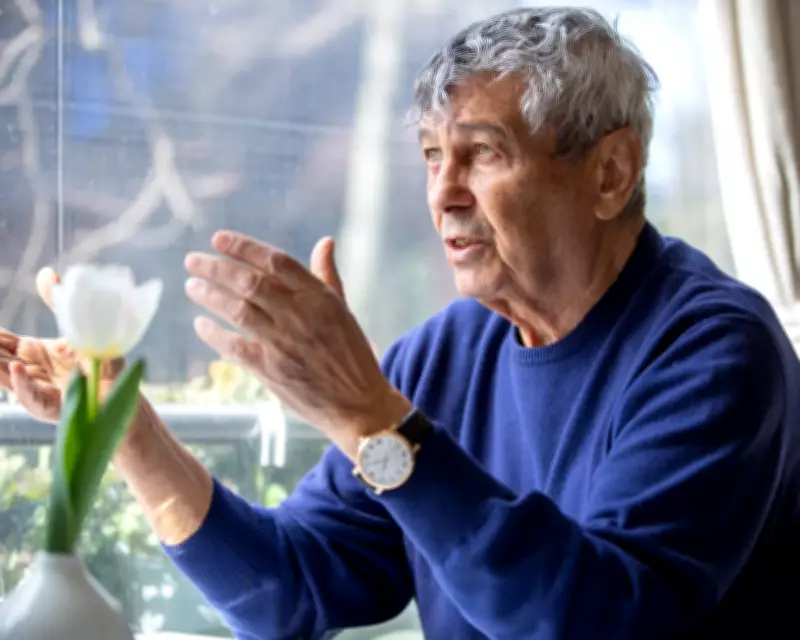
Mircea Lucescu's Final World Cup Quest at 80 While Battling Illness
Mircea Lucescu, the legendary Romanian football manager with over 30 trophies to his name, is embarking on what could be his final and most challenging campaign: leading Romania to their first World Cup appearance in 28 years. At 80 years old and facing significant health issues that have required multiple hospital admissions since December, Lucescu refuses to abandon his post, viewing his role as a sacred duty to Romanian football.
Hospital Preparations and Unwavering Commitment
From his hospital room, Lucescu has been meticulously preparing for Thursday's playoff semi-final against Turkey. "When the doctors told me I could continue coaching, I focused entirely on what I had to do for Romania," Lucescu revealed in an exclusive interview. "I'm not in my best shape, but I can't leave like a coward. We must believe in our chance to qualify."
The veteran coach has chosen not to disclose the exact nature of his illness, concerned it might distract from the team's crucial matches. Despite visible weight loss, his passion for football remains undiminished, his face lighting up whenever discussing tactics, players, or Romania's footballing legacy.
A Storied Career Comes Full Circle
Lucescu's connection with Romanian football spans generations. As a player, he captained Romania at the 1970 World Cup in Mexico, where his team impressed against football giants Brazil and England. Their tactical approach under manager Angelo Niculescu has since been recognized as an inspiration for modern possession-based football.
His first stint as Romania's manager began in 1981 when he was just 36, leading the team to Euro 1984 qualification and nearly reaching the 1986 World Cup. During this period, he gave an 18-year-old Gheorghe Hagi his international debut, launching the career of Romania's greatest ever player.
Building Foundations and European Success
"When I built the national team more than 40 years ago, I wanted young players hungry to play for Romania," Lucescu explained. "I gave them chances at senior level, focusing on players with strong motivation and emotional control. Building self-belief in their minds leads to performance."
His early work laid the foundation for Romania's golden era: three consecutive World Cup appearances (1990, 1994, 1998) and European Championship qualifications in 1996 and 2000. Between national team duties, Lucescu built an extraordinary club management career with Inter Milan, Galatasaray, Besiktas, Zenit St. Petersburg, Shakhtar Donetsk, and Dynamo Kyiv, becoming the world's second most successful manager behind only Sir Alex Ferguson for many years.
Returning to Duty Amid Modern Challenges
Lucescu's second stint as Romania manager began after the 2024 European Championship. "I felt it was my duty to take charge," he emphasized. "It wasn't just responsibility—it was my duty for everything Romanian football has given me. I hoped to help by changing how Romanian football works at a mental level."
The modern football landscape has presented unexpected challenges. "I was very surprised to see how things had changed since I returned," Lucescu noted. "It's tougher to find praise these days. Fake news moves quickly and influences public opinion. You can't build surrounded by constant negativity."
Preparing for Turkish Atmosphere and Player Challenges
The upcoming match in Turkey presents particular difficulties. Lucescu knows Besiktas's stadium intimately, having helped fund its reconstruction during his time at the club. "It's one of the best stadiums I've ever been to," he acknowledged. "When the other team has the ball, they create extraordinary pressure. I don't know if there's any remedy for the noise they'll create."
Injuries have further complicated preparations, with key players Ionut Radu and Marius Marin ruled out. Lucescu remains focused on mentality: "I need players who put their entire soul on the pitch. Everything starts in your brain—you make settings for success or failure there."
He maintains constant communication with his squad, adapting his approach to modern attention spans. "Players lose concentration after about 10 minutes in tactical meetings. You need to tell them what's essential during those minutes when you have their full focus."
Ukrainian Connections and Defining Moments
Lucescu's thoughts occasionally drift to Ukraine, where he spent 15 years managing Shakhtar Donetsk and Dynamo Kyiv. He left his Donetsk apartment with all belongings inside when conflict began in 2014 and never returned. "I have no information about what happened to my home there," he shared, maintaining contact with former players and friends amid ongoing conflict.
Despite the distractions, his focus returns to the immediate challenge. "I hope my players treat this game as a moment to mark a before and after," Lucescu concluded. "It can define a generation. Reaching the World Cup would be an extraordinary achievement—not for me, but for Romania."
As Romania prepares for their most important football match in decades, their 80-year-old coach continues his dual battle: against opponents on the pitch and his own body off it, driven by a lifetime of football passion and national duty.