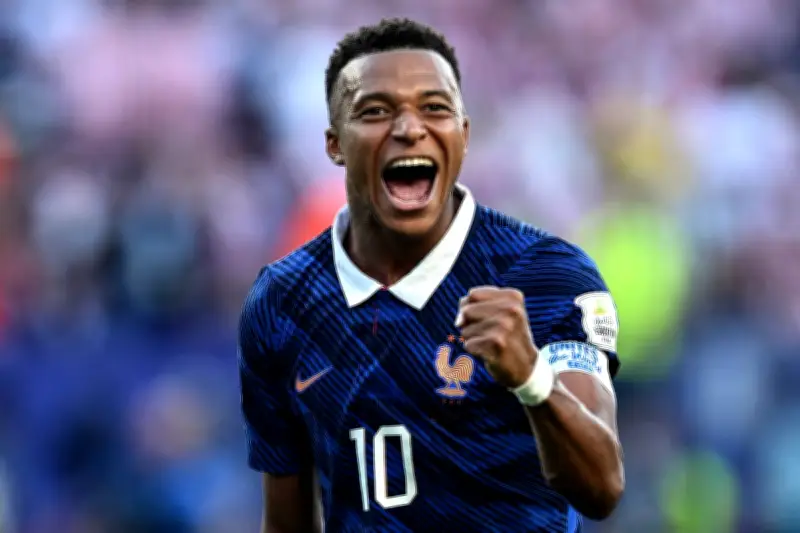
Kylian Mbappé, already France's all-time leading scorer, has become the defining figure of the 2026 World Cup, transcending football to become a cultural phenomenon. His on-field dominance is matched by his off-field persona as a statesman, comedian, and moral authority.
The Complete Footballing Package
Mbappé's athletic prowess is unparalleled: whistling speed, bulldog power, and footwork that generates its own weather. In French, top players are called "crack," and no one fits the onomatopoeia better. Lean and savage, he is the whip personified, so fast he's outrun one of his own surnames—once Mbappé Lottin, now simply Mbappé. Referee view technology has exposed the pickpocketing nonchalance behind his speed and violence; every demonstration of strength is also an expression of feathery mercy. He is the cat and the raptor, the fox and the mongoose.
Cultural Supremacy and Meme Lord
At this World Cup, Mbappé has transformed into a total cultural product. Dictator memes proliferated on the eve of the tournament, so pervasive that coach Didier Deschamps felt compelled to note his captain is not a despot but a cherished teammate. The Mobutu comparisons, embraced by teammates, burnish his reputation. To be memed is to be godly; previous greats like Messi, Ronaldo, and Zidane were too tepid for such treatment. Kyks Baps leads a new generation bursting with personality.
Verbal Excellence and Political Combat
French footballing culture values verbal excellence; professional academies compete in an annual eloquence contest at the presidential palace. Mbappé, staging dummy press conferences from age five, has reached new heights. His thoughts on football's evolution ("It's always the team that wins that is right"), teammates' "liberation of space," and hydration breaks ("Don't ask players for their opinion, we're like weather vanes") burst forth with skiddy authority. He has steadfastly defended Deschamps, describing him as a joker, friend, and "disciplinarian dad."
Mbappé's most forceful public intervention was a volcanic denunciation of Paraguayan senator Celeste Amarilla after her racist attack following France's round-of-16 victory. "Madame Celeste Amarilla, you are a despicable woman," his statement began; "I will never allow people like her the freedom to spread their hatred and racism across the world," it ended. After years of dreary neutrality among sporting elites, Mbappé's embrace of political combat marks a new era: the Mbappécene.
Roots in Bondy and the Banlieue
Mbappé's personality is a product of education. A restless child, his parents provided a psychologist from seventh grade, flute and theatre lessons, and football. The family home in Bondy, a northeastern Paris suburb, was a block from Stade Léo-Lagrange. This World Cup began with 56 players from Paris—more than any other city. The banlieue, home to 13 million residents, is a formidable football talent factory. Bondy reveals a whimsical public housing development with brightly glazed towers, an Oscar Niemeyer-designed Brutalist bourse du travail, and a swimming center named after Jacques Brel—a grid of monotony, amenity, solidarity, and ambition.
The Unquestioned King
Mbappé gathers disparate threads of French culture, embodying the best of its self-critical and sporting traditions. He is a statesman and comedian, a wellspring of memes and dealer of hard truths, the sport's highest moral authority and trustiest punchline. A footballer, flautist, and thespian, he charges into World Cup history with imperial calm. Napoleon may have crowned himself, but there is no question on whose head football's jewelry of state lies today.