
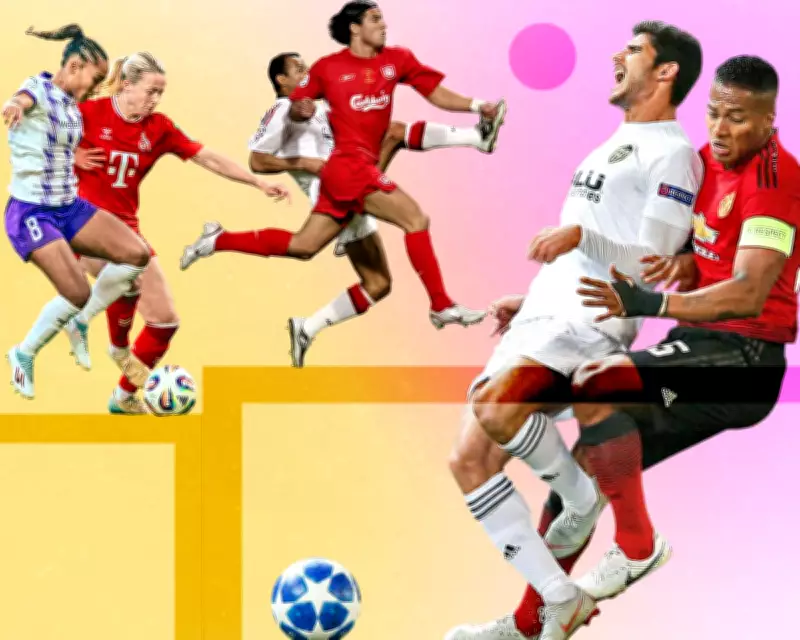
The Curious Case of Footballers Facing Teams in Their Own Name
In the world of football, where statistics and records are meticulously tracked, a peculiar and often overlooked phenomenon involves players competing against teams that share their names. This quirky occurrence, known as nominative opposition, has sparked intrigue among fans and historians alike, revealing a fascinating layer of the sport's rich tapestry.
Sandra Jessen and the Essen Encounter
A recent example that caught the attention of enthusiasts involves Sandra Jessen of FC Köln, who faced off against Essen in a Frauen Bundesliga match. James Vortkamp-Tong highlighted this instance, pondering if it was the first such occurrence. However, as Alicia Butteriss pointed out, Jessen had previously played against Essen while with Bayer Leverkusen during the 2018-19 season, and she notably scored both goals in Köln's 2-1 victory earlier this season. This underscores that such name clashes are not entirely unprecedented but remain a rare and amusing footnote in football lore.
Historical Instances Across Leagues
Delving deeper, the history of nominative opposition spans decades and continents. For instance, Conor Coventry of Charlton Athletic played against Coventry City in the Championship, though he did not score in those encounters. His first match against Coventry was as a substitute for Peterborough United in 2021, a game Coventry won 3-0 with Viktor Gyökeres netting twice.
In a more iconic setting, Liverpool's Milan Baros faced Milan in the 2005 Champions League final, a match remembered for Liverpool's dramatic comeback from 3-0 down. Other players named Milan, such as Milan Pjanic, Milan Skriniar, and Milan Badelj, have also competed against the Italian giants. Similarly, Italian club names like Roma have seen opponents like Alessandro Romagnoli of Lazio and Filippo Romagna of Sassuolo and Cagliari.
English football offers its own examples, including Alan Sunderland playing against Sunderland, Matt Derbyshire facing Derby, and Jack Charlton taking on Charlton Athletic. Internationally, Manchester United's Antonio Valencia clashed with Valencia in the Champions League, while Russian player Spartak Gogniev encountered Spartak Moscow multiple times. At the international level, Mike England represented Wales against England, and Mousa Dembélé played for Belgium against the USA.
Early Cases and Record-Breaking Moments
The earliest documented cases of nominative opposition date back to the mid-20th century. Joe Stynes notes that Luigi Milan played against Milan in the 1960s, while Mark Baker recalls Geoff Barrowcliffe of Derby County facing Barrow in 1956. Tom Reed adds that Bobby Charlton scored twice against Charlton Athletic on his Manchester United debut in 1956. However, the earliest example might be John Aston Sr, who played for Manchester United against Aston Villa in 1947.
A particularly amusing coincidence occurred in February 2022 when Arbroath fielded three players named Hamilton against Hamilton Academical, who also had a Hamilton on their team. Similarly, in 1993, Leyton Orient and Barnet both had players named Barnett scoring in a match, adding to the whimsical nature of these encounters.
Hat-Trick Heroes Snubbed for Awards
Beyond name clashes, football history is riddled with oddities, such as players scoring hat-tricks or more without receiving the player-of-the-match award. Geraint Lewis questioned this after Alan Shearer's comment, and Adam Pinder provided a striking example: Mark de Vries scored four goals for Hearts in a 5-1 win over Hibs in 2002, yet the award went to Jean-Louis Valois. This highlights how individual brilliance can sometimes be overshadowed by other performances, even in record-setting games.
Managers Sacked After Big Wins
Another curious aspect involves managers being dismissed shortly after significant victories. Jim Hearson pointed out Flamengo sacking Filipe Luís after an 8-0 win, prompting a look back at similar cases. In 2009, Bryan Gunn was sacked by Norwich following a 4-0 victory, while Kevin Keegan resigned from Newcastle after a 7-1 win in 1997. Graham Taylor also stepped down after England's 7-1 win over San Marino in 1993. Perhaps most notably, Dave Sexton was sacked by Manchester United in 1981 despite winning his last seven games, underscoring the harsh realities of football management.
Alphabetical and Promotional Quirks
Vasco Wackrill noted that in the 2003-04 season, when Arsenal won the Premier League, York City—alphabetically the last team in the Football League—finished bottom of League Two, adding a layer of symmetry to the league tables. Meanwhile, Ant Gee pondered if Wrexham could achieve four consecutive promotions, a feat that would place them among an elite group of clubs with such rapid ascension.
Unanswered Questions and Future Curiosities
The article concludes with a series of intriguing questions from readers, such as whether Bodø/Glimt is the only professional team with a forward slash in its name, or if any manager has been sacked multiple times in a short period, like Rubén Sellés. These queries reflect the endless fascination with football's minutiae and the desire to uncover new layers of trivia.
Overall, the world of football is filled with unexpected connections and bizarre occurrences, from name-based matchups to managerial paradoxes. As fans continue to explore these quirks, the sport's history becomes ever more enriched with stories that go beyond the scorelines, reminding us that football is as much about human interest as it is about athletic prowess.