When Idrissa Gueye saw red for slapping Everton teammate Michael Keane at Old Trafford, it sent shockwaves through football. This bizarre incident of intersquad violence made fans wonder: just how many players have turned on their own teammates during a game?
The Infamous Fight Club
Football history contains several remarkable examples of teammates coming to blows, with some incidents dating back decades. In the 2004 article covering this topic, several classic cases were highlighted that set the precedent for such behaviour.
Derek Hales and Mike Flanagan of Charlton Athletic made history in the 1978-79 FA Cup when their simmering tension boiled over against non-league Maidstone. With Charlton chasing a winner, Hales felt Flanagan was refusing to pass to him. "So I've had a word and hit him one!" Hales later admitted. Flanagan returned the favour, and both strikers were dismissed.
Perhaps the most brutal encounter occurred between Craig Levein and Graeme Hogg of Hearts during a 1994-95 pre-season friendly against Raith Rovers. After Gordon Dalziel nearly scored, the defenders came to blows, with Hogg throwing the first punch and Levein responding with what Dalziel described as "two haymakers which Mike Tyson would have been proud of." The severity became apparent when Levein broke Hogg's nose.
Premier League Era Incidents
The modern era has witnessed its share of teammate confrontations, with four players receiving red cards for violent conduct against their own colleagues in Premier League history.
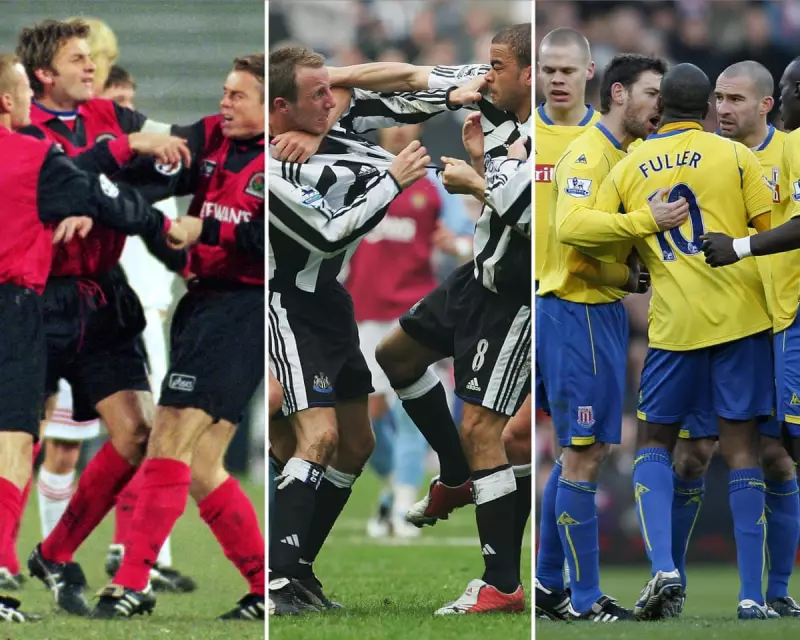
Fans will never forget the dark comedy of Lee Bowyer and Kieron Dyer's physical altercation during Newcastle's 3-0 home defeat to Aston Villa in April 2005. The fight became instant Premier League folklore, with manager Graeme Souness sitting between the pair afterwards with what could only be described as a look that could kill.
In December 2008, Ricardo Fuller of Stoke City was sent off for striking his captain Andy Griffin, while Gueye's recent slap completes the quartet of Premier League red cards for teammate violence.
Other notable near-misses include Bruce Grobbelaar and Steve McManaman's heated exchange during a Merseyside derby in September 1993, and Aston Villa's Anwar El Ghazi scraping his head against Tyrone Mings in 2019 without sanction.
Internationally, Galatasaray's Marcão started the 2021 Süper Lig season in spectacularly bad fashion by headbutting teammate Kerem Akturkoglu before attempting several haymakers, resulting in an inevitable red card.
World Cup Waiting Game
In other football matters, Scotland goalkeeper Craig Gordon's potential World Cup 2026 appearance raises questions about lengthy international waits. Should Gordon feature, it would be approximately 22 years since his Scotland debut in May 2004.
However, Essam El-Hadary holds the remarkable record, making his Egypt debut in March 1996 and waiting 22 years and three months before appearing at the 2018 World Cup. His memorable performance included becoming the first African goalkeeper to save a penalty at World Cup finals.
Canada's Atiba Hutchinson also endured a significant wait, debuting in January 2003 before finally appearing at the 2022 tournament.
Champions Humiliated at Home
Liverpool's recent 3-0 defeat to Nottingham Forest prompted examination of heavy home losses suffered by reigning Premier League champions. While Forest's victory shocked Anfield, heavier defeats have occurred.
The most dramatic remains Manchester United's 6-1 thrashing by rivals Manchester City in August 2011, with City scoring multiple late goals. Tottenham also defeated Leicester 6-1 in May 2017, with Harry Kane netting four times.
The list of comprehensive home defeats for champions includes Manchester City's recent 4-0 loss to Tottenham and several 4-1 reverses, with Leeds United's 1992 defeat to Forest being particularly unexpected given their strong home record.
Unlikely Champions
In a remarkable statistical anomaly, Huddersfield's 2017 promotion with a negative goal difference prompted investigation into whether any team has won a title while conceding more than they scored.
Brazil's 1985 champions Coritiba achieved this unlikely feat, scoring just 25 goals in 29 games and finishing with a negative goal difference despite ultimately lifting the trophy. Their overall record read: P29 W12 D7 L10 F25 A27.
South Korea's POSCO Atoms also won the 1986 championship despite a negative goal difference of -2, proving that sometimes the most unlikely teams can triumph against conventional football wisdom.