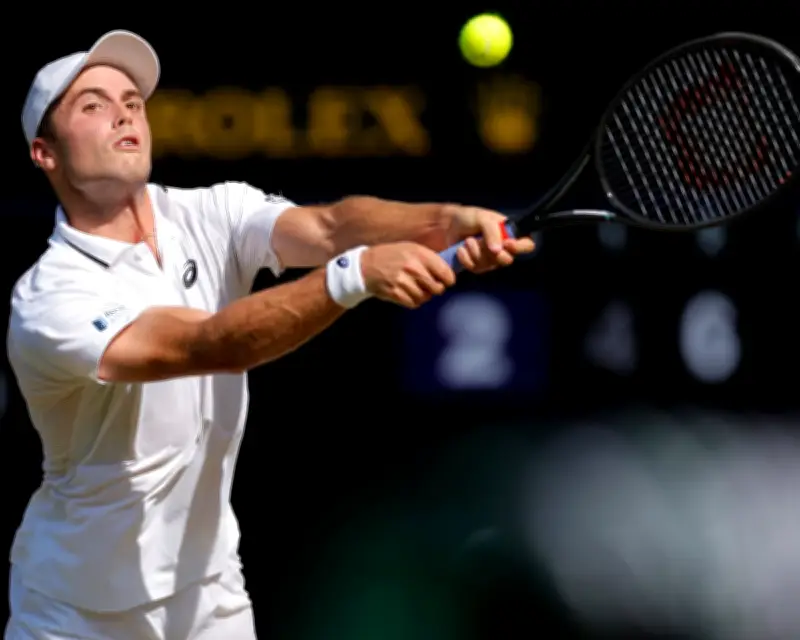
Arthur Fery has stunned the tennis world by reaching the Wimbledon men's semifinals as a wildcard, becoming only the fifth British man to do so in the Open Era. Standing at 5ft 9in, he faces a formidable challenge in 6ft 6in Alexander Zverev, the French Open champion and world No. 2. To topple Zverev, Fery must execute a precise tactical plan across several key areas.
Serve and Return Strategy
Fery's first-serve percentage has been around 60% across his five matches, but he needs to push that closer to 70% to pressure Zverev's return. When Fery wins the first point on serve, he remains unbroken in two matches and dropped only one game in two others. His return game has been stellar, putting 70% of balls back into play. He has won over half the points on opponents' second serves. Against Zverev, Fery must stand close to the baseline to neutralize the German's kick serve, which could otherwise bounce over his head. Zverev often goes big on second serve, and if Fery forces errors, double faults may follow.
Net Play and Aggression
Zverev has adjusted his positioning at Wimbledon, standing closer to the baseline than in Paris, but he still retreats about six feet behind the baseline to return. This opens opportunities for Fery to serve wide on the deuce court and charge the net. Fery has won 15 of 19 points when serving and volleying, and 149 of 230 points (65%) at the net overall. In his quarterfinal against Flavio Cobolli, he won 77% of net points. While both players are consistent from the baseline (each winning 49% of points there), Fery must come forward to disrupt Zverev's rhythm.
Drop Shot to Disrupt Rhythm
Fery's deft touch has been a highlight, and his drop shot is a critical weapon to keep Zverev off balance. The German excels at hammering backhands from the baseline, and Fery cannot allow him to settle. Using the drop shot immediately after the serve could be effective, and even if it doesn't always succeed, the threat alone can plant doubt in Zverev's mind. Zverev is less comfortable at the net, so drawing him forward may yield errors.
Capitalize on Break Points
Zverev's serve has been dominant, with a 77% first-serve percentage in his quarterfinal win over Taylor Fritz and winning over 70% of points on both first and second serves. Fery's block return should help him get into points, but when break-point chances arise, he must seize them decisively. Zverev's second serve has historically been a vulnerability, and Fery needs to attack it aggressively.
Harness the Crowd's Energy
The Centre Court crowd will be firmly behind Fery, who has already played four hours more than Zverev this tournament. He acknowledged the crowd's role after his quarterfinal win: "I've been trying to use the crowd to my advantage in important moments, just to add a little pressure maybe to the opponents. I'll try and do that again at moments that feel right on Friday." Engaging the crowd early could provide an energy boost and add pressure on Zverev.
Fery's remarkable run has already made history, and a victory over Zverev would be a fairytale. With precise execution in these tactical areas, he has a fighting chance to reach the Wimbledon final.