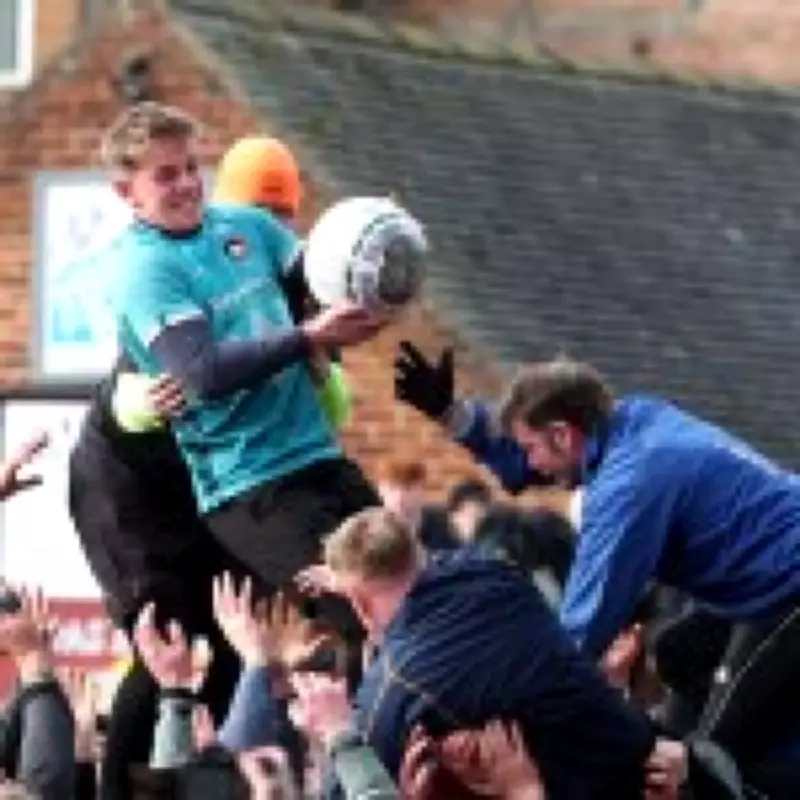
Hundreds of participants are engaging in a brutal 16-hour ball game for the 826th time, as Ashbourne, Derbyshire, hosts its legendary Royal Shrovetide Football Match. This annual event, one of the oldest forms of mass football in England, has split the town into two fierce teams, igniting two days of intense competition that draws locals and spectators from across the region.
The Historic Tradition Unfolds
At 2pm, the game commenced with the town divided into the Up'ards, representing those born north of the river, and the Down'ards, from the south. Their objective is to 'goal' at opposite ends of the town, navigating a challenging three-mile course filled with rivers, fields, and urban infrastructure. Before the start, a large crowd gathered at the Shawcroft Car Park by the Shrovetide plinth, where renditions of God Save the King and Auld Lang Syne set the stage for the iconic 'turning up' of the ball.
Key Figures and Game Dynamics
This year, Sir Andrew Walker-Okeover, an Up'ard, was honored to turn up the ball on Shrove Tuesday, followed by Pete Mellor, a lifelong Down'ard and self-employed plumbing and heating engineer, who will perform the same duty on Ash Wednesday. Once the ball was in play, the Down'ards immediately aimed to score at the Clifton goal to the west, while the Up'ards targeted the Sturston goal to the east.
Play continues until 6pm, after which the game transitions to a next-goal-winner format for that day. If no goal is scored between 6pm and 10pm, play halts, with the aggregate score over both days determining the ultimate winner. The Down'ards currently hold the championship title, having defeated the Up'ards 1-0 in the previous year.
Rich History and Rare Cancellations
The Royal Shrovetide Football Match is a cherished tradition played every Shrove Tuesday and Ash Wednesday in Ashbourne, with roots tracing back to at least the 1660s. Shrovetide ball games in England date even further, to the reign of Henry II from 1154 to 1189. Although a fire in the committee office during the 1890s destroyed early records, obscuring the exact origins, the community has steadfastly maintained this legacy.
Remarkably, the match has been cancelled only three times since 1891: in 1968 and 2001 due to foot-and-mouth disease outbreaks, and in 2021 because of the coronavirus pandemic, highlighting its resilience and cultural significance.
Gameplay and Royal Connections
The match begins at a plinth in the town centre, where the ball is 'turned up' and then advanced toward the goals through a series of 'hugs,' reminiscent of a rugby scrum. While kicking, carrying, and throwing the ball are permitted, the gameplay is predominantly characterized by these physical hugs. The event earned its 'Royal' designation after two kings participated while still Princes of Wales: King Edward VIII, who turned up the ball in 1928 and sustained a bloody nose in the fray, and King Charles III, who threw the ball into play in 2003.
This year's edition continues to embody the spirit of community and competition, with hundreds braving the elements to uphold a tradition that has endured for centuries, making it a unique spectacle in the world of sports and cultural heritage.