
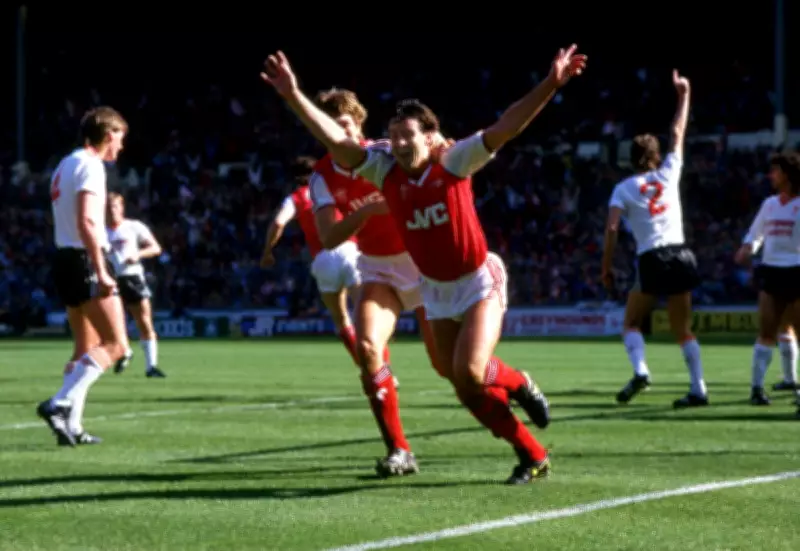
Charlie Nicholas' Wembley Masterclass: Arsenal's 1987 League Cup Triumph
On a sun-drenched Sunday afternoon at Wembley Stadium in April 1987, Charlie Nicholas delivered a performance that would etch his name into Arsenal folklore forever. The Scottish striker, whose time at the club had been marked by inconsistency, rose to the occasion when it mattered most, scoring both goals in a dramatic 2-1 comeback victory over Liverpool to secure Arsenal's first-ever League Cup trophy.
The Build-Up to Wembley Glory
Arsenal's journey to the final was anything but straightforward. Under new manager George Graham, who had taken charge in the summer of 1986, the team was undergoing a significant transformation. Nicholas, a £650,000 signing from Celtic in 1983, found himself under constant scrutiny, with many speculating his days at Highbury were numbered. The stylish forward hardly fit Graham's preferred industrious style, yet he would prove instrumental when it mattered most.
The semi-final against Tottenham Hotspur showcased the resilience Graham was instilling in his young squad. Trailing 2-0 on aggregate midway through the second leg at White Hart Lane, Arsenal staged a remarkable comeback, scoring twice to force a replay before winning 2-1 three days later. The Tottenham stadium announcer's premature ticket information for Wembley had inadvertently provided the motivation Arsenal needed.
Facing the Mighty Reds
Liverpool entered the final as overwhelming favorites. The reigning champions had reached eight domestic cup finals in the previous decade and possessed vast Wembley experience. As Guardian reporter David Lacey noted in his preview, "They have visited the place so often in recent years that the stadium has practically become their second home." Only Gary Gillespie among Liverpool's starting lineup lacked previous Wembley experience.
Yet Liverpool arrived at Wembley with vulnerabilities. They were faltering in their title race with Everton, having lost their previous two league matches. Injuries had depleted their squad, with Mark Lawrenson, Jim Beglin, and Steve Nicol all ruled out for the season. Arsenal, despite their league form tailing off since the new year, sensed an opportunity.
The Final Unfolds: From Despair to Delight
The match began in classic Wembley fashion: live BBC coverage, a traditional 3pm kick-off, Jimmy Hill presenting with Bobby Charlton and Trevor Brooking as pundits, and that iconic long walk from the tunnel. Liverpool started strongly, controlling possession and creating early chances. Ian Rush dragged an effort wide, Craig Johnston forced a fine save from John Lukic, and Jan Mølby blazed over after capitalizing on a Kenny Sansom mistake.
Liverpool's pressure told in the 23rd minute when Rush scored what commentator Barry Davies called "such a familiar sight." The move began with Bruce Grobbelaar and culminated with Mølby's superb pass to Steve McMahon, who cut the ball back for Rush to finish clinically. The statistic haunting Arsenal fans was that Liverpool had never lost any of the 144 matches in which Rush had scored.
Rather than collapse, Arsenal responded with renewed determination. Paul Davis struck the post from distance before Nicholas equalized in the 30th minute. After a scramble in Liverpool's penalty area, Nicholas hit the post before sweeping home the rebound. "It's Charlie. Charlie Nicholas has done it," exclaimed Davies as Tony Adams grabbed the goalscorer in a celebratory headlock.
The Decisive Moment
The second half developed into a tense, evenly-matched contest. Both sides created chances, with Mølby and McMahon going close for Liverpool, while Viv Anderson's dramatic dive in the penalty area drew comparisons to swimmer Duncan Goodhew from co-commentator Bobby Charlton. As the match approached its final stages, extra time seemed inevitable.
Then came the 83rd-minute breakthrough. Substitute Perry Groves, a £50,000 signing from Colchester, used his blistering pace to skip past Gillespie on Arsenal's left flank. His cutback found Nicholas, whose shot deflected off Ronnie Whelan and trickled past a stranded Grobbelaar. Nicholas and Groves embraced behind the net while Graham punched the air in delight. Even BBC presenter Bob Wilson momentarily forgot his impartiality, rising to his feet in celebration.
Legacy of the Victory
The final whistle sparked wild celebrations among Arsenal players and fans alike. Chants of "Arsenal are back" and "Charlie, Charlie" echoed around Wembley as the club ended its eight-year trophy drought. Rush's remarkable scoring record was broken, and Arsenal had defeated Liverpool in a Wembley final for the third time, following their 1950 and 1971 FA Cup triumphs.
Newspaper coverage focused on Nicholas' heroics and his contract situation, but Graham remained focused on the bigger picture. "This can be the start of a run of success similar to Liverpool's over the last two decades," he declared after the match. While Arsenal wouldn't quite achieve that level of dominance, the victory proved foundational. Graham, emboldened by this unexpected success in his first season, would go on to build a team that eventually toppled Liverpool's supremacy.
For Nicholas, the triumph represented both a peak and an ending. With Alan Smith recently signed from Leicester, his departure became inevitable, and he moved to Aberdeen in January 1988. Yet his Wembley heroics ensured his place in Arsenal history, providing the perfect parting gift to the fans who had waited so long for silverware. The 1987 League Cup victory marked the beginning of Arsenal's modern era of success, proving that sometimes, being one-nil down can indeed lead to being two-one up.