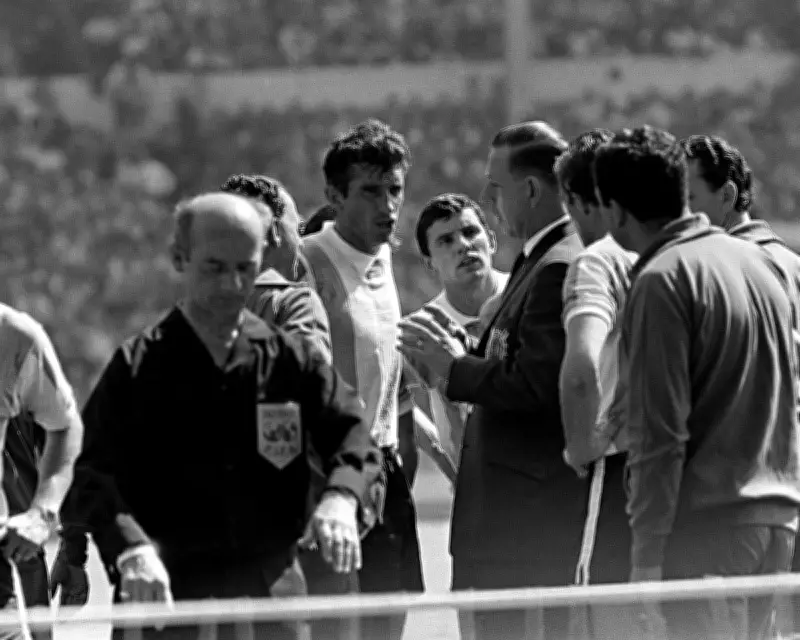
Antonio Rattín, the Argentine footballer whose dramatic sending-off in the 1966 World Cup quarter-final against England led to the introduction of yellow and red cards, has died in Buenos Aires at the age of 89. His refusal to leave the pitch after being dismissed by West German referee Rudolf Kreitlein became one of the most iconic moments in World Cup history.
The 1966 incident
With barely 30 minutes played at a sunlit Wembley Stadium, Kreitlein sent off Rattín for what he described as “violence of the tongue” – a peculiar justification given that neither man spoke the other’s language. Kreitlein later said: “Rattín said nothing I could understand, I could see in his face what he was saying.” It took eight minutes and the intervention of two uniformed policemen and Argentina’s trainer to escort the captain from the field, an unprecedented scene on English soil. Rattín initially sat on the red carpet reserved for the Queen, then paused at a corner flag to tweak the Union Jack pennant. “I regret that,” he said years later, “but nothing else.”
Impact on football
England won the match 1-0 with a second-half goal by Geoff Hurst. After the game, England manager Alf Ramsey stopped his players from swapping shirts, calling the Argentines “animals” despite statistics showing England had committed 33 fouls to Argentina’s 19. The incident deepened a rivalry that would be inflamed by later clashes, including the 1986 “Hand of God” goal by Diego Maradona. The chaotic scenes directly inspired English referee Ken Aston, the tournament’s referees supervisor, to create the yellow and red card system, which was introduced at the 1970 World Cup to prevent linguistic misunderstandings.
Career and legacy
Born on 16 May 1937 in Tigre, Argentina, Rattín was the son of an Italian immigrant engineer. He worked as a delivery boy and electrician before joining Boca Juniors, where he spent his entire 15-year playing career. Standing 6ft 3in, he began as a defender and evolved into a powerful defensive midfielder, a forerunner of modern midfield anchors. He played 382 matches for Boca, winning five national championships and the Copa Argentina, and earned 34 caps for Argentina between 1959 and 1969, including victory in the 1964 Nations Cup in Brazil.
Later life
After retiring at 33, Rattín managed Gimnasia y Esgrima La Plata, Tigre, and briefly Boca Juniors in 1980. He later entered politics, serving as a national deputy for the Federalist Union party from 2001 to 2005 and as a Peronist councillor until 2009. A statue of Rattín was unveiled at Boca’s La Bombonera stadium in 2005. His death coincided with Argentina’s World Cup quarter-final victory over Switzerland, for which the team wore black armbands – a match that set up a semi-final against England. Rattín is survived by his legacy as both a symbol of Argentine football and the unintended catalyst for one of the game’s most universal disciplinary tools.