Police Statement Reveals Timeline of Football Violence
The Amsterdam Police Force has released a comprehensive statement detailing the violent clashes that erupted in the Dutch capital during and around the Europa League fixture between Ajax and Maccabi Tel Aviv in November 2024. The report outlines a series of confrontations involving organised groups of football supporters and activists, leading to widespread unrest.
According to the statement, the Amsterdam police had previously held a video meeting with West Midlands Police in the first week of October. The subject of this discussion was assessing the risks associated with Maccabi supporters potentially travelling to the city of Birmingham for a European football match.
Organised Ultras and City Centre Clashes
The police assessment identified that among the Maccabi supporters were a group of 500-800 high-risk ultras who visited Amsterdam in November 2024. The authorities stated that, similar to other European ultra groups, these fans were highly organised and, on several occasions, appeared willing to engage in physical confrontations.
A total of around 2,500 Maccabi supporters were present in the city on Wednesday, 6 November and Thursday, 7 November. The police worked to prevent confrontations between pro-Palestine activists and the visiting supporters in Amsterdam's city centre, but could not stop groups from provoking each other with shouted insults.
The report highlights a specific incident in the early morning of 7 November, at approximately 12:20 am. The control room received reports that a group of about 50 Maccabi Tel Aviv supporters were pulling a Palestinian flag off a building façade and obstructing traffic. Some supporters wore face coverings, shouted anti-Palestinian slogans, and harassed members of the public.
The group then split up, with one part moving towards Central Station and Spui, and another towards the red-light district. By 12:32 am, the control room reported that individuals from the group walking along the Rokin were using their belts to attack taxis and padlocks to assault scooter riders.
Escalating Tensions and Flash Attacks
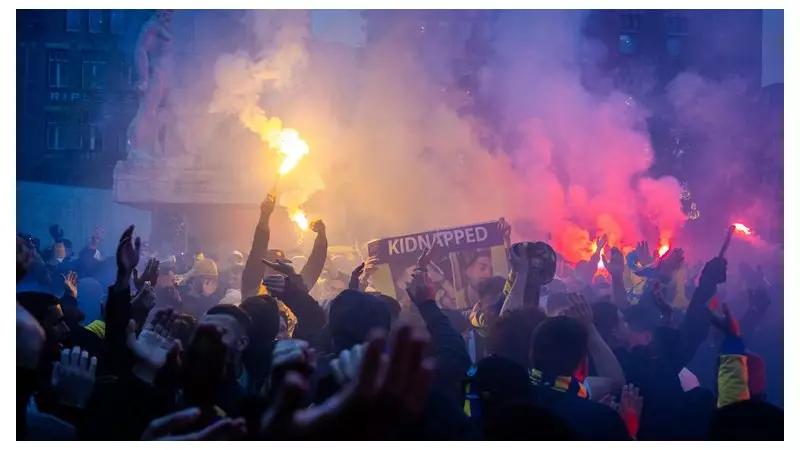
The following day, Dam Square served as a gathering point for Maccabi supporters before their departure for the Johan Cruijff ArenA. Around 12:15 pm, supporters began arriving and quickly grew in number, chanting anti-Palestinian slogans. The police noted that young people from Amsterdam on scooters circled the group, monitoring the supporters and making frequent phone calls.
The fan walk commenced around 17:30 from Dam Square. During this escorted walk towards Central Station, supporters shouted slogans in Hebrew, which were later confirmed to include highly offensive, racist expressions. A group wearing face coverings led the procession.
Later that night, around midnight, Maccabi Tel Aviv rioters gathered at Central Station and moved towards the city centre, equipping themselves with metal rods and stones, which were thrown at taxis.
Simultaneously, a new development emerged as small groups of pro-Palestinian rioters actively searched for individuals they perceived as Israeli, Jewish, or Maccabi supporters. At 23:55, the first 'flash' attacks on Maccabi supporters began at Dam Square, followed by several dozen violent incidents in the city centre.
These attackers used various methods to reach their victims, some moving on foot while others used scooters or taxis to move quickly through the city. This mobile tactics made it difficult for police to intervene quickly and effectively. The authorities noted this represented a fundamentally different form of violence compared to the earlier group confrontations.
From 1:24 am onward, reports of attacks decreased, but the police confirmed that fear among Jewish residents of Amsterdam and Israeli tourists remained high. Multiple reports were received of people feeling unsafe and not daring to leave their hotels.
The Amsterdam police concluded that much of the disorder during those days resulted from different groups provoking each other, and that compared to other European high-risk football supporters, the Maccabi supporters were assessed as particularly self-confident and unafraid of either opponents or the police.