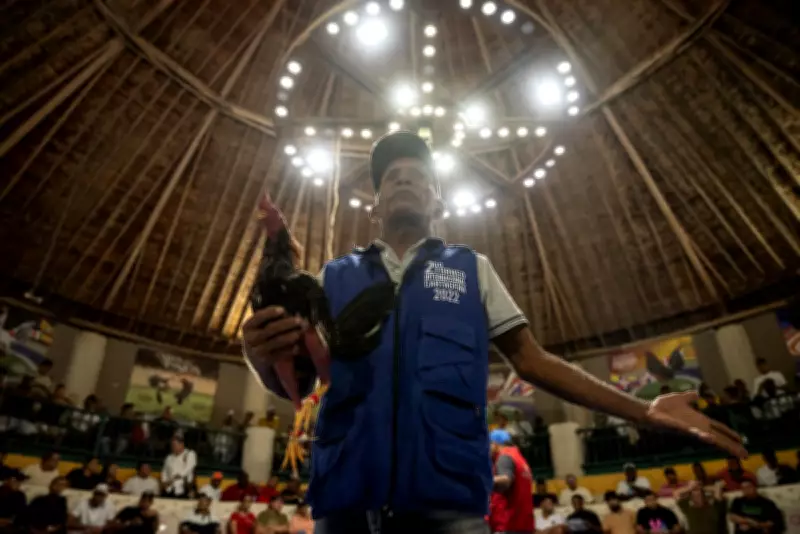
Colombia's Cockfighting Tradition Faces Extinction After Landmark Court Ban
On the outskirts of Cartagena, far from the city's historic facades and fortress walls, a crowd of about 300 people erupted into a roar. While Colombians are known for their passion for football, these cheers followed the bloody climax of a bout in a cockfighting ring, where white padded walls were splattered with blood. The Santa María cockfighting arena, one of the largest and most important venues in Cartagena and the Bolívar department, hosted over 100 fights on a single evening in October 2025, with each rooster owner paying approximately £193 per bird.
A Tradition Under Threat
Cockfighting, introduced by Spanish colonisers, remains highly popular in Colombia, but its days are now numbered. In September, a constitutional court ruling banned the practice, establishing a three-year "transition" period during which the government must provide alternative livelihoods for tens of thousands of people who rely on it. José Ramirez, a judge for the evening, estimated that 115 fights could be held, likely concluding by dawn the next day.
Alí Viveros, a 38-year-old breeder of about 50 fighting cocks and owner of a shop selling specialised supplies, expressed horror at the ruling. "Cockfighting is a tradition, it's part of our culture," he said, referencing its place in Gabriel García Márquez's One Hundred Years of Solitude, where an insult at a cockfight sparks a duel leading to the founding of Macondo. Viveros emphasised the economic impact, noting that many families depend on the industry, including galleros, food vendors, doormen, judges, cleaners, and cage makers.
Economic and Cultural Clash
The national cockfighting federation, which is seeking to overturn the ban, estimates nearly 10,000 arenas nationwide and between 270,000 and 290,000 families reliant on the activity. However, animal rights organisations dispute these figures, citing informality and a lack of reliable data. Senator Andrea Padilla, a leading figure behind the ban, argued against cultural justifications, stating, "Until recently, child marriage was also considered an acceptable cultural practice in Colombia. The fact that something is deeply rooted in a society does not mean it's morally valid."
The court's ruling also upheld bans on bullfights, coleo, and corralejas, with a rightwing senator introducing a bill in January to roll back these prohibitions, claiming they are part of the nation's heritage. The central justification for the ban was that cultural tradition cannot legitimise violence or the deliberate killing of sentient beings.
Breeders' Perspectives and Practices
Fabián Montes, a 60-year-old leading cock breeder with about 1,000 birds, questioned the logic, asking, "And what about the chickens and cattle we kill to eat – aren't they sentient too?" Montes, a dentist who said breeding is not his primary income, argued that the animals are not mistreated and fight due to their "natural condition." He explained that even brothers raised together will inevitably fight after five and a half months, a result of centuries of human-driven artificial selection.
Despite this, training involves simulated bouts and aerobic exercises once a chick is identified as a "fighter." The animals undergo modifications such as trimming combs, wattles, and feathers, and replacing natural spurs with artificial ones made of metal, resin, or bone, costing between £0.67 and £0.96 per pair. Breeders claim fewer than 20% of cocks die during fights, but Padilla disputes this, stating, "The objective is always for one to die."
Future Challenges and Clandestine Risks
Padilla warned that the government is not moving adequately to find alternative livelihoods, risking rampant clandestinity when the ban takes effect in 2028. "Staging a cockfight is very easy – all it takes is a small space where people can gather, place bets and put two cocks to fight," she said, adding, "To think that a law can simply erase a cultural practice is absurd. Laws do not perform miracles."
As bettors clinked drinks and collected winnings at the Santa María arena, handlers carried off defeated birds and workers cleaned the ring, highlighting an industry at a crossroads between tradition and modern ethics.