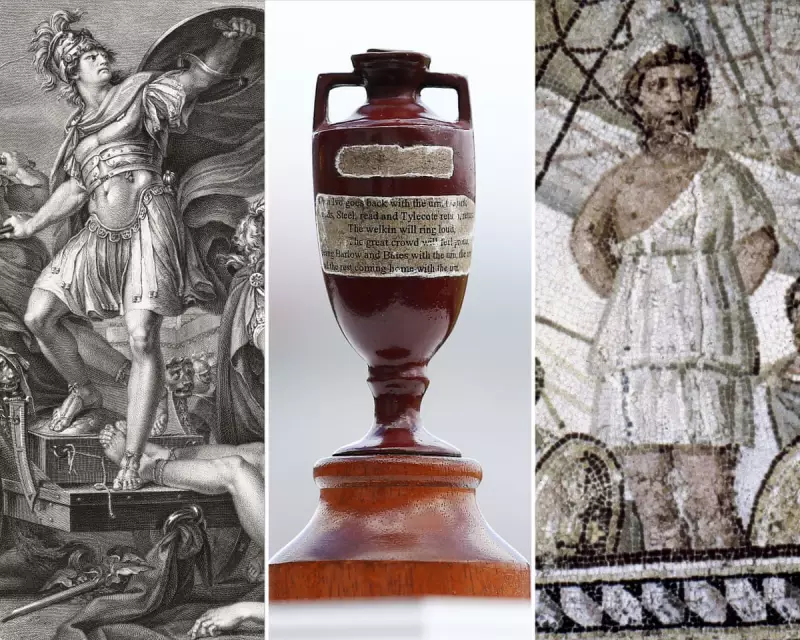
When cricket enthusiasts describe the historic clashes between England and Australia, one word consistently rises to the surface: epic. This beloved biennial contest, steeped in over a century of fierce rivalry, possesses a narrative depth that surprisingly echoes the foundational works of Western literature.
The First Ball: Cricket's Homeric Opening
Much like Homer's epic poems began with single, powerful words that set their entire tone, every Ashes series carries the weight of anticipation for that very first delivery. The opening ball of the First Test often becomes legendary, setting the narrative course for the entire contest.
Who could forget Michael Slater's authoritative boundary off Phil DeFreitas in 1994? Or Zak Crawley's confident strike against Pat Cummins in 2023? Conversely, the memory of Steve Harmison's wayward delivery to second slip in 2006 or Rory Burns' tragic dismissal in 2021 serves as cricket's equivalent of a dramatic Greek tragedy. These moments, frozen in Ashes history, mirror how Homer used opening scenes to establish his epic tales.

The Wrath of Achilles: Mitchell Johnson's Iliadic Revenge
Homer's Iliad begins with "menin" - meaning wrath - perfectly capturing Achilles' rage after being dishonoured by Agamemnon. The Greek hero's withdrawal from battle and subsequent vengeful return finds its cricket parallel in Mitchell Johnson's spectacular 2013-14 campaign.
After enduring mockery from the Barmy Army during the 2010-11 series, Johnson spent three years in what could be described as a professional tent, brooding over his humiliation. His return was nothing short of Achillean, terrorising England's batting order with 37 wickets at an astonishing average of 13.97. This display of vengeful brilliance powered Australia to a 5-0 whitewash and earned Johnson the 2014 ICC Test Player of the Year award, cementing his status as a modern cricket warrior.
The Cunning Odysseus: Warne's Many Twists and Turns
While The Iliad explores collective rage, The Odyssey focuses on a single protagonist - the "polutropon" man, translated by Cambridge Professor Simon Goldhill as "tricky bastard." This describes Odysseus, the cunning hero who used intelligence and deception to overcome obstacles during his decade-long journey home.
In Ashes history, several figures embody this quality. Mike Brearley's cerebral leadership during England's 1981 victory demonstrated strategic brilliance over brute force. However, the ultimate cricketing Odysseus must be Shane Keith Warne, the master of spin whose deliveries truly embodied the "many twists and turns" of Homer's hero.
Warne's ability to deceive batters with his variations, combined with his strategic mind, made him the perfect embodiment of Homer's complicated hero. The only regret is that he never delivered the first ball of an Ashes series - a moment that would have been truly epic in every sense.
Beyond the Cricket Pitch: Epic Stories Then and Now
The connection between ancient epic and modern cricket runs deeper than mere metaphor. The word "epic" itself derives from the Greek "epos," meaning simply "word." From this humble origin comes the power to create stories that resonate across millennia.
While film director Christopher Nolan prepares to spend $250 million bringing The Odyssey to cinema screens, cricket fans need look no further than the Ashes for their epic fix. The 2019, 2005, 1981, and 1932-33 series all deserve their epic labels, containing narratives of heroism, tragedy, and redemption that would feel familiar to Homer himself.
When the next Ashes series begins, watch not just for the cricket but for the unfolding epic - a story where modern warriors create legends worthy of classical literature, where a single delivery can echo through history, and where the spirit of ancient heroes lives on in flannelled warriors.