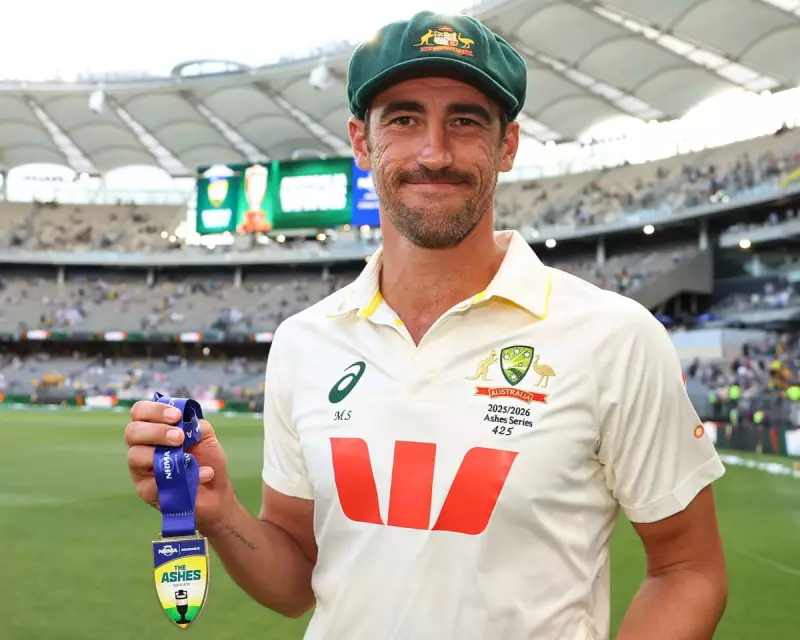
Mitchell Starc's Perth Onslaught Secures His Legendary Status
When Mitchell Starc begins his run-up, a sense of inevitability descends upon the batsman. The veteran left-arm fast bowler, at 35 years of age, delivered a performance for the ages at Perth Stadium, single-handedly ripping through the England batting line-up and claiming the Player of the Match award. His efforts were the cornerstone of a comprehensive Australian victory that concluded in less than two days, leaving England's 'Bazball' approach in tatters.
A First-Over Phenomenon
Starc's ability to strike early is the stuff of nightmares for opening batters. In the first innings at Perth, he produced a career-best figures of 7 wickets for 58 runs. This was not an isolated incident but part of a well-established pattern. The dismissal of Zak Crawley in the second innings marked the 21st time Starc has taken a wicket in the first over of a Test innings. English fans will have painful memories of Rory Burns being bowled by the very first ball of the 2021-22 Ashes series at the Gabba, a perfect inswinger that set the tone for a one-sided contest.
At Perth, his dominance over England's key players was absolute. Joe Root, Ben Stokes, and Zak Crawley all fell to him twice, collectively managing a paltry 16 runs between them, which included three ducks. His hold over Ben Stokes is particularly telling; the brutal delivery that clattered into Stokes' stumps in the second innings was the 11th time Starc has dismissed him in Test cricket, with five of those being bowled.

By the Numbers: A Career of Sustained Excellence
Former Australian cricketer Kerry O'Keeffe has labelled Starc "one of the most underrated cricketers Australia have produced," and a glance at the statistics makes his case undeniable. During the first session in Perth, Starc surpassed a significant milestone, claiming his 100th Ashes wicket. He stands alone as the only fast bowler with 100 wickets against England who made his debut in the 21st century.
His career achievements place him firmly among the pantheon of Australian greats. He was the second Australian fast bowler to reach 400 Test wickets, trailing only the legendary Glenn McGrath. In the all-time Australian wicket-takers list, only McGrath, Nathan Lyon, and Shane Warne sit above him. With 17 five-wicket hauls, he is second only to the great Wasim Akram (25) among left-arm bowlers.
Beyond the cricket pitch, Starc is one half of a celebrated sporting power couple with Australian women's captain Alyssa Healy. Despite his ferocious on-field persona, he is known for his modesty and perspective, recently remarking on the fickle nature of public attention between a Test in the West Indies and an Ashes series.
England's Missed Opportunity and the Arrival of the Cavalry
This comprehensive defeat, described by The Australian as the affectionate remembrance of Bazball's death, leaves England with profound questions. With Australia's premier fast bowlers Pat Cummins and Josh Hazlewood watching from the sidelines, this was England's chance to strike. Instead, Starc shouldered the attack with immense skill. As former wicketkeeper Brad Haddin analysed, "He’s at the top of his game, he stood up at all big moments... He bowled smart, with clear plans."
The sound England now hears is the ominous thud of boots in the nets, as Cummins and Hazlewood return to fitness. The cavalry is arriving, and for an England team already on the back foot, the challenge is about to become significantly greater.
Bouchier Leads Cricket's Climate Initiative
In a separate but noteworthy development, England batter Maia Bouchier is among a group of over 100 athletes joining Sport One, Carbon Zero, a new climate fund. The initiative allows athletes to donate to fund research into the sectors responsible for sports' carbon footprint, such as travel and infrastructure, effectively a form of lifestyle offsetting.

Bouchier acknowledged the inner conflict of a professional cricketer whose career depends on frequent travel. "There’s also this hypocrisy trap where you don’t want to tread on people’s toes," she said. "What I like about this initiative is that it focuses on systemic change... athletes can trust that the fund is a way to contribute to something meaningful." This athlete-led action comes five years after the 'Hit for Six' report recommended the ICC establish a global climate disaster fund, a suggestion that has yet to be acted upon.