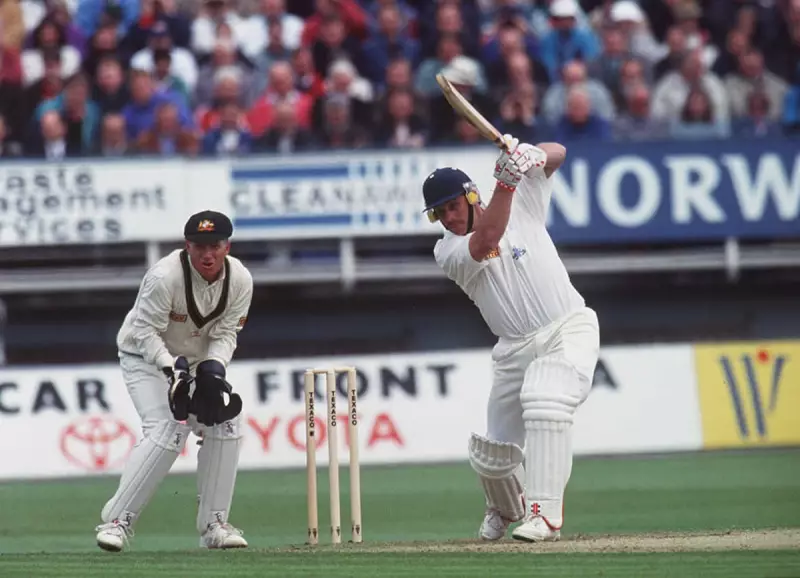
The passing of former England batsman Robin Smith at the age of 62 has prompted a wave of reflection on a career defined by bravery and a unique brand of attacking flair. In an era where English cricket often floundered, Smith stood as a symbol of resilience, facing down the world's most fearsome fast bowlers with unwavering courage.
A Batting Stance That Signalled Defiance
For fans in the late 1980s and early 1990s, a Robin Smith innings was an event. More than just runs, it was a statement. His signature shot, the square cut, was not merely a scoring stroke but a whip-crack declaration of intent. At a time of frequent batting collapses and inconsistent selection, that explosive shot served as a reminder that the fight was not yet over.
Smith's very presence at the crease—shirt unbuttoned, chain glinting, forearms like oak—radiated a combative spirit. He was shuffled up and down the order, filling roles from opener to number seven, yet his pugnacious approach remained constant. With a Test average of 43.67, he was second only to Graham Gooch among English batters during his international career, a statistic that only tells part of the story of his impact.

Conquering the Greatest Bowling Attacks
Smith's true worth was measured against the most demanding opponents. He announced himself with two centuries and a score of 96 during England's 4-0 Ashes defeat in 1989. One of his most memorable knocks came at Trent Bridge that same summer. With England reeling at 1 for 2 in reply to Australia's 602, Smith blazed a defiant 101, his cuts scything across the outfield to rally a dispirited crowd.
His courage against extreme pace was legendary. An innings of 175 against the West Indies in St Johns in 1994, overshadowed by Brian Lara's 375, was a masterpiece of resistance against Curtly Ambrose and Courtney Walsh. Furthermore, a brutal 41 not out in England's second innings total of 89 at Edgbaston in 1995, on what captain Mike Atherton called the worst pitch he'd seen, was described by Atherton as being worth a century anywhere else.
The Man Behind The 'Judge' Persona
Behind the cavalier, larger-than-life image was a more complex individual. His autobiography, The Judge, co-written with Rob Smyth, revealed the contrast between his on-field persona and private self. "The Judge was a fearless warrior," Smith wrote. "Robin Arnold Smith was a frantic worrier." This vulnerability made his on-field feats all the more remarkable and his eventual struggle with life after cricket deeply poignant.
Smith's legacy endures not just in the record books, but in the memory of a batter who looked the fastest bowlers in the eye and refused to blink. In a helmet often worn without a visor, his face visible to all, he embodied a raw, human contest between bat and ball. He gave a struggling team heart and provided fans with unforgettable moments of pure, gilded defiance.