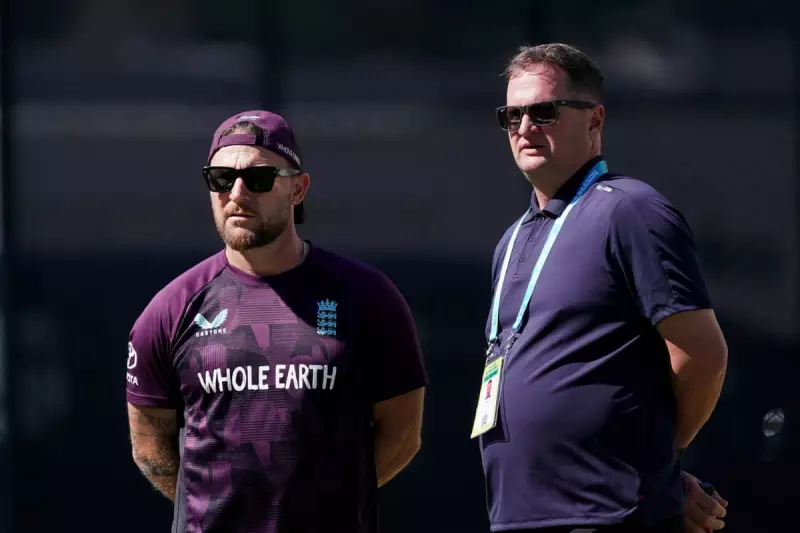
The England and Wales Cricket Board (ECB) is not planning a wholesale clearout of the team's senior leadership, despite another chastening Ashes series defeat in Australia. However, head coach Brendon McCullum and managing director Rob Key are expected to face significant internal scrutiny when a full review takes place.
Tour Review to Focus on Planning and Execution
England's hopes of regaining the Ashes urn were extinguished in just 11 days of play, marking only the fourth such rapid conclusion in the rivalry's 143-year history. The 82-run defeat in Adelaide confirmed Australia's retention of the urn, with the threat of a 4-0 series whitewash now looming in the remaining Melbourne and Sydney Tests.
A comprehensive examination of the tour's preparation and strategy will be conducted after the final Test next month. While this could put jobs at risk, the ECB is reportedly keen to avoid a repeat of the widespread dismissals that followed the 4-0 defeat in Australia four years ago. Back then, coach Chris Silverwood and director of cricket Ashley Giles were sacked, with captain Joe Root stepping down months later.

The board's current belief is that mass firings would be counterproductive, potentially hindering England's ability to learn from this latest failure. There is a desire at Lord's to retain some institutional knowledge of Ashes tours, a challenge England have consistently found insurmountable, winning just one series in Australia since 1987.
McCullum's 'Bazball' Approach Under the Microscope
The spotlight will fall most intensely on Brendon McCullum. The architect of England's aggressive 'Bazball' philosophy, his methods have been found wanting in Australian conditions. Following the Adelaide loss, McCullum himself admitted that the long-term planning for the tour had been inadequate.
He conceded for the first time that relying on a white-ball tour of New Zealand and a single intra-squad warm-up match in Perth was insufficient preparation for the First Test. He also reiterated his view that the squad trained too hard before their defeat in Brisbane.
McCullum's situation is complicated by his dual role as England's white-ball coach, a position he took on in January. His contract runs until the 2027 home Ashes series and the 50-over World Cup in South Africa the following year. While England's white-ball form under him has also been poor—including a Champions Trophy exit without a win and a home ODI series loss to South Africa—the imminent T20 World Cup in India and Sri Lanka, beginning on 7 February, may afford him some breathing space.
Key Decisions and Captain Stokes's Future
Rob Key's position as managing director will also be debated internally. He was the driving force behind McCullum's appointment as Test coach and a staunch supporter of the attacking approach. Key also made the decision to give McCullum the white-ball reins at the end of last year, a move that has yet to yield success.
His broader decision-making is likely to be examined, including a perceived dismissive approach to the County Championship. Critics argue this has left players like Jamie Smith and Jacob Bethell short of vital red-ball practice ahead of the Ashes.
In a positive note for the ECB, Test captain Ben Stokes stated unequivocally after the Adelaide defeat that he "absolutely" wants to continue as skipper after the Ashes. The board is desperate to retain his services as a player for as long as possible. The 34-year-old all-rounder signed a new two-year central contract before the series, which expires after the 2027 World Cup.
The coming weeks will determine whether evolution or revolution is the chosen path for English cricket as it seeks to end its long drought on Australian soil.