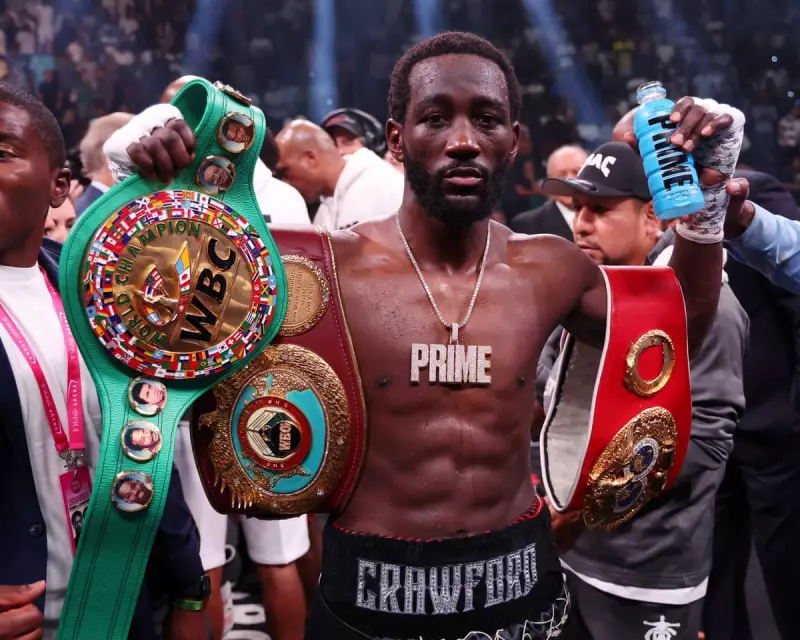
Terence "Bud" Crawford, widely regarded as the finest pound-for-pound boxer on the planet, has announced his retirement from competition, walking away from the sport on his own terms and with an unblemished professional record.
A Legacy Secured: The Perfect Exit
The 38-year-old American made the announcement on Tuesday, just three months after delivering the most spectacular performance of his storied career. In September 2025, Crawford scaled two weight divisions to decisively outclass the formidable Canelo Álvarez in Las Vegas, seizing the undisputed super-middleweight championship in the process.
With 42 professional wins and zero defeats, 31 of those victories coming by way of knockout, Crawford leaves the sport without a single asterisk against his name. No late-career declines, no controversial decisions, and no sense of a fighter clinging on past his prime. He exits while still universally recognised as the world's best, a status shared only with the likes of Naoya Inoue and Oleksandr Usyk.
From Omaha Streets to Immortality
To understand Crawford's journey is to start in Omaha, Nebraska. The city's North 33rd Street, where opportunities were scarce, provided the gritty backdrop. Boxing offered more than a future; it provided a rigid structure and a moral code for a young Crawford. His legendary adaptability was forged early, famously switching to fight southpaw after breaking his right hand, a skill that would later become his trademark.
His resilience was tested beyond the ring, most notably surviving a gunshot wound to the head in 2008. He drove himself to hospital, recovered, and remained steadfastly on course. This unwavering focus defined a career built not on flashy promotion, but on an older, simpler logic: keep winning decisively, and the world will have no choice but to acknowledge you.
The Problem-Solver Who Redefined Greatness
In the ring, Crawford was boxing's ultimate problem-solver. He did not merely overpower opponents; he methodically dismantled them. Fights would begin competitively, only for Crawford to download data, probe with his jab, and then systematically alter the geometry of the contest. Angles shifted, distance dissolved, and victories became inevitable.
The titles accumulated as proof of his mastery. He became a world champion at lightweight, then the first undisputed champion at 140lbs in the four-belt era. At welterweight, the long-anticipated clash with Errol Spence Jr. in 2023 ended not in drama but in a one-sided demolition.
His final act, the victory over Canelo, catapulted him into the all-time pantheon of legendary weight-jumpers like Henry Armstrong and Manny Pacquiao. The statistics of his career are staggering: the sixth man to win world titles in five weight classes; the third to claim lineal championships in four; only the second, after Armstrong in 1938, to become an undisputed champion in three separate divisions.
In an era fragmented by pay-per-view walls and promotional disputes, Crawford's greatness was a quiet, relentless force. He refused the modern script that demands theatrics alongside talent, trusting instead in the purity of victory. Now, with the ultimate validation secured, he is leaving anyway. He framed his decision not as quitting fighting, but as "stepping away from competition" and winning "a different type of battle."
If this is truly the end, his legacy is immovable. He joins the rare group of fighters about whom contemporaries will forever insist, "No one could have beaten him." The argument itself is a form of boxing immortality. And if the door ever creaks open again, it won't be because boxing lured him back. It will be because Terence Crawford, the sport's premier problem-solver, saw a new puzzle he simply wished to solve.