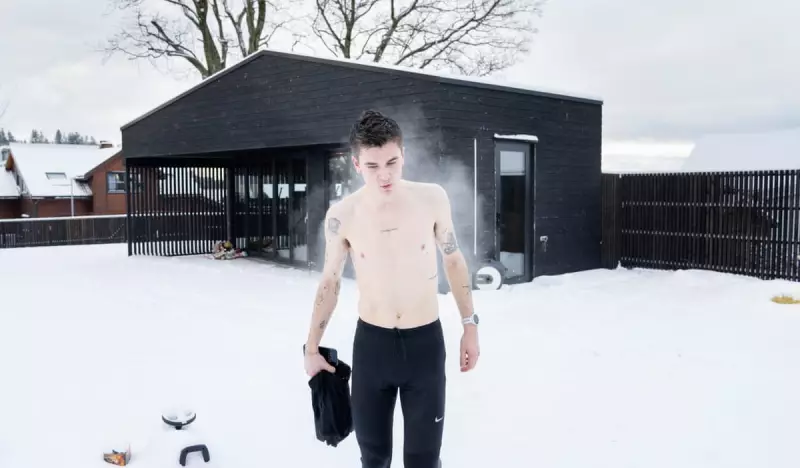
On a frigid New Year's morning in Sandnes, Norway, the world's most compelling athlete is generating enough perspiration to form miniature pools across his treadmill surface. For forty uninterrupted minutes, Jakob Ingebrigtsen maintains a blistering 6:40 minute-per-mile pace with the casual ease of a leisurely weekend walk, conversing freely while the temperature in his custom-built home gym soars beyond 32.4°C (90°F). Only when questioned about his defining characteristic does the double Olympic champion pause to gather his breath. "In Norwegian we have a word for it," he eventually responds. "Ingen kompromiss. No compromise."
The Relentless Regime of a Champion
For the final twenty minutes of his session, Ingebrigtsen intensifies his effort. Music fills the space as the treadmill accelerates to a punishing 5:13 minute-per-mile pace. His heart rate climbs steadily from 130 to 172 beats per minute, sweat flowing freely as Black Sabbath's "Iron Man" provides the perfect soundtrack to his exertion. This scene encapsulates the essence of an athlete who, following a devastating 2025 season marked by an Achilles tear and a highly publicised court case against his father and former coach Gjert, is preparing to reclaim his dominance in track and field.
Ingebrigtsen, frequently mischaracterised as arrogant when he is merely forthright, demonstrates remarkable hospitality during our exclusive visit to his Norwegian home. He welcomes us into his private world alongside his wife Elisabeth and their two golden retrievers, Maximus and Jupiter, without the customary buffer of public relations personnel. Elisabeth even visits the local bakery to procure lunch, while Jakob later drives me to his nearby farm in one of his sports cars—gestures that remain exceptionally rare in elite athletics.
The Psychological Landscape of Victory and Defeat
When asked whether victories or defeats occupy more mental space, Ingebrigtsen's response proves startlingly candid. "I want to say that I almost don't remember the wins," he admits. "Almost." Pressed about whether defeats linger longer, he nods affirmatively. "Right now I feel like it's 99% losses to wins." This psychological framework stems from an upbringing that blended scientific experimentation with reality television exposure, having trained professionally since age four or five and running over 100km weekly by twelve years old.
His competitive resume already includes two Olympic gold medals, four world titles across indoor and outdoor competitions, five world records, and twenty-two European titles in track and cross-country events. Yet it's the opportunities that escaped him—particularly the 1500m final at the Paris Olympics where he led with a suicidal 54-second opening lap before fading to fourth—that continue to haunt him eighteen months later. "Considering how good shape I was in at those Olympics, I think nine out of ten times I would have won the 1500m," he reflects. "And this was the tenth."
Overcoming Adversity and Setting New Targets
The Norwegian's appearance at September's World Championships in Tokyo, despite knowing he wasn't fully recovered from his Achilles injury, speaks volumes about his character. "That is just how I am, and how my life has been," he explains. "I'm always competing, even if the odds are against me." Now, four months after his last competition, Ingebrigtsen reports positive progress. "The Achilles is very good," he confirms, while adopting a more cautious approach to his preparation for the outdoor season.
His ambitions for the coming year include double gold at the European Championships, a Diamond League final victory, and serious world record attempts in the 1500m, mile, and 5000m distances. The 25-year-old will also renew his competitive dynamic with British rival Josh Kerr, though Ingebrigtsen maintains a characteristically individual perspective. "I have never considered anyone to be my rival," he states. "Because I'm always competing against myself."
Beyond the Track: Passions and Perspectives
Ingebrigtsen proves equally outspoken regarding the state of his sport. While praising the Athletics Integrity Unit as "a very good organisation," he advocates for significantly increased funding to combat doping. Drawing comparisons with Formula One, he questions why athletics hasn't capitalised more effectively on its inherent excitement. "The paradox is indescribable," he observes, "because how can a sport that is so boring in reality be so entertaining for so many people?"
Beyond athletics, Ingebrigtsen nurtures a passionate interest in automobiles, maintaining a collection he deliberately refrains from counting. "I think if you start counting, that's when you have an issue," he remarks. Each Wednesday, he gathers with friends—some professional mechanics—to work on vehicles, describing himself as "100% a petrolhead." He also acknowledges a collecting tendency that extends to Pokémon cards, though he clarifies reports of a $300,000 expenditure have been "rounded up."
Family, Farm, and Future Aspirations
The athlete's mood has lightened considerably since last year's court proceedings involving his father, which resulted in a suspended sentence for Gjert regarding an incident with Jakob's sister while other charges were dismissed. Ingebrigtsen prefers focusing forward, particularly on his 18-month-old daughter Filippa, whose rapid development he marvels at daily.
He describes himself as "very much an introvert in general, but also very much an extrovert in an environment where I feel safe," a assessment his wife Elisabeth corroborates. Despite recent challenges, Ingebrigtsen's ultimate ambition remains unchanged: to retire as the greatest distance runner in history. Currently running 175-180km weekly—extraordinary volume for a 1500m specialist—he maintains an uncompromising schedule that included training twice on Christmas Day.
"I know I can beat most of the world records from 1500m to the marathon," he asserts. "But it's not easy. You really have to prioritise it, and you also have to find the right place and right time." With approximately ten competitive years remaining, Ingebrigtsen believes he possesses "a good chance of reaching my ultimate goal"—before returning to his treadmill for another session of sweat and suffering, continually fueling what he openly acknowledges as his lifelong obsession.