
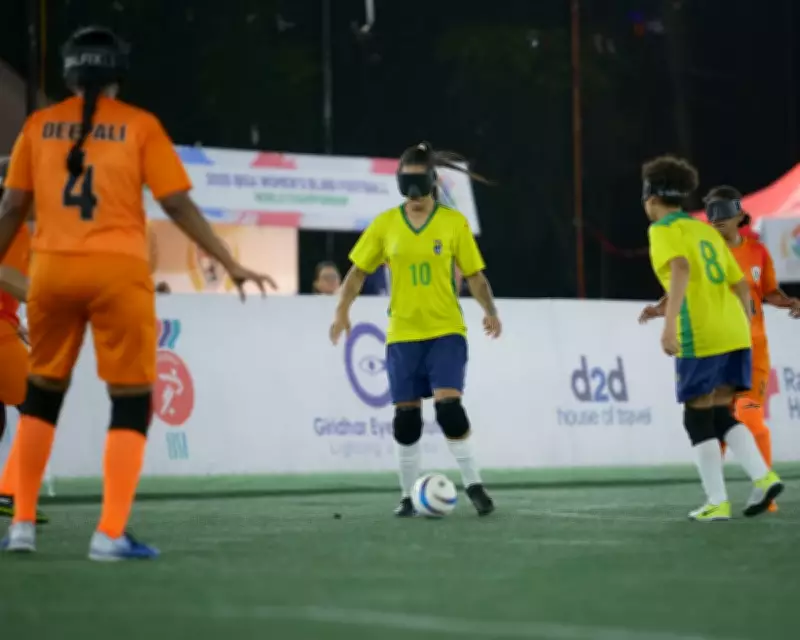
Brazil's Women's Blind Football Team: A New Era of Inclusion and Triumph
In a groundbreaking moment for sports, the Brazilian women's blind football team has rapidly emerged as a symbol of resilience and empowerment. Established only in 2024, this pioneering squad made an impressive debut at the world championship in Kochi, India, in October 2025, securing a fourth-place finish. Their journey, marked by personal struggles and collective determination, highlights the transformative power of sport for athletes with visual impairments.
Overcoming Barriers and Scoring Goals
The team's midfielder, Eliane Gonçalves, 39, encapsulates their spirit. After losing her sight to retinitis pigmentosa, she turned to football as a lifeline, pulling herself out of depression. "Sport took me out of depression. It gave me a better perspective on life, new dreams," she reflects. In their opening match against India, Gonçalves scored the decisive goal in a 1-0 victory, a moment of triumph for a player who had started training just two years prior. Despite advancing unbeaten to the semi-finals, Brazil faced a narrow 1-0 loss to reigning champions Argentina and then fell to Japan in the third-place playoff. However, finishing fourth in their first World Cup, with a squad assembled via video due to the absence of a domestic league, is a remarkable achievement.
The Role of Key Players and Challenges Faced
Goalkeeper Lígia Nogueira, 27, one of the few sighted players, had to adapt to the unique demands of blind football, where she serves as the sole guiding voice in the defensive third. "I thought I knew how to be a goalkeeper, but I had to learn from scratch. It's so much more than not letting the ball in," she notes, joking that she leaves matches more exhausted from talking than from saving shots. The team's journey was not without hardships; in India, they struggled with spicy food, relying largely on tuna, and none of the players were paid, balancing training with other commitments like university studies and jobs.
Historical Context and Gender Disparities
Wagner Xavier, an anthropologist at the University of Campinas, explains the delayed formation of Brazil's women's blind football team. While men's competitions began in 1978, the women's team was only officially established in 2025, facing a double barrier of gender and disability prejudice. He points out that football has historically been structured as a male domain, with women relegated to supportive roles. Blind football in Brazil dates back to the 1940s in schools for the visually impaired, often played with improvised equipment like balls wrapped in plastic bags. Although a women's team briefly existed in 2009, it folded due to lack of competitions, underscoring systemic neglect.
Future Prospects and Broader Impact
With the Copa América set for São Paulo in 2026, the timing is crucial for consolidating women's blind football. Xavier emphasizes that increased visibility, inspired by stars like Marta, is driving change. "There is someone representing me – so there is a point of access. I could be there too," he says, highlighting the importance of representation. Gonçalves aims to strengthen the team's foundation and offers a message of hope: "Sport is here to embrace us. I hope it can do for someone else what it did for me." This team's emergence not only challenges stereotypes but also paves the way for future generations of athletes with visual impairments to dream big and compete on the global stage.