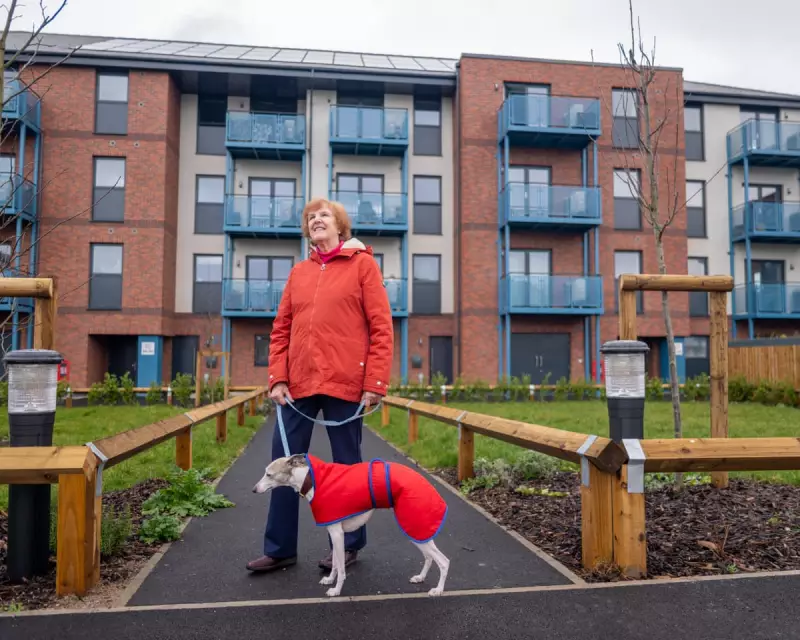
On a crisp winter morning in the Somerset coastal town of Minehead, retired carer Carole Guscott walks her whippet, Gracie, back to her new flat. Her route passes the local Premier Inn before turning into a quiet cul-de-sac named Rainbow Way. "I knew as soon as I saw it," she recalls warmly. "I just thought: 'I can make this place my home.'"
A Rare Beacon of Hope in Council Housing
Until recently, Carole was paying £780 monthly for a private rental near Minehead's centre. For four years, she had watched Rainbow Way take shape, aware these homes represented something increasingly scarce in post-Thatcher Britain: new council housing. This meant not only security for selected tenants but fierce competition for places.
When the call finally came inviting her to view a property, she was stunned. She immediately decided to move, now paying just over £500 in monthly rent while enjoying views of the surrounding hills and townscape. "The flat is just so open and bright," Carole reflects. "I feel blessed that I'm here." She adds a crucial point: "Without a council house, there just isn't the security."

The Rainbow Way Development
Rainbow Way comprises 54 new council homes: 33 flats and 21 houses, marking the first such dwellings built in this part of Somerset in three decades. Approximately half the residents were recently "homeless, facing harassment, being moved on from supported accommodation or urgently needing two or more bedrooms due to family circumstances."
Notably, 89% of new tenants were already Minehead residents, with 11% having "strong local connections." This matters significantly in a town synonymous with deprivation and low social mobility, where the economy revolves around seasonal employment—symbolised by the vast Butlin's resort—and where housing need remains dire.
Architecture and Atmosphere
The development features gently contemporary architecture, a compact children's playground, and homes designed to be zero carbon. During a recent visit, councillors and officers gathered for a ceremonial ribbon-cutting in front of a four-storey apartment block. As gulls called overhead, a delivery van arrived with furniture for a new flat.
Inside one vacant flat awaiting tenants, a dossier offered instructions and suggestions for optimising garden use and exploring local walking routes. The overall atmosphere conveyed tangible calm, wellbeing, and lives taking a positive new direction.
How This Happened in Somerset
Somerset's new unitary council, formed by absorbing four district councils previously responsible for housing, created this opportunity. While two districts had long sold their stock to housing associations, others maintained their housing provision. The ruling Liberal Democrat administration thus inherited 10,500 existing council homes with ambitions to build more.
With 11,644 households currently on Somerset's waiting list, current efforts may only scratch the surface, yet the drive to build remains urgent.
National Political Questions
Rainbow Way's success raises pressing national questions. Amid widespread public resentment and a housing crisis gripping many regions, why aren't there more developments like this? Given government promises of "the biggest increase in social and affordable housebuilding in a generation," when will a breakthrough occur?
This leads to Labour's record and under-discussed policy aspects. Thanks largely to Angela Rayner's tenure at the Ministry of Housing, Communities and Local Government, the government has significantly restricted the right-to-buy scheme that previously made council housing economics nearly impossible. Measures include limiting discounts, allowing councils to retain all sales receipts, and planning to exclude new properties from the scheme for 35 years.
Unlike past periods of budget squeezes from rent caps, councils can now increase rents annually by up to inflation plus 1%. The most substantial move is £39 billion allocated for affordable housing over a decade, theoretically funding 180,000 socially rented homes by 2035, though tangible results aren't expected until late in the current parliament.

Charity Perspectives and Systemic Barriers
Housing charity Shelter acknowledges these steps' significance but notes that 18,000 new council homes annually falls far short of the 90,000 completions needed to address the housing crisis effectively. Another glaring issue stems from a 2012 agreement transferring £13 billion of historic housing debt from Whitehall to councils based on assumptions—steady rent rises and sustained right-to-buy sales—that proved unfounded.
Somerset now carries £190 million of this debt, which it claims it can service, though freedom from this burden would enable more building. Other authorities face tougher situations.
Local Authority Struggles
Sarah King, leader of Southwark Council, illustrates broader challenges. Her council built 600 new London homes last year but is constrained by £408 million in housing debt and post-Grenfell fire safety demands imposed without additional funding. Debt servicing costs now prevent Southwark from borrowing to build further.
"We have sites with planning permission, but we can't build on them because of our finances," King explains. While ministers understand her predicament, she and colleagues across scores of councils demand meaningful action, starting with central government writing off at least some debt to unlock housing investment.
King emphasises obvious truths: "If you invest in council homes, you save massive amounts on the housing benefit bill. You make savings on people's health because people are living in homes that are warm, safe and dry. You provide space for children to do their homework."
The Bigger Picture
Rainbow Way offers a life-affirming example of what's possible, yet it highlights nagging policy gaps, tightening timelines, and Britain's tragic habit of waiting anxiously while knowing what urgently needs doing. As Minehead's new residents settle into security and comfort, the national question remains: how many more Rainbow Ways can Britain build before time runs out?