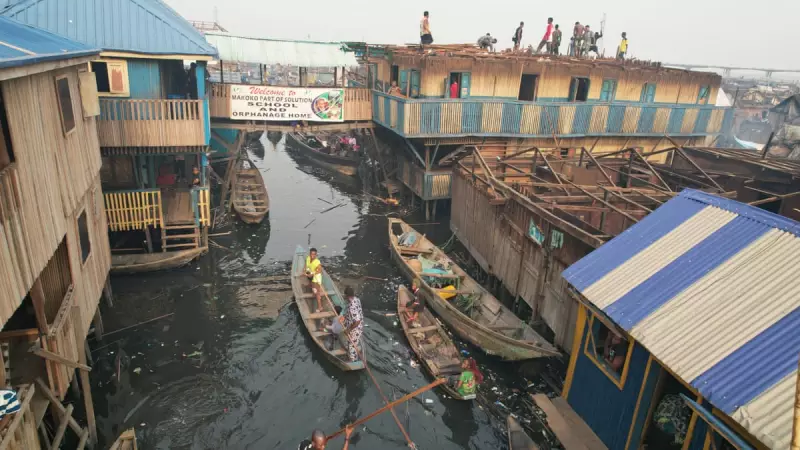
Makoko Residents Forced to Dismantle Their Own Community Amid Government Demolitions
In a desperate bid to salvage what little they have left, residents of Makoko, Nigeria's largest informal waterfront settlement, have begun dismantling their own homes and community structures. This includes a school that also served as a home for orphaned children, as fear of further government demolitions grips the community.
Demolition Operations Escalate
The Lagos state government has conducted multiple demolition operations in Makoko since December, using amphibious excavators escorted by armed police. Officials claim these actions are essential for sanitation and security, particularly citing hazards from a high-voltage power line. However, residents report receiving little warning and having nowhere to go.
Augustine Agpoko, a 42-year-old fisherman and father of eight, describes the traumatic experience of losing his six-bedroom bungalow on January 16th. "I was removing my roofing sheets, trying to salvage materials from my house when the bulldozers began demolition," he recalls. "When they started firing tear gas into the air, I had to quickly evacuate my family to safety."

A Community Built on Water
Makoko has existed for over a century, with an estimated population of up to 300,000 people living in wooden shacks built on stilts above the Lagos Lagoon. The community has developed unique adaptations to aquatic life, with fishing, canoe transport, and lagoon trade forming the backbone of its economy.
Sixty-year-old Timothy Ategi, a lifelong Makoko resident, witnessed the December 21st demolition from his church doorway. "You could hear the machines before you could see them," he says. By the time he rushed back, his family home, built by his father and repaired by his sons, had been flattened along with his fishing nets.
Livelihoods Destroyed
The demolitions have devastated the community's economic foundations. Women who once operated fish smoking sheds - a crucial, female-dominated industry - have lost their livelihoods entirely. Elizabeth Peter, a 40-year-old fish smoker who learned the trade from her mother, says: "They destroyed it as though it meant nothing."
Without proper smoking facilities, fish spoil quickly, cutting off income streams and pushing families deeper into poverty. Many residents now sleep on boats or among the debris of their former homes.
Government Response and Community Backlash
Gboyega Akosile, special adviser on media and publicity to the Lagos state governor, insists the government was carrying out necessary enforcement. "Our personnel will not knowingly kill anybody," he states, though he acknowledges the government would investigate alleged deaths during the operations.
Community leaders dispute the government's claims. Emmanuel Shemede, traditional head of the waterfront community, alleges the government betrayed a verbal agreement to only remove structures within 100 metres of the power line, instead destroying buildings over 200 metres away.
Human Rights Concerns
Isa Sanusi, executive director of Amnesty International Nigeria, condemns the actions as serious human rights violations. "What the Lagos government has done is a deliberate disregard of international human rights standards, depriving people of their shelter and rendering them homeless," he asserts.
The demolitions follow similar operations in 2005 and 2012, which left thousands homeless and drew international condemnation. Residents now live in constant fear, with some choosing to dismantle their own structures preemptively.
Education and Community Services Disrupted
Rodrick Ayinde Oluwatosin, 31-year-old proprietor of the Potential Children school, is now soliciting funds to dismantle his educational institution. "I am trying to move the planks to another location, which I have yet to secure, to avoid the government destroying them," he explains.
Children have been unable to attend school since the demolitions began, compounding the community's difficulties. Religious institutions have also been destroyed, with Prophet Dona Gansvou losing his church to the wreckage.

Climate Adaptation Paradox
Experts note the troubling irony of Lagos - a low-lying coastal city facing increasing flood risks and sea level rise - dismantling one of its communities best adapted to aquatic life. Dr Abisoye Eleshin, a research fellow at the University of Lagos, argues for formalising these adaptive communities rather than destroying them.
"The government should formalise the idea of allowing these people to live in a way that aligns with the city's stated ideology of being climate friendly and water adaptive," Eleshin suggests.
Uncertain Future
With no clear resettlement plan, no compensation paid, and increasing allegations that the government is clearing land for luxury developments, Makoko residents face an uncertain future. The community's unique way of life, developed over generations, now hangs in the balance as demolition machinery continues to threaten what remains of their homes and livelihoods.