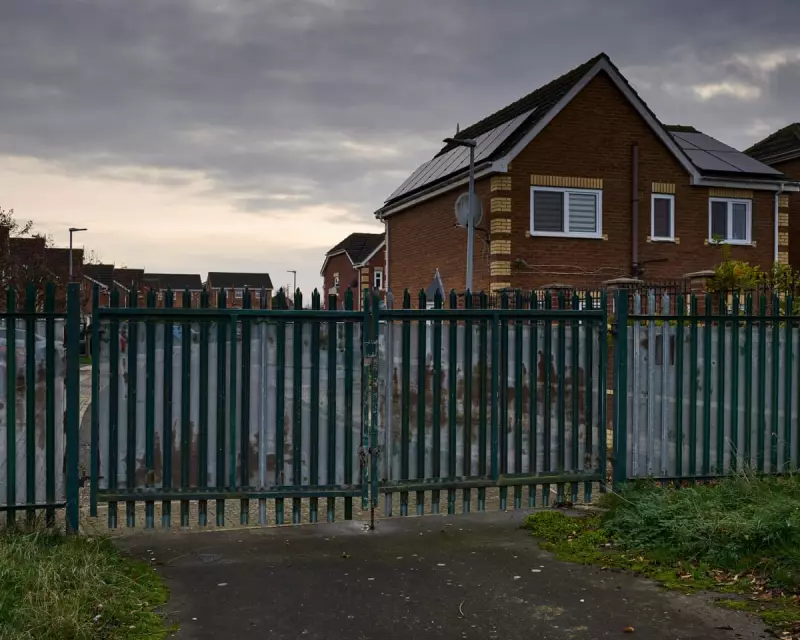
A stark metal barrier in Grimsby has become a physical embodiment of the deepening social and economic divides spreading across England. New data reveals a significant increase in neighbourhoods where some of the country's most affluent and most deprived residents live just metres apart, separated by little more than a wall, a hedge, or a road.
The Wall That Divides a Community
In Grimsby, Lincolnshire, residents of the postwar Nunsthorpe estate – known locally as ‘The Nunny’ – find their homes sitting just a few metres away from the conservatories and driveways of the more prosperous Scartho area. A 1.8-metre-high (6ft) purpose-built metal barricade blocks off roads and walkways that once connected the two communities.
What should be a short walk now becomes a 25-minute detour, forcing people to navigate around the edge of the estate or through hospital grounds. "It's the posh-poor divide," said Serenity Colley, 37, a Nunsthorpe resident. She believes the wall, in place since the newer estate was built, is unlikely to come down. "I don't think they'll want to mix with us," she added, acknowledging the desire of her neighbours to protect their property investments.
A National Picture of Side-by-Side Inequality
A Guardian analysis of official government data paints a concerning national picture. The research, which examined the most and least deprived 10% of areas in England, found that the number of places where such extremes border each other has risen sharply.
In 2019, only 65 of the most deprived neighbourhoods directly bordered one of the least deprived. By the latest data release in October, that figure had jumped to 119. Experts suggest this increase is due to a combination of factors, including the construction of new private housing estates next to existing social housing and improved data collection that now accounts for high housing costs.
Years of austerity and underinvestment mean that almost two-thirds of councils now contain a neighbourhood ranking among the most deprived in the country, a significant rise from just under half in 2004.
Daily Hardships and a Hidden Crisis
For those living on the Nunsthorpe side of the wall, the barrier creates tangible daily problems. Serenity Colley explains that the school run takes an hour, whereas a direct route would cut it to 15-20 minutes. The wall also lengthens trips to a new Aldi supermarket and a local care home, a key employer for estate residents.
The structure has also become a hotspot for antisocial behaviour, with reports of rubbish being thrown over from both sides, drug deals, and broken glass. "You try to have a nice house and nice garden, and then you live opposite that," said one neighbour, pointing to the rusted metal divider.
At the Centre4 community hub in Nunsthorpe, staff are inundated. Weekly slots for financial advice are fully booked within 15 minutes of opening, with people increasingly arriving at crisis point, sometimes carrying bags of unopened bills. The charity is building a new youth centre to replace stripped-away facilities, though some local teenagers worry it looks "too posh for them."
Tracey Good, Centre4's chief executive, stresses that challenge exists on both sides of the divide, but confirms many they help are from Nunsthorpe, which ranks in the most deprived 10% nationally for income, employment, education, health, and crime. In stark contrast, Scartho ranks among the least deprived 10% overall.
Echoes in the South: The 'No Hope' Estate
This pattern of stark juxtaposition is not confined to the North. The Stanhope estate in Ashford, Kent – a 1960s London overspill estate once nicknamed "No Hope" – finds itself bordered by spacious detached homes built in the early 2000s.
Stanhope remains in the 10% most deprived neighbourhoods in England, with worsening health deprivation since the pandemic. Just across the divide, the newer properties sit in the top 10% for employment and living environment.
The financial gap is clear: an average three-bedroom house sells for about £275,000 on Stanhope, compared to £410,000 just a short walk away. Residents like Phil Hockley, 63, speak of a stronger community spirit on their side, suggesting those in the more expensive houses "don't even speak to each other."
Susan Riley-Nevers, 56, another Stanhope resident, highlights the tangible effects of this division, from oversubscribed GP surgeries to neglected local amenities. "Most of the community problems here are to do with poverty," she said. "It's a very different story in other areas."
The rise of these "deprivation divides" across England, symbolised by Grimsby's wall, points to a growing geographic entanglement of wealth and poverty, creating physical and social fissures in the heart of communities.