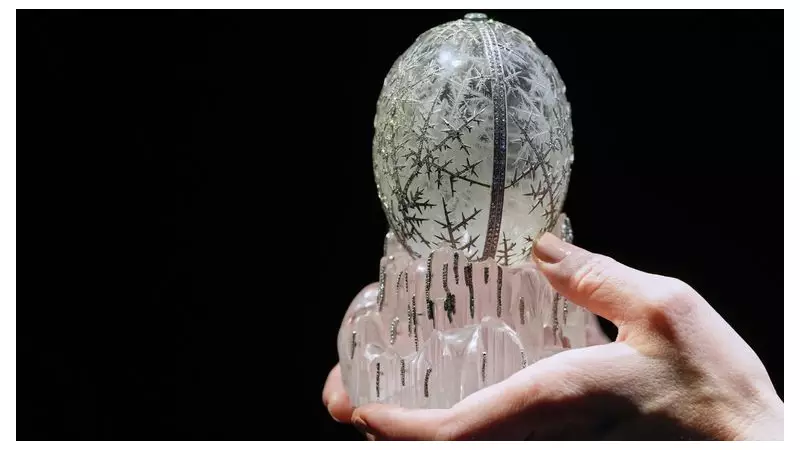
A legendary piece of Russian imperial history, the exquisite Winter Egg by Faberge, has shattered the world auction record for the famed jeweller's work, fetching an astonishing £22.9 million at Christie's in London.
The Record-Breaking Imperial Treasure
The sale price of £22.9 million dramatically eclipsed the previous high of £8.9 million, paid for another Faberge egg at Christie's in 2007. This marks the third time this specific egg has set a world record price for a Faberge item. The 4-inch (10cm) tall masterpiece is carved from rock crystal and adorned with a platinum snowflake motif, studded with an incredible 4,500 tiny diamonds.
A Royal Gift with a Hidden Surprise
Crafted in 1913, the egg was commissioned by Tsar Nicholas II as an Easter gift for his mother, the Dowager Empress Maria Feodorovna. It is one of only two imperial eggs designed by a female artisan, Alma Pihl. The egg opens to reveal a delicate, removable basket made of quartz flowers, symbolising the arrival of spring and the theme of resurrection central to Easter.
Peter Carl Faberge and his workshop created more than 50 of these elaborate eggs for the Russian royal family between 1885 and 1917, each unique and containing a hidden 'surprise'. Of these, only 43 imperial eggs are known to have survived, with most residing in museum collections today.
A Turbulent Journey to a Record Sale
The Winter Egg's journey to its multi-million pound sale is a tale of dramatic historical shifts. Following the 1917 revolution and the execution of the Romanov family in 1918, the egg was among the artistic treasures sold off by cash-strapped Communist authorities in the 1920s. It was reportedly purchased by a London dealer for as little as £450 during this period.
Believed lost for decades, it resurfaced at Christie's in 1994 and again in 2002, each time setting a record. Margo Oganesian, head of Christie's Russian art department, hailed the piece as "the 'Mona Lisa' for decorative arts", a supreme example of craftsmanship. Christie's stated the egg is widely considered one of the most original and inventive creations Faberge made for the Imperial family.